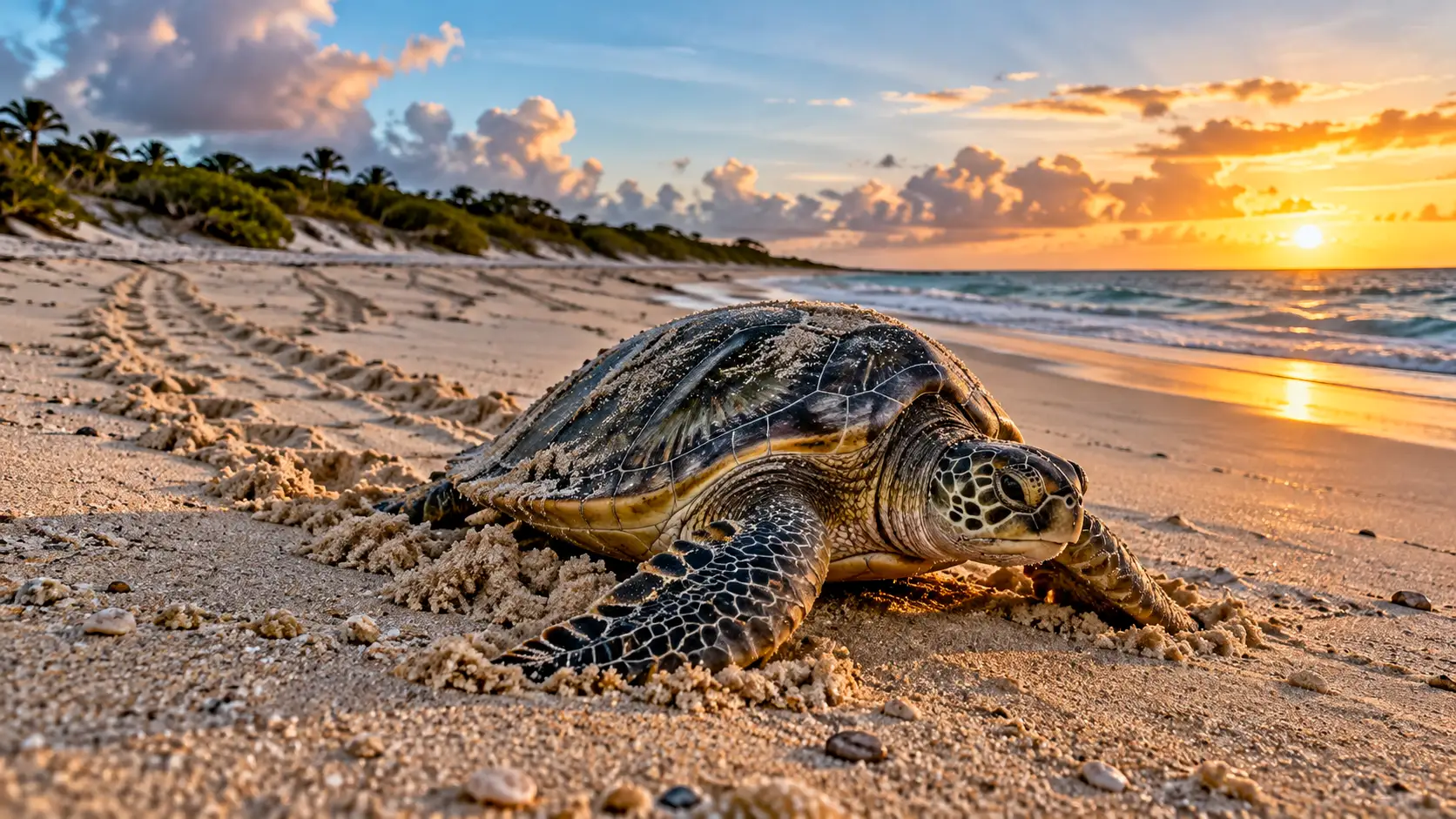
In the remote Entrecasteaux Islands, an exceptional nesting ground for green turtles faces the challenges of climate change.
Entrecasteaux preserves isolated beaches with rare green turtle nesting
The Entrecasteaux Atolls lie to the north of Grand Terre, far from populated areas. Designated a UNESCO World Heritage site in 2008, the area has seen enhanced protections since then. As of January 1, 2024, this entire region is classified as a strict nature reserve.
The main nesting beaches in the archipelago include Huon, Surprise, Fabre, and Le Leizour. The Coral Sea Natural Park estimates around 47,000 female turtles come to lay their eggs each year. However, a single track on the sand doesn’t always indicate a different turtle.
Nesting nights at Huon can approach 400, but not all are distinct turtles
From November to February, the beach at Huon transforms as turtles leave their marks overnight. Scientists estimate around 200 nesting events nightly, with peaks reaching nearly 400. Meanwhile, the WWF reports up to 600 appearances during peak season.
These figures indicate differing phenomena. A turtle might come ashore without nesting, and the same turtle may return to lay eggs about two weeks later in the season.
Long-term studies have highlighted the actual activity levels at the site. Between 1988 and 2021, researchers compiled 1,456 nights of monitoring at Entrecasteaux. Depending on the seasons, they estimate between 5,513 and 103,511 nesting activities.
The megafauna program measures nest temperatures and beach changes at Entrecasteaux
Launched in 2025, the Megafauna program has tracked turtles over two consecutive nesting seasons. Teams document nesting tracks, monitor hatchling emergence, and retrieve thermometers placed in nests. This data aims to clarify reproductive success and the sex ratio of hatchlings.
Temperature plays a crucial role during egg incubation. Warmer nests tend to produce female turtles, while cooler temperatures favor males. Furthermore, excessive heat can be lethal to embryos, reducing hatching success.
Researchers are also employing drones to monitor the shape of the islands. In 2026, they utilized LiDAR technology for the first time to create detailed topographical maps, measuring erosion, accretion, and areas at risk of inundation.
Turtles migrate over 1,000 kilometers from Entrecasteaux, complicating conservation efforts
While the reserve safeguards nesting, it does not cover the turtles’ entire life cycle. After nesting, some females migrate to Australia, Papua New Guinea, or other regions in New Caledonia. These migrations are often over 1,000 kilometers, linking diverse parts of the Coral Sea.
The green turtle has been categorized as “Least Concern” by the IUCN Red List since October 2025, with a global population increase of approximately 28% since the 1970s. However, Entrecasteaux remains vulnerable to climate change, erosion, and rapid alterations to its beaches.