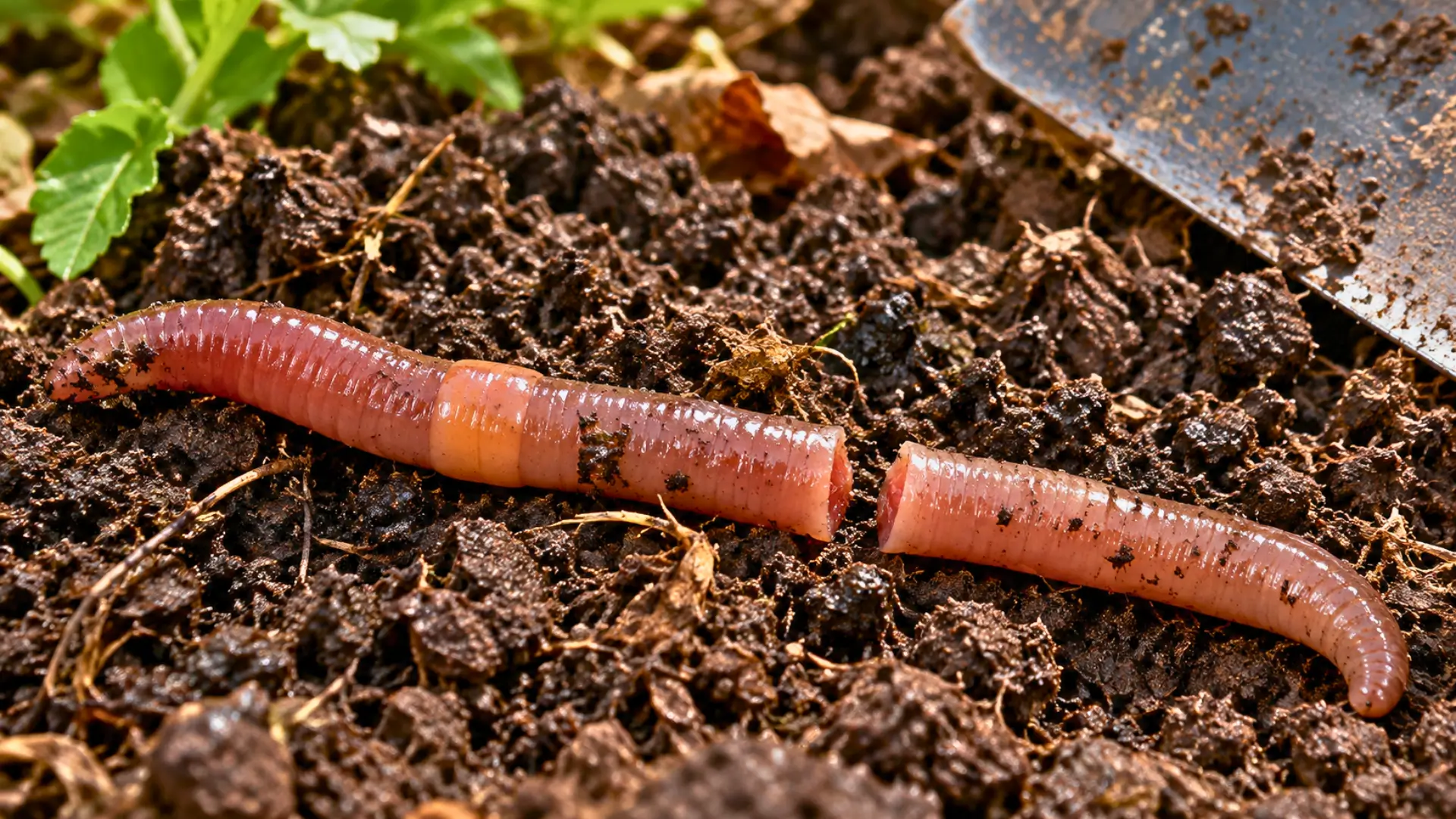
When you slice a worm in half with a spade, you might think that you have created two living beings. However, this apparent feat masks a fascinating anatomy, complete with five pairs of pseudo-hearts and highly variable regenerative abilities.
Why do both halves of a worm continue to move after being cut?
This situation is all too familiar for gardeners. A spade embeds itself in the soil, accidentally slicing through an earthworm, causing both halves to squirm. It is hard to resist the notion that each half is living independently. This illusion of survival has fueled the belief for generations that a severed worm could grow into two separate organisms.
However, movement does not equate to survival. The worm’s nervous system consists of a chain of ganglia running along its body, which allows segments to exhibit muscle reactions after severe injury. These impressive contractions do not indicate healing or the formation of a new organism.
Worms conceal five pairs of pseudo-hearts beneath their nearly identical rings
At first glance, an earthworm appears as a simple tube made up of rings. However, its internal organization is remarkably intricate. Near its front end lie the mouth, brain-like ganglia, and several vital organs. The clitellum, a distinctive band found in adults, helps mark the side of the head.
Even more surprisingly, many worms have five pairs of contractile vessels, often referred to as pseudo-hearts. These structures are responsible for circulating blood between the main vessels of the body. Unlike a human heart, they do not form a single pumping unit. This anatomical feature, documented in studies by the University of California, contributes to their circulatory system’s function.
The posterior part of the worm also contains muscles, nerves, vessels, and digestive organs. Therefore, it is not just a biologically empty segment. However, in most common species, it generally lacks the necessary structures to rebuild a functioning head after a significant injury. This is where the myth begins to unravel.
One half can regenerate its tail, but this remarkable regeneration has its limits
If a cut occurs far enough behind the vital organs, the anterior part may sometimes heal and regenerate posterior segments. This process requires the formation of new tissues and their gradual organization. However, the success of this repair hinges on the species, the location of the injury, and the survival conditions. There are no guarantees of success.
The North Carolina State University emphasizes that a common worm does not become two worms after being cut. Nevertheless, there is a noteworthy scientific nuance: research on specific species, particularly Eisenia fetida, has revealed limited possibilities for head regeneration. Therefore, the assertion that all posterior fragments are universally incapable of regeneration is overly simplistic.
This old myth reveals why earthworms deserve protection
Researchers have long investigated the extraordinary reparative capabilities of annelids. A synthesis published in 2021 in the journal Frontiers in Cell and Developmental Biology highlights that some species can regenerate both ends, while others have much more modest capabilities. Thus, beneath the term regeneration lies a variety of different mechanisms.
This diversity is of particular interest in developmental biology. Researchers are trying to understand how cells contribute to the reconstruction of complex tissues, especially neural and muscular tissues. Studying these phenomena in worms allows for an exploration of fundamental repair mechanisms, though it does not promise replication in humans.
In gardens, the impact is far more immediate. By burrowing through soil and decomposing organic matter, worms play a critical role in soil structure and fertility. Harming them unnecessarily compromises valuable underground helpers who are already facing soil disturbances and certain intensive agricultural practices.