
What is Cell Structure?
Cell structure refers to the organization of different parts inside a cell. A cell contains organelles such as nucleus, cytoplasm, and cell membrane, which work together to perform various life functions.
Cells are the basic structural and functional units of life. Understanding cell structure helps in studying cell function, growth, and division.
What You Will Learn
In this chapter, you will study the basic organization of cells and understand how different cellular components work together to support life. By the end of this chapter, you will be able to:
Understand the basic structure of a cell and its main components
Distinguish between prokaryotic and eukaryotic cells
Identify the structure and functions of major cell organelles
Compare the structure of plant and animal cells
Explain how cell components contribute to cellular activities and life processes
Types of Cells
Cells are broadly classified into two main types based on their internal organization and complexity. Understanding these two types is essential for learning cell structure and function.
Prokaryotic Cells
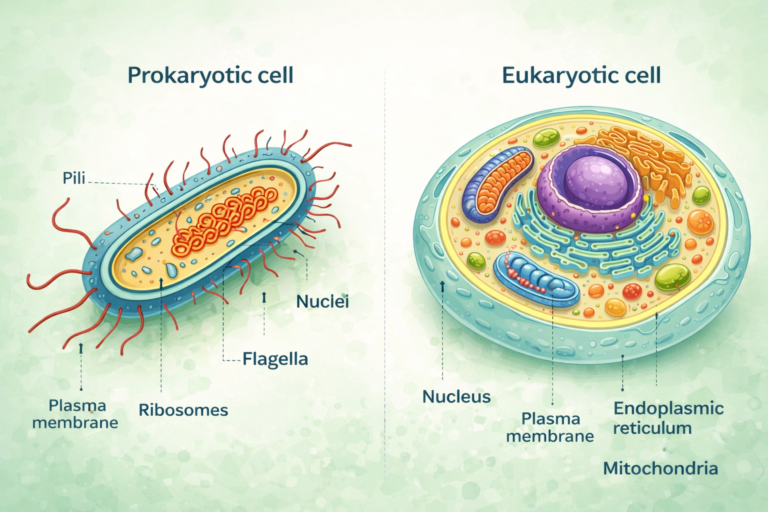
Prokaryotic cells are simple and primitive cells that do not have a true nucleus or membrane-bound organelles. Their genetic material is present in a region called the nucleoid, which is not enclosed by a nuclear membrane.
These cells are usually small in size and have a relatively simple structure. Prokaryotic cells are found in unicellular organisms such as bacteria and cyanobacteria.
Key characteristics of prokaryotic cells:
Absence of a true nucleus
No membrane-bound organelles
Genetic material present in the nucleoid region
Usually unicellular and microscopic
Cell wall is commonly present
Eukaryotic Cells
Eukaryotic cells are more complex and advanced cells that contain a well-defined nucleus enclosed by a nuclear membrane. They also possess various membrane-bound organelles that perform specific functions.
These cells are generally larger in size and are found in plants, animals, fungi, and protists. The presence of specialized organelles allows eukaryotic cells to carry out complex life processes efficiently.
Key characteristics of eukaryotic cells:
Presence of a true nucleus
Membrane-bound organelles such as mitochondria and endoplasmic reticulum
Larger and more complex structure
Can be unicellular or multicellular
Division occurs by mitosis or meiosis
Differences Between Prokaryotic and Eukaryotic Cells
The major differences between prokaryotic and eukaryotic cells are based on the presence of a nucleus, organelles, and cellular complexity.
Prokaryotic cells lack a true nucleus and membrane-bound organelles, whereas eukaryotic cells possess a well-defined nucleus and several specialized organelles. Prokaryotic cells are simpler and smaller, while eukaryotic cells are more complex and larger in size. These structural differences allow eukaryotic cells to perform more specialized functions.
Structure of a typical cell
A typical cell is a highly organized living unit made up of various structures that perform specific functions. Although cells vary in size and shape, most cells share a common internal organization that allows them to carry out essential life processes such as metabolism, growth, and reproduction.
The basic structural components of a typical cell include the cell envelope, cytoplasm, and nucleus. These components work together to maintain the structure and functioning of the cell.
Cell Envelope
The cell envelope forms the outer boundary of the cell and separates the internal contents of the cell from its external environment. It plays a crucial role in protecting the cell and regulating the movement of substances into and out of the cell.
In most cells, the cell envelope consists of the cell membrane, and in some cells, an additional cell wall is present outside the membrane.
Key points about the cell envelope:
Provides structural support and protection
Maintains the shape of the cell
Regulates the exchange of materials
Helps the cell respond to its environment
Cell Membrane
The cell membrane is a thin, flexible, living membrane that surrounds the cytoplasm. It is composed mainly of lipids and proteins and is selectively permeable, allowing some substances to pass through while restricting others. This selective permeability is essential for maintaining the internal balance of the cell.
Cytoplasm
The cytoplasm is the semi-fluid substance present between the cell membrane and the nucleus. It consists of a fluid matrix called cytosol, in which various cell organelles are suspended.
Most of the biochemical reactions necessary for life occur in the cytoplasm. It provides a medium that allows organelles to interact and function efficiently.
Functions of cytoplasm:
Supports and suspends cell organelles
Serves as the site for metabolic reactions
Facilitates transport of materials within the cell
Maintains the internal environment of the cell
Nucleus
The nucleus is a prominent, spherical structure found in most eukaryotic cells. It acts as the control center of the cell by regulating cellular activities such as growth, metabolism, and reproduction.
The nucleus contains genetic material (DNA) organized into chromosomes. This genetic information controls protein synthesis and determines the characteristics of the organism.
The nucleus is surrounded by a double-layered nuclear membrane, which contains pores that allow the exchange of materials between the nucleus and the cytoplasm.
Main functions of the nucleus:
Stores and protects genetic material
Controls cell activities through gene expression
Regulates cell division
Coordinates growth and development
Cell Organelles and Their Functions
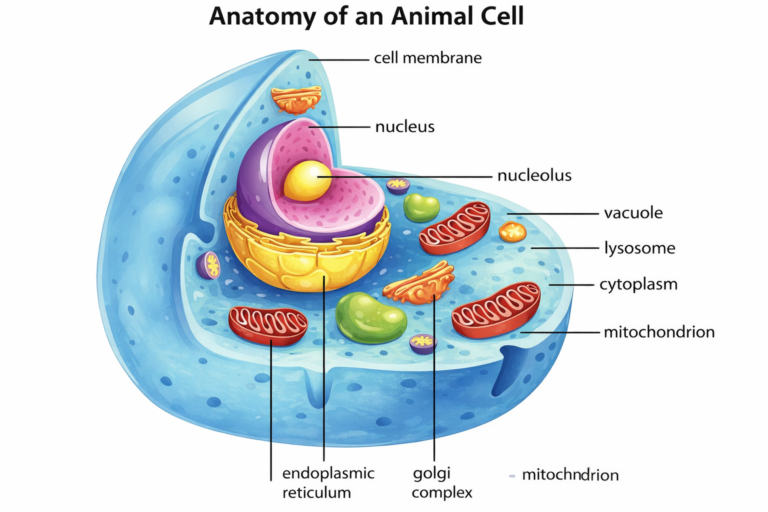
Cell organelles are specialized structures present within the cytoplasm of a cell. Each organelle performs a specific function, and together they coordinate various life processes such as energy production, protein synthesis, transport, and waste removal.
In eukaryotic cells, most organelles are membrane-bound, which allows different cellular activities to occur simultaneously and efficiently.
Nucleus
The nucleus is a large, spherical organelle that acts as the control center of the cell. It contains the cell’s genetic material in the form of DNA, which regulates all cellular activities.
The nucleus is surrounded by a double-layered nuclear membrane with pores that allow the exchange of materials between the nucleus and cytoplasm.
Functions of the nucleus
Stores genetic material
Controls cell activities
Regulates cell division
Directs protein synthesis
Mitochondria
The mitochondria are known as the powerhouses of the cell because they produce energy in the form of ATP through cellular respiration.
They have a double membrane structure, with the inner membrane folded into cristae, which increases the surface area for energy production.
Functions
Production of cellular energy (ATP)
Regulation of metabolic activities
Involved in programmed cell death (apoptosis)
Endoplasmic Reticulum (ER)
The endoplasmic reticulum is a network of membranous tubules involved in synthesis and transport of cellular materials.
Types of ER
Rough Endoplasmic Reticulum (RER)
RER has ribosomes attached to its surface and is involved in protein synthesis and transport.
Smooth Endoplasmic Reticulum (SER)
SER lacks ribosomes and is involved in lipid synthesis, detoxification, and calcium storage.
Ribosomes
Ribosomes are small, non-membranous structures that serve as the sites of protein synthesis.
They may be found freely in the cytoplasm or attached to the rough endoplasmic reticulum.
Functions
Synthesis of proteins
Essential for cell growth and repair
Golgi Apparatus
The Golgi apparatus is a stack of flattened membranous sacs responsible for modifying, packaging, and transporting proteins and lipids.
It acts like a processing and distribution center of the cell.
Functions
Modifies proteins and lipids
Packages materials into vesicles
Transports substances within and outside the cell
Lysosomes
Lysosomes are membrane-bound sacs filled with digestive enzymes. They help in breaking down waste materials and worn-out organelles.
They are often referred to as the “suicide bags” of the cell due to their role in programmed cell death.
Functions
Intracellular digestion
Removal of damaged organelles
Defense against pathogens
Vacuoles
Vacuoles are fluid-filled sacs involved in storage and regulation of cellular contents.
In plant cells, vacuoles are large and help maintain turgor pressure, while animal cells usually have smaller vacuoles.
Functions
Storage of food, waste, and water
Maintenance of cell shape (in plants)
Centrosome (Animal Cells Only)
The centrosome plays an important role in cell division by organizing spindle fibers.
It contains a pair of centrioles and is found near the nucleus in animal cells.
Functions
Formation of spindle fibers
Helps in cell division
Difference Between Plant and Animal Cells
Although plant and animal cells are both eukaryotic cells, they show several structural differences based on their functions and mode of life. These differences are mainly due to the presence or absence of certain cell organelles.
Understanding the differences between plant and animal cells helps explain how plants and animals perform their unique biological functions.
| Feature | Plant Cell | Animal Cell |
|---|---|---|
| Cell wall | Present (made of cellulose) | Absent |
| Cell shape | Usually regular and rectangular | Usually irregular or rounded |
| Chloroplasts | Present (for photosynthesis) | Absent |
| Vacuole | Large central vacuole present | Small or temporary vacuoles |
| Centrosome | Usually absent | Present |
| Mode of nutrition | Autotrophic (makes its own food) | Heterotrophic (depends on others for food) |
| Plastids | Present | Absent |
| Energy storage | Stored as starch | Stored as glycogen |
Key Points
Cells are the basic structural and functional units of life.
Cells are broadly classified into prokaryotic and eukaryotic cells based on their internal organization.
A typical cell consists of the cell envelope, cytoplasm, and nucleus.
Prokaryotic cells lack a true nucleus and membrane-bound organelles.
Eukaryotic cells contain a well-defined nucleus and specialized organelles.
Cell organelles perform specific functions that help maintain cellular activities.
Mitochondria are responsible for energy production in the form of ATP.
The endoplasmic reticulum helps in protein and lipid synthesis.
The Golgi apparatus modifies, packages, and transports cellular materials.
Lysosomes are involved in intracellular digestion and waste removal.
Plant and animal cells differ in structure based on their functions and mode of nutrition.
Summary of Cell Structure
• Cell is the basic unit of life
• Cell structure includes membrane, cytoplasm, nucleus, organelles
• Cells are of two types — prokaryotic and eukaryotic
• Organelles perform specific functions
• Plant and animal cells have some differences