
Cell Cycle
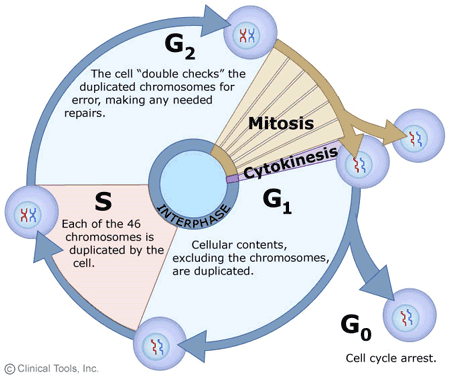
The cell cycle is the process by which a cell grows, prepares for division, and divides into two daughter cells. It is an important biological process responsible for growth, repair, and reproduction in living organisms.
The cell cycle consists of different phases including G1 phase, S phase, G2 phase, and M phase. Each phase has a specific function that ensures proper cell division.
The cell cycle consists of two main phases:
Interphase
Mitotic phase (M phase)
Phases of Cell Cycle
Interphase is the longest phase of the cell cycle. During this phase the cell grows and prepares for division.
Interphase has three stages:
G1 Phase – Cell growth takes place.
S Phase – DNA replication occurs.
G2 Phase – Cell prepares for division.
Mitotic Phase (M Phase)
The mitotic phase is the phase where the cell divides into two daughter cells.
It includes:
Mitosis – division of nucleus
Cytokinesis – division of cytoplasm
Stages of Mitosis
Prophase – Chromosomes become visible and spindle fibers form.
Metaphase – Chromosomes align at the center.
Anaphase – Chromatids separate.
Telophase – Two nuclei form.
Cytokinesis – Cell divides into two cells.
| Phase | Function |
|---|---|
| G1 | Cell growth |
| S | DNA replication |
| G2 | Preparation for division |
| M | Cell division |
Importance of Cell Cycle
The cell cycle is important for growth, tissue repair, and reproduction. It ensures that genetic material is copied correctly and passed to new cells.
Key Points
• Cell cycle controls cell division
• Interphase is longest phase
• DNA replicates in S phase
• Mitosis produces identical cells
• Important for growth and repair
FAQs
What is cell cycle?
The process by which a cell grows and divides.
Which phase is longest?
Interphase
Where DNA replication occurs?
S phase
What is mitosis?
Division of nucleus
Summary
Cell cycle has two main phases.
Interphase prepares the cell.
M phase divides the cell.
This process is essential for growth and repair.