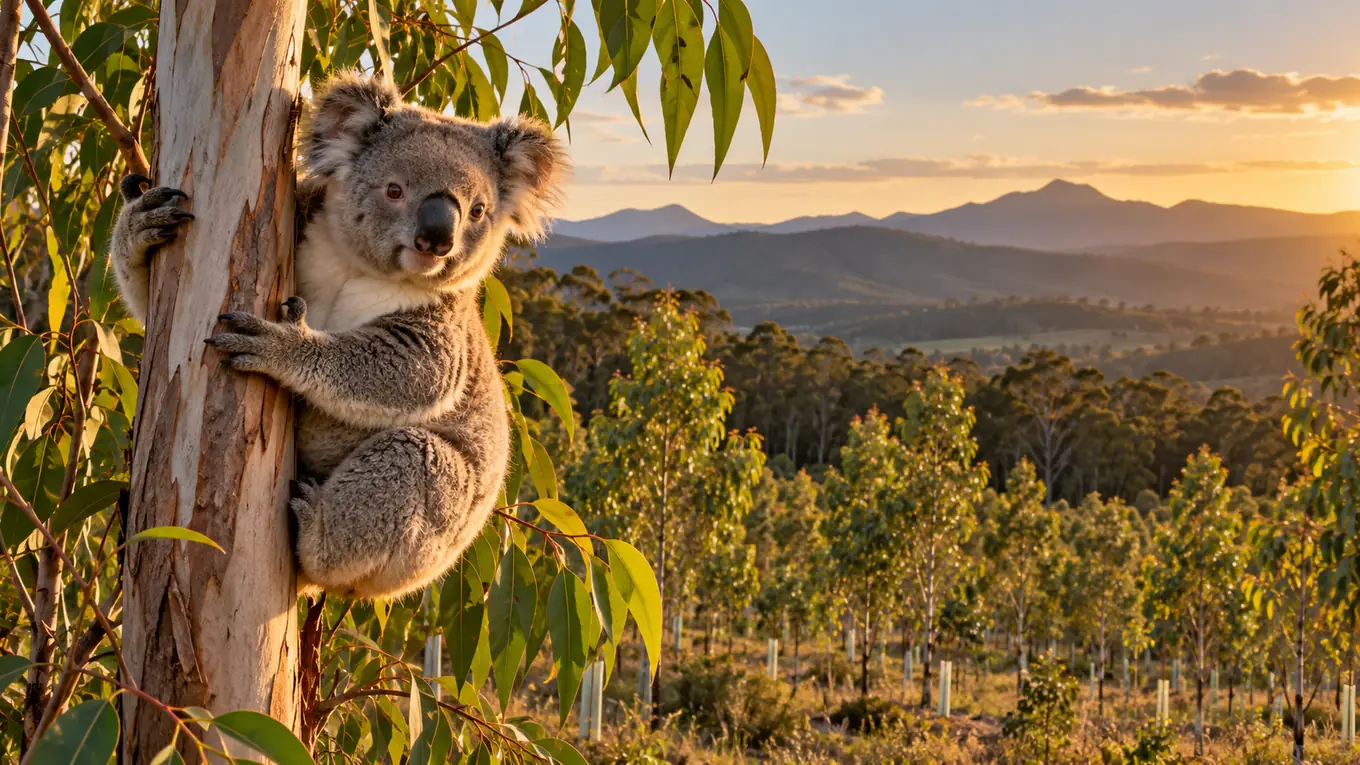
In 1994, Steve and Terri Irwin purchased a rural property in Queensland to create a refuge for koalas. Three decades later, Ironbark Station is part of a protected area spanning over 180,000 hectares, showcasing the patience required for habitat restoration as the species now faces endangerment.
Correction on the land area of Ironbark Station
Located near Blackbutt at the foothills of the Great Dividing Range, Ironbark Station spans approximately 3,500 acres, equivalent to about 1,416 hectares. Misunderstandings often arise, with the size frequently misrepresented as 3,500 hectares.
Shortly after the purchase, the Irwins planted around 44,000 eucalyptus trees. This choice was deliberate, as koalas primarily feed on the leaves of certain eucalyptus species, which also serve as their habitat. The property expanded by an additional 660 hectares, bringing its total to just over 2,000 hectares.
The endangered status of koalas in Australia
As of February 12, 2022, koala populations in Queensland, New South Wales, and the Australian Capital Territory have been classified as “endangered” under the federal Environment Protection and Biodiversity Conservation Act, a change from their previous vulnerable status since 2012. The Australian Environment Department attributes this shift to significant population declines.
Key threats include habitat loss, vehicle collisions, dog attacks, and chlamydia infections. Additionally, the droughts and wildfires of the summer of 2019-2020 have exacerbated their situation. Thus, every preserved or replanted eucalyptus forest becomes vital for their survival.
Importance of landscape connectivity
Research conducted in southeastern Queensland, particularly by Clive McAlpine’s team at the University of Queensland, emphasizes the significance of landscape configuration. The likelihood of encountering koalas hinges not only on the area of forest available but also on its fragmentation.
Animals forced to traverse open areas face increased risks from dogs and traffic. Therefore, connecting patches of forest with corridors mitigates these dangers. The conservation teams also tackle invasive plant species that threaten young trees and hinder wildlife movement.
From a personal endeavor to a larger conservation effort
Following Steve Irwin’s passing in September 2006, the conservation initiative continued under Australia Zoo and its Wildlife Warriors foundation. In 2007, the foundation further expanded by acquiring the Steve Irwin Reserve in Cape York, which covers about 130,000 hectares.
Today, Wildlife Warriors reports that combined land holdings protect over 450,000 acres, or more than 180,000 hectares, across Queensland. This network encompasses arid zones of the Brigalow Belt and eucalyptus forests of the Great Dividing Range. Ironbark Station represents a crucial starting point in a long-term commitment to conservation.