What if streetlights are preventing trees from recognizing winter? In Florence, a study of 283 plane trees reveals a surprising phenomenon: some hold onto their leaves long after others. This discovery raises questions about the impact of urban lighting on nature.
Florence researchers discover some plane trees refuse to shed their leaves
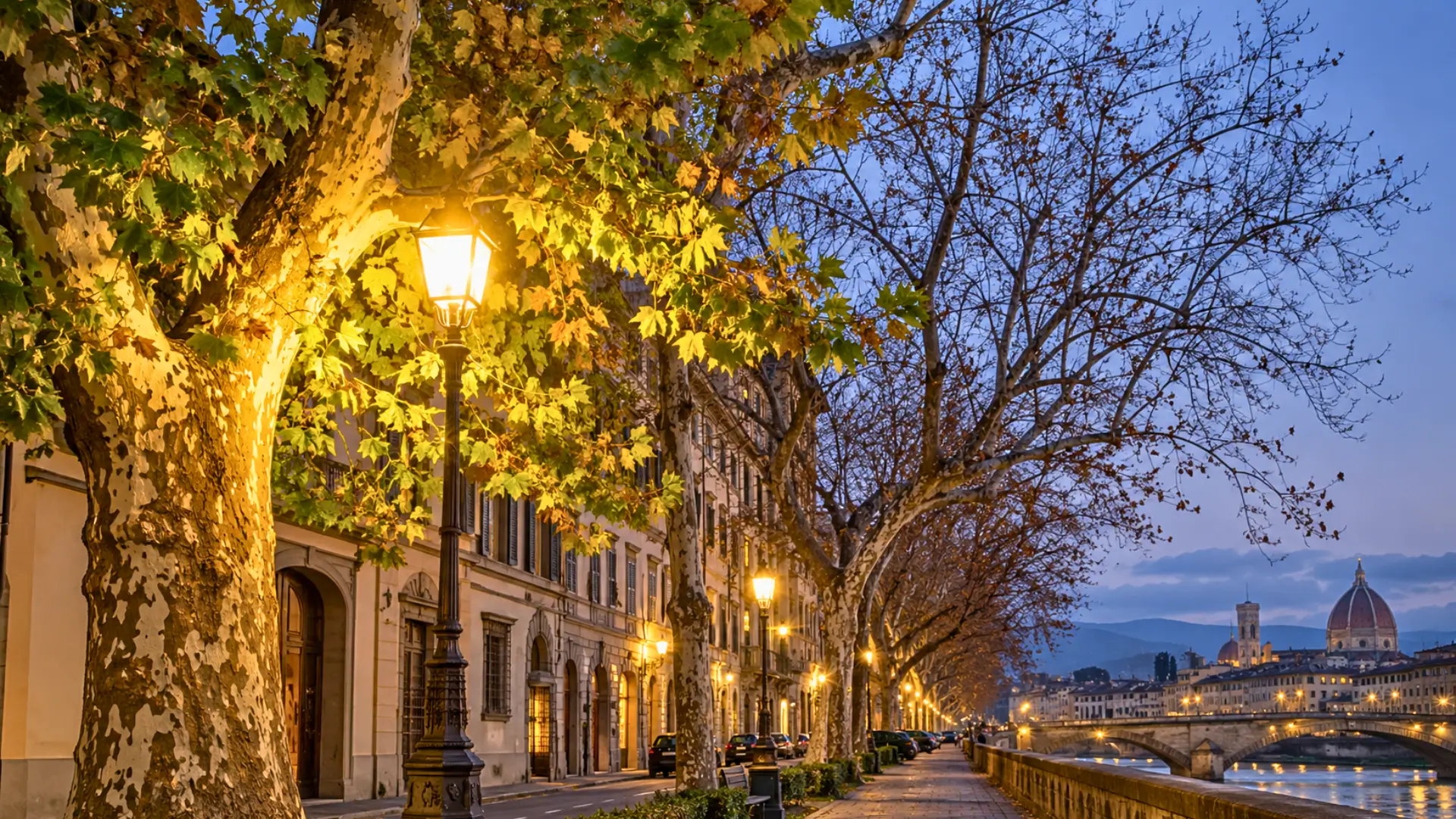
In Florence, certain plane trees seem oblivious to the arrival of winter. While trees in darker areas gradually lose their leaves, those under streetlights remain surprisingly green. This seasonal discrepancy often goes unnoticed by passersby, yet it piqued the interest of Luciano Massetti, a researcher at the Italian National Research Council (CNR).
Between 2014 and 2017, his team investigated 283 plane trees subjected to varying lighting conditions. The findings, published in 2018 in Urban Forestry & Urban Greening, revealed a significant difference. The illuminated trees retained more green foliage between mid-December and late January, a trend that intensified during the cold winter of 2016-2017.
Cascine Park shows striking contrast with the city’s illuminated streets
Cascine Park provides a particularly stark contrast. This large green space in Florence remains relatively shielded from urban lighting. Here, researchers observed a notable phenomenon: the period of no green leaves began at least 20 days earlier than in other studied areas, despite all trees experiencing the same regional climate.
This difference may be attributed to photoperiod, which refers to the daily duration of light exposure. Trees use this natural signal to prepare for seasonal changes. As nights lengthen, their metabolic activities slow down, signaling a transition into winter dormancy. However, the presence of a streetlight may disrupt this biological clock.
This observation is not entirely new. As early as 1936, scientists noted similar behavior; branches close to a lamp sometimes retained their leaves longer. The Florence study, however, provides field data to this botanical curiosity. One question still lingers: can light alone drive such an alteration?
Pisa’s LED experiment reveals two-month delay, but not for all trees
To delve deeper into this mystery, scientists at the University of Pisa conducted an experiment. They selected 30 young trees: 15 plane trees and 15 large-leaved linden trees. Some were exposed to LED lights at night, while others served as controls. The results were published in 2023 in Science of the Total Environment.
The findings were striking. Under nighttime lighting, the plane trees displayed a dormancy delay of approximately two months. However, the linden trees showed no comparable delay. It is essential to note that this result comes from a controlled experiment where the lamps were placed close to the foliage, and thus may not apply to all urban plane trees.
Behind these still-green trees, nighttime light could conceal other disruptions
Researchers also identified a more subtle effect. The mature leaves of trees exposed to LED lights assimilate less CO₂ at dawn, suggesting a sort of physiological fatigue following a night of illumination. This response occurred in both species studied, yet only the plane tree showed a marked delay in dormancy.
These observations raise several questions. Leaves that remain active too long may become more susceptible to frost. They could also disrupt the tree’s energy reserves. However, these consequences remain theoretical for now. The experiments cannot conclusively state that nighttime lighting shortens the lifespan of plane trees, and further research is required.
For communities, the issue extends beyond mere energy consumption. A more nature-friendly urban lighting could help maintain the natural rhythms of trees. This perspective encourages a reevaluation of our illuminated streets. During a winter stroll, one detail now deserves attention: why do some leaves stay green while their neighbors are already bare?