Deep beneath the Atlantic Ocean, around 5,000 meters down, lies evidence of our industrial past. The Nodssum scientific mission has confirmed the rupture of nuclear containers submerged decades ago, revealing alarming radioactive leaks and a unique biological colonization.
Nuclear pollution accumulated over decades by three European countries
Between 1949 and 1982, several nations disposed of over 200,000 metal drums into the Northeast Atlantic. These 200-liter containers housed radioactive waste encased in concrete or tar, with authorities of the time aiming to seal the materials before submerging them.
The United Kingdom conducted 34 operations to submerge 140,000 containers, while Belgium disposed of 55,000 barrels and France discarded 46,000 in two campaigns. These shipments were simply tipped overboard into areas deeper than 4,700 meters.
Robots and researchers observe the decay of drums at the abyssal plain
In 2025, the CNRS launched the Nodssum expedition aboard the ship L’Atalante to locate these waste sites across 14,500 km². The Ulyx autonomous robot completed 16 dives, traveling 800 kilometers and capturing images of 3,355 partially buried containers.
This first mapping effort covered roughly 165 square kilometers of the ocean floor, allowing scientists to collect 5,000 liters of water and conduct 345 sediment cores. Moreover, the teams gathered 34 specimens of local fauna for initial observations.
Between May and June 2026, the mission deployed the crewed submersible Nautile from the vessel Pourquoi pas ?. Researchers ventured into total darkness at nearly 4,700 meters to examine the actual condition of the metal cylinders.
Abnormal radiological measurements confirm leaks among deep-sea fauna
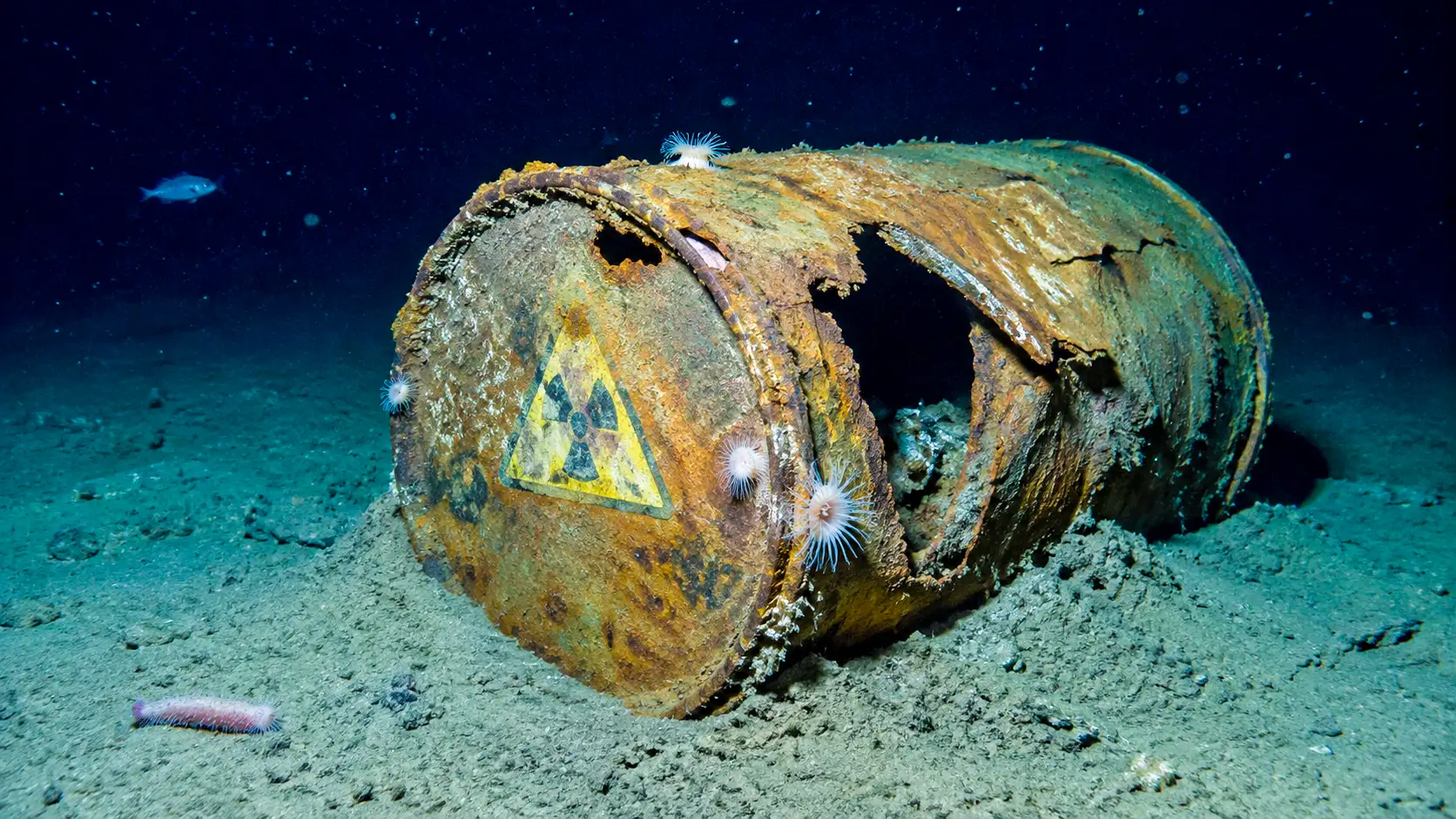
Cameras on the submersible revealed structures severely degraded by salt and pressure. Many specimens showed cracks in their concrete and tar casings. Consequently, the barrels could no longer contain the radioactive materials inside.
Instruments detected radioactive activity exceeding expectations. The evident presence of specific radionuclides confirmed that containment failed after four to five decades, with the originally designed shells meant to last twenty years revealing their limitations.
Despite the contamination, marine life has taken over these industrial remnants. Anemones and sea cucumbers have attached themselves to the corroded metal, while amphipods and grenadiers swim around these nuclear relics, which have turned into an artificial habitat.
International laboratory analyses must now assess ocean dispersion
Following the return of the vessels, researchers’ work continues on land. Teams from France, Germany, Norway, and Spain analyze water and sediment samples to quantify the radionuclides and measure their actual spread.
This abyssal study is part of a global environmental challenge. Other submarine nuclear graveyards exist in the North Sea, the Arctic, and the Pacific Ocean. The protocols developed by the CNRS will aid in assessing these various dumping sites.