The colder months mean we spend more time indoors, but is that safe?
The season of indoor confinement begins
From October to March, many homes in France remain closed off, with doors and windows sealed tight. Heating systems run continuously, ventilation becomes a rare luxury, and the concentration of airborne pollutants increases steadily as the weeks pass. Already, we spend around 80% of our time indoors, inhaling about 15,000 liters of air each day; this number climbs even higher in winter.
The toll of this exposure is staggering. A study published in April 2014 by the Indoor Air Quality Observatory estimated the cost at 19.5 billion euros per year, roughly 1% of France’s GDP, and responsible for nearly 20,000 annual deaths. Unfortunately, the exposure data has not been updated significantly since the national campaign from 2003-2005, highlighting just how neglected this issue remains.
This article clarifies what truly contributes to indoor pollution, what can be measured effectively, and what products are essentially worthless. We have previously listed materials that worsen indoor air quality and explored how air purifiers work. What follows will incorporate official statistics, threshold values, and insights that sellers tend to overlook.
In summary: ventilation is the only proven solution, a €100 sensor provides more insights than a €400 purifier, and the most deadly pollutant in France is invisible and odorless.
What actually pollutes a home
Over 5,000 pollutants have been identified in indoor air. The majority of the health costs attributed by OQAI stem from five key pollutants: fine particles, radon, carbon monoxide, benzene, and trichloroethylene. Fine particles alone account for a staggering 73% of the total cost and 16,236 deaths annually.
| Pollutant | Source in homes | Ways to reduce it |
|---|---|---|
| Fine particles (PM2.5) | Cooking, candles, incense, fireplaces, vacuuming without filters, outdoor air ingress | Use exhaust hoods when cooking, HEPA filtration, reduce indoor combustion |
| Radon | Soil, through cracks and pipe passages, not related to furniture | Ventilate crawl spaces, seal entry points, renew air |
| Carbon monoxide | Improperly ventilated or adjusted combustion appliances: boiler, water heater, stoves | Annual maintenance is mandatory, avoid obstructing ventilation grilles, install CO detectors |
| Benzene | Tobacco smoke, combustion, certain solvents, attached garages | No smoking indoors, insulate garages, ventilate after solvent use |
| Formaldehyde and VOCs | Particle board furniture, adhesives, paintings, household products, indoor fragrances | Ventilate extensively after purchasing new furniture, minimize scented products |
| Humidity and mold | Kitchen, bathroom, drying laundry indoors, thermal bridges | Maintain relative humidity between 40 and 60%, address issues at the source |
Two key takeaways emerge from this table. Major sources are activities rather than objects: cooking, burning, cleaning, and drying laundry. Most solutions involve addressing issues at the source instead of treating a volume of contaminated air afterward.
CO₂ is not a pollutant, but a messenger
This is one of the most widespread misunderstandings. At home concentrations, carbon dioxide is not toxic. Its significance lies elsewhere: levels rise with human occupancy and drop when fresh air circulates. Therefore, it serves as a real-time indicator of whether your home is adequately ventilated and whether other pollutants may also be building up.
| CO₂ concentration | What it means | Recommended action |
|---|---|---|
| 400 to 600 ppm | Equivalent to outdoor air, excellent renewal | No action required |
| 600 to 800 ppm | Normal occupancy, adequate ventilation | No action required, this is the target |
| 800 to 1,200 ppm | Insufficient renewal, air becoming polluted | Open windows for five minutes, check air entry points |
| 1,200 to 2,000 ppm | Notable confinement. Fatigue, decreased concentration, headaches | Immediate ventilation, check heating, ventilation, and air conditioning (HVAC) |
| Above 2,000 ppm | Severe confinement often found in a closed bedroom during the night | Reassess room ventilation, not just open windows |
The critical value to remember is 800 ppm for occupied spaces. This is also the benchmark that regulations have chosen for facilities accommodating children: since January 1, 2023, crèches, schools, and youth services must conduct annual evaluations of their ventilation systems through direct CO₂ measurements, supplemented by self-assessments every four years, periodic checks by accredited organizations, and creation of action plans. Medical and social facilities will fall under similar guidelines starting January 1, 2025.
However, no equivalent obligation exists for private residences. What the state mandates for a classroom goes unchecked in a child’s bedroom.
Radon, the pollutant nobody seeks
This naturally occurring radioactive gas, released from the decay of uranium in soils, infiltrates homes through cracks, pipe passages, and cellars. It is odorless, colorless, and has been classified as a known human carcinogen by the International Agency for Research on Cancer since 1987.
In France, radon accounts for approximately 3,000 lung cancer deaths each year, close to 10% of lung cancer fatalities. It is the second leading cause of this cancer after tobacco, yet receives very little attention.
Radon risk zones align with granite geological formations including the Armorican Massif, Central Massif, Corsica, and Vosges, complemented by certain sandstone and black shale areas. A mapping resource is available for public viewing on Géorisques.
The reference value established is 300 becquerels per cubic meter on an annual average, based on recommendations from the WHO and the European Commission. Surprisingly, no mandatory threshold applies to private homes in France.
Measurement can be performed with a passive dosimeter placed in a living space for several weeks, preferably during the heating season – which is now. Kits typically cost between 30 and 60 euros. If levels exceed the reference value, two strategies should be combined: enhance air renewal and seal off entry points by repairing cracks and pipe passages.
Measure before you buy
This advice can save the most money. A sensor will reveal when and where your air quality deteriorates; without this knowledge, purchasing a purifier is akin to gambling.
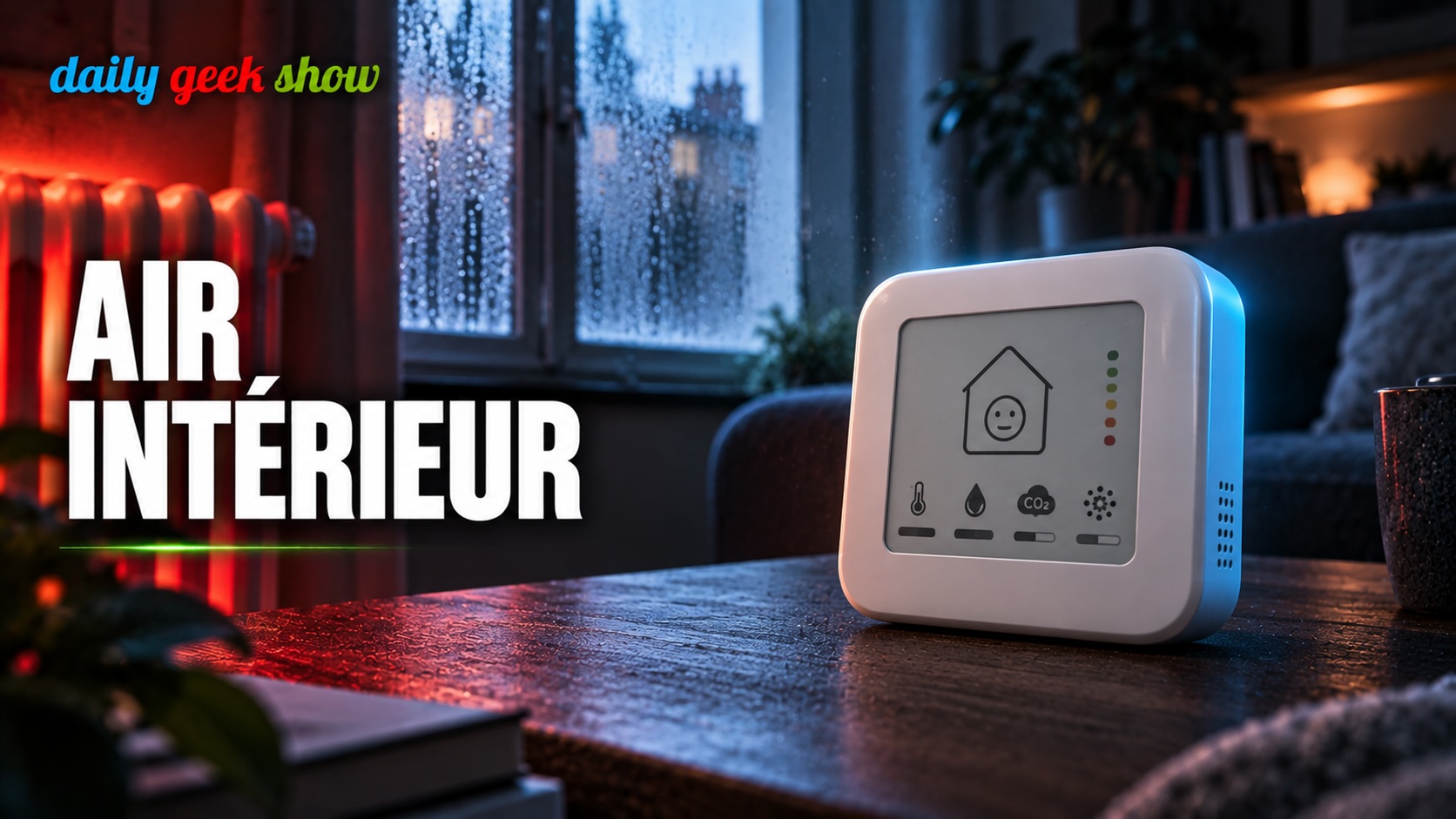
A reliable NDIR CO₂ sensor ranges from 100 to 250 euros. The Aranet4 Home is a top choice for precision and battery life; the Netatmo sensor adds temperature, humidity, and sound measurements in a connected format. We introduced devices of this type when the market was still emerging with the portable Flow sensor.
It is important to know that budget sensors often struggle with total VOCs. Most consumer-grade devices utilize non-selective sensors that can respond similarly to household cleaners and peeled fruit. As such, absolute values may be misleading, while fluctuations are more informative. The same caution applies to PM2.5 readings from low-end optical sensors.
A week of monitoring in a bedroom, kitchen, and living room is usually sufficient to identify the real problem. The most common issue is confined nighttime sleeping areas instead of diffuse chemical pollution.
What aNSES says about air purifiers
The agency examined over 500 indoor air purification devices, autonomous purifiers accounting for 64% of the market. Its conclusion, published in September 2017, remains unmatched: existing scientific data does not demonstrate the effectiveness or safety of indoor air purifiers under real-world conditions.
Of particular concern are some active technologies. Devices that generate ozone pose risks, especially for individuals with asthma. Moreover, breaking down odor compounds may produce byproducts that are odorless and sometimes more harmful than the original substances. In essence, the scent disappears, but the problem may persist.
However, this evaluation does not discredit mechanical filtration. A HEPA filter physically captures particles and its effectiveness is measurable, making it the recommended technology in official guidelines. The caveat lies with active technologies, such as ionization, ozonation, photocatalysis, and scented sprays, as well as blanket claims about purifying a space.
When selecting a purifier, two rules suffice. Exclude any model that produces ozone. Additionally, base your choice on the Clean Air Delivery Rate (CADR), which must correspond to the room’s volume rather than its surface area. A decent model for a bedroom costs between 80 to 150 euros, with a Levoit HEPA filter being a solid option in this range.
What truly works, and costs nothing
Official guidelines converge on one principle: the best way to improve indoor air quality is to eliminate the pollution source and then invite in outdoor air. The purifier should come second, not first.
- Ventilate for five to ten minutes daily while heating is off. This suffices for air renewal, and the heating cost is negligible since dry air warms up quickly without allowing walls to cool.
- Never block ventilation grilles. The winter habit of sealing grilles to keep warm leads to the most significant degradation of air quality.
- Clean HVAC vents. If clogged, they can lose effectiveness. Annual cleaning can dramatically improve airflow.
- Use the exhaust hood whenever cooking. Cooking is the primary source of fine particles in non-smoking homes.
- Avoid drying laundry indoors without ventilation. A wet laundry machine can release several liters of water into your home.
- Minimize scented candles, incense, and air fresheners. These contribute directly to particulate and VOC emissions.
- Ventilate extensively after purchasing new particle board furniture. This is when formaldehyde emissions peak.
- Have combustion appliances serviced annually. This is not just recommended but essential to prevent carbon monoxide poisoning.
It is important to note this does not contradict energy efficiency. Proper ventilation does not drastically inflate heating bills. We’ve analyzed the components that genuinely impact heating costs, and daily five-minute ventilation does not rank among them. A single degree decrease in temperature settings carries significantly heavier weight.
What to do based on your home situation
| Your situation | Priority | Useful budget |
|---|---|---|
| New apartment with HVAC | Clean vents, do not obstruct, check airflow | 0 € |
| Older home without HVAC | Disciplined manual ventilation, CO₂ sensor to monitor | 100 to 150 € |
| Child’s bedroom closed at night | CO₂ sensor in the bedroom first to identify surprising values | 100 to 250 € |
| Radon risk area (Brittany, Central Massif, Vosges, Corsica) | Radon dosimeter during the heating season before any purchase | 30 to 60 € |
| House with stove, fireplace, or auxiliary heating | Carbon monoxide detector and annual maintenance are non-negotiable | 25 to 50 € |
| Allergies or asthma in the household | HEPA filtration in the bedroom, alongside ventilation. Avoid any ozone-producing device | 80 to 150 € |
| Moving into newly renovated accommodation | Intensive ventilation for several weeks: peak VOC emission period | 0 € |
| Humidity, condensation, or visible mold | Tackle the source: ventilation, thermal bridging, leaks. A purifier has no impact on mold | Variable |
Frequently asked questions
What is an acceptable CO₂ level in a home?
The benchmark is 800 ppm in an occupied space. Between 800 and 1,200 ppm, air renewal is inadequate. Above 1,200 ppm, fatigue and concentration drop occur. A closed bedroom frequently exceeds 2,000 ppm in the early morning.
Are air purifiers effective?
ANSES concluded in 2017, after reviewing over 500 devices, that the available data did not support claims about their effectiveness and safety under real conditions. HEPA filtration is notably effective for particles; active technologies like ionization or ozonation should be avoided, especially for asthmatics.
How much does indoor air pollution cost in France?
Approximately 19.5 billion euros annually, accounting for nearly 1% of GDP and roughly 20,000 deaths per year according to the Indoor Air Quality Observatory. Fine particles alone represent 73% of this cost. Note, however, that the exposure data is over two decades old.
How can I tell if my home is at risk for radon?
Radon risk area maps are available for public consultation on Géorisques. At-risk zones align with granite massifs: the Armorican Massif, Central Massif, Vosges, and Corsica. Measurement is typically carried out using a dosimeter left in place for several weeks during the heating season, for 30 to 60 €.
Should I ventilate in winter despite heating?
Yes, for five to ten minutes each day with heating off. Dry air warms up quickly without cooling down walls; the cost increase is negligible. In contrast, blocking ventilation grilles to save on heating is the most damaging mistake for air quality.
Do plants purify indoor air?
Not at the room scale. Studies demonstrating absorption capacity were conducted in controlled laboratory settings with concentrations and volumes far removed from typical homes. Hundreds of plants would be needed per room for a measurable effect.
Are consumer VOC sensors reliable?
Moderately. Total VOC sensors in consumer devices are non-selective and can react to both cleaning products and peeled fruit. Absolute values are often meaningless, but their variations are worthwhile. NDIR-measured CO₂ is far more reliable.
Conclusion
Only three purchases are justified, none exceeding 250 €. A carbon monoxide detector if your home has a combustion appliance: 25 to 50 €, and this is the only purchase that may save a life at night. A radon dosimeter if you live in a granite area: 30 to 60 €, to be positioned now since measurements should be conducted during the heating season. Lastly, a CO₂ sensor to assess ventilation: 100 to 250 €, likely to show that the issue lies within bedrooms.
The air purifier ranks fourth in importance, serving as a supplementary measure for targeted filtration only after issues are identified. Health authorities have not validated sweeping market claims, and active technologies raise additional concerns.
Much remains unquantified: a health cost of 19.5 billion euros calculated from exposure data over twenty years old, no enforcement of standards in private homes where the state mandates them in classrooms, and no legal threshold for a gas linked to 3,000 fatalities annually. Indoor air quality is not merely a matter of appliances. It is a significant blind spot.