
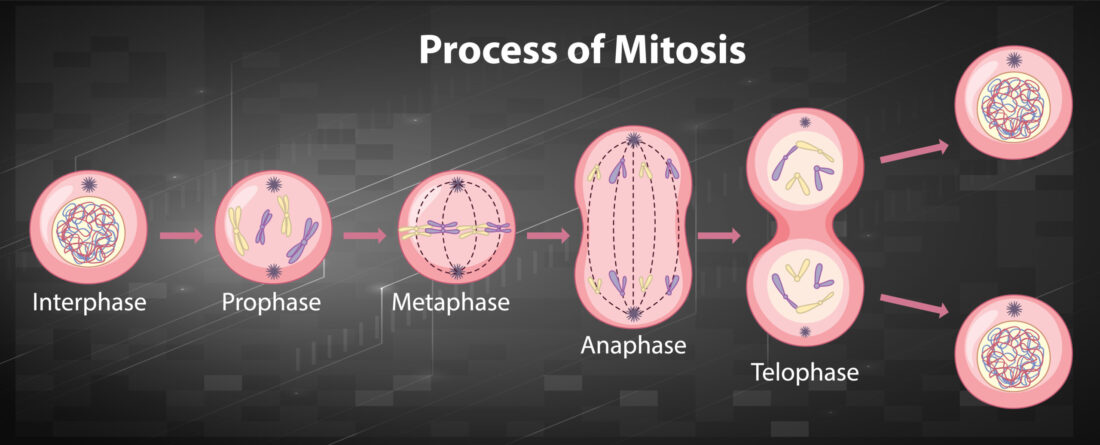
Mitosis is a fundamental process of cell division in which a single eukaryotic cell divides into two identical daughter cells, each containing the same number of chromosomes as the parent cell. This process is crucial for growth, tissue repair, and asexual reproduction in multicellular organisms. Mitosis consists of several distinct stages, each with its own significance in ensuring accurate chromosome distribution and the formation of genetically identical daughter cells. Let’s explore each stage of mitosis and its significance:
1. Interphase (Preparation for Mitosis):
Before mitosis begins, the cell undergoes a phase called interphase, which is further divided into three subphases: G1 (cell growth and preparation), S (DNA synthesis and replication), and G2 (cell growth and final preparations). During interphase, the cell grows, duplicates its organelles, and replicates its DNA to ensure that each daughter cell will receive a complete set of genetic information.
2. Prophase:
- Chromosomes condense: Chromatin (the complex of DNA and proteins) condenses into visible chromosomes. Each chromosome consists of two sister chromatids connected by a centromere.
- Spindle apparatus forms: Microtubules called spindle fibers begin to form, radiating from structures called centrioles (in animal cells) or spindle pole bodies (in some fungi).
- Nuclear envelope dissolves: The nuclear envelope breaks down, allowing spindle fibers to interact with the chromosomes.
Significance of Prophase: Prophase marks the beginning of mitosis and ensures the proper organization of genetic material into visible, compact structures. The breakdown of the nuclear envelope allows the spindle fibers to access the chromosomes.
3. Metaphase:
- Chromosomes align at the metaphase plate: The spindle fibers guide the chromosomes to the metaphase plate, an imaginary plane equidistant between the two spindle poles.
- Chromatids attach to spindle fibers: The centromere of each chromatid attaches to spindle fibers, ensuring that each chromatid will be pulled to opposite poles during the next stage.
Significance of Metaphase: Metaphase ensures precise alignment of chromosomes at the metaphase plate, facilitating accurate distribution of genetic material during cell division.
4. Anaphase:
- Sister chromatids separate: The centromere splits, allowing sister chromatids to be pulled apart toward opposite spindle poles by shortening spindle fibers.
- Chromatids become individual chromosomes: Once separated, each chromatid becomes an independent chromosome.
Significance of Anaphase: Anaphase ensures the proper segregation of genetic material into two distinct sets, which will be enclosed within the nuclei of the daughter cells.
5. Telophase:
- Chromosomes reach the poles: The separated chromosomes arrive at the spindle poles.
- Nuclear envelopes form: New nuclear envelopes begin to form around the separated chromosomes, creating two distinct nuclei within the cell.
- Chromosomes de-condense: The chromosomes begin to de-condense and revert to their chromatin state.
- Spindle apparatus disassembles: The spindle fibers break down.
Significance of Telophase: Telophase marks the end of chromosome movement and the reformation of nuclear envelopes around the separated chromosome sets, setting the stage for cytokinesis.
6. Cytokinesis:
- Cytoplasm divides: Cytokinesis is the process by which the cytoplasm of the parent cell is divided between the two daughter cells.
- Cleavage furrow (in animal cells) or cell plate (in plant cells) forms: In animal cells, a contractile ring of actin filaments creates a cleavage furrow, pinching the cell into two. In plant cells, a cell plate forms at the center of the cell, eventually becoming the new cell wall.
Significance of Cytokinesis: Cytokinesis completes the cell division process by physically separating the two daughter cells, each with its own nucleus and complete set of organelles.
In summary, mitosis is a highly orchestrated process involving interphase, prophase, metaphase, anaphase, telophase, and cytokinesis. Each stage has a specific role in ensuring accurate chromosome segregation and the formation of genetically identical daughter cells. By producing new cells for growth, repair, and reproduction, mitosis is essential for the maintenance and development of multicellular organisms.