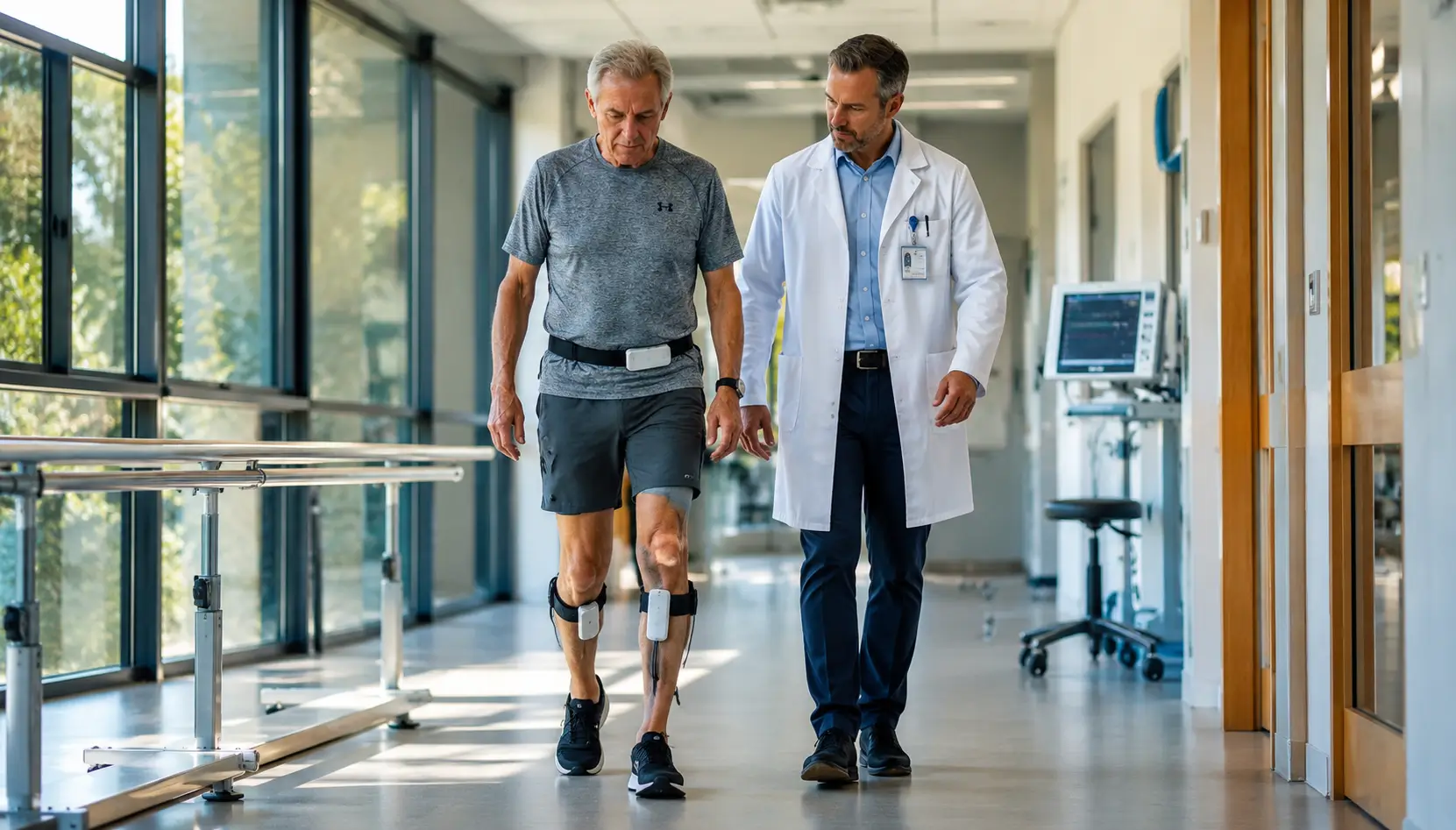
What if a brain implant could finally stop acting as a blind metronome and instead adapt to the real rhythm of the body? A new approach has already shown promising results for Parkinson’s patients, leading to more stable walking and reducing the ever-present risk of falling.
Walking difficulties are one of the most debilitating symptoms of Parkinson’s
The challenges of Parkinson’s disease are often overshadowed by the well-known tremors. However, many patients face a more daunting hurdle when simply attempting to walk. The body becomes hesitant, feet seem glued to the floor, and momentum is lost. Walking, a normally automatic movement, turns into a constant negotiation with the brain.
This issue is far from trivial. Over 10 million people worldwide live with Parkinson’s, and episodes of freezing and imbalance rank among the most feared symptoms. They substantially increase the risk of falls and erode daily independence. This is where standard treatments sometimes fall short.
Traditional deep brain stimulation quickly reaches its limits with walking
For decades, deep brain stimulation has served as a sort of brain pacemaker. Electrodes implanted within the brain deliver continuous electrical currents that can alleviate rigidity, slowness, and certain tremors. For many patients, this treatment marks a significant medical turning point, often showing immediate results after adjustments.
However, walking does not adhere to a fixed rhythm. It requires ultra-fast coordination, almost choreographed, between both sides of the body. Yet constant stimulation -even if carefully calibrated -struggles to keep pace with this intricate mechanism. It is akin to trying to conduct an entire orchestra with a single sustained note.
Researchers at the University of California, San Francisco aimed to break this limitation. Instead of delivering more stimulation, their goal was to provide the right impulse at the right moment, taking into account the moving leg, pace, and associated brain signals.
An adaptive implant adjusts stimulation in real-time based on walking signals
In a study published on June 15, 2026, in Nature Medicine, researchers focused on five patients already using deep brain stimulation. They then incorporated sensors capable of recording activity related to each leg. This advancement allowed them to adjust stimulation almost in real-time without relying on external computers.
This detail changes everything. Instead of imposing a uniform signal, the implant identifies individual biomarkers of walking. For some participants, these indicators stemmed primarily from the motor cortex, while for others, they originated more from the basal ganglia. This means that the brain does not transmit the same instructions to everyone.
In laboratory settings, this method improved step symmetry and reduced gait variability, both markers of more stable walking. Additionally, three participants continued home testing in a double-blind phase. The system was well-tolerated and effectively managed other motor symptoms.
This advancement paves the way for much more personalized brain therapies
The number might seem small, and it’s important to be clear: five patients, by themselves, do not herald a clinical revolution. The study remains a proof of concept and does not yet provide definitive evidence of large-scale effectiveness. However, it opens an exciting door, demonstrating that an implant can react to behavior instead of operating on autopilot.
This revelation is perhaps the most significant aspect of this research. Historically, brain implants have been designed as relatively rigid systems. Now, stimulation becomes dynamic, almost context-sensitive. Currently, it follows walking patterns, while future teams are already envisioning devices that could adjust to speech, mood, cognitive functions, or other brain states.
For patients, this development is monumental. Regaining a more consistent walking pattern means reclaiming paths to the street, the grocery store, and an ordinary sense of freedom. Behind this advancement lies a growing question: how far could truly personalized brain therapies help enhance daily life without merely correcting the illness?