In 2025, a record surge of sargassum swept through the tropical Atlantic and the Caribbean. But what could sustain such a massive plant? Long-lived corals have unveiled an oceanic mechanism that is far more surprising than previously thought.
The focus has been on the amazon and agricultural runoff
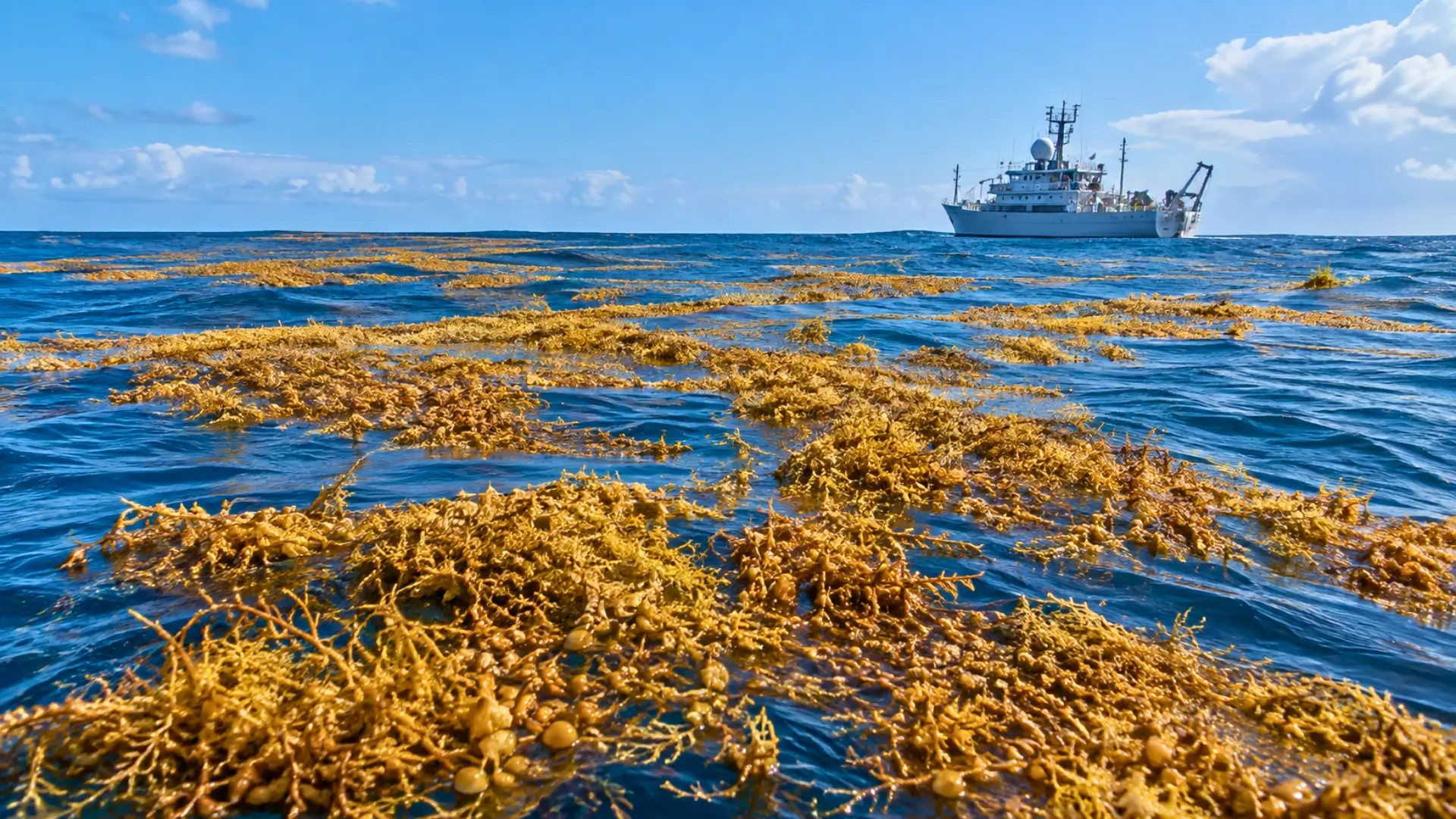
In the spring of 2025, satellites detected an unusual occurrence. By May, approximately 37.5 million tons of sargassum were observed floating in the Atlantic, Caribbean, and Gulf of Mexico. By July, the University of South Florida’s estimates reached 38 million tons, marking an unprecedented level in modern records.
Since the emergence of the Great Atlantic Sargassum Belt in 2011, attention has been drawn to nutrients contributed by major rivers, agriculture, and deforestation. While these factors can influence local conditions, a study published in Nature Geoscience indicates that they do not fully account for the enormous year-to-year fluctuations.
The main contributor originates from the depths of the equatorial Atlantic
The researchers proposed a scenario that begins far from tourist beaches. Near the equator, winds promote a phenomenon known as upwelling: deep waters rise, bringing excess phosphorus to the ocean’s surface layers. These nutrient-rich waters can then be transported to the northern tropical Atlantic.
This perspective significantly alters the narrative. The essential fuel for these massive blooms does not solely originate from vast agricultural inputs. A substantial component of this phenomenon is linked to natural ocean circulation, which fluctuates with winds and major climate patterns in the Atlantic.
The study illustrates that periods of vigorous equatorial upwelling correspond to increased phosphorus availability. In the analyzed models, the interplay between nitrogen fixation and climatic variability accounts for many of the biomass fluctuations observed since 2011, surpassing the contributions from various other nutrient sources.
Sargassum has microscopic partners that provide nitrogen
However, another puzzle remained: phosphorus alone cannot produce this much biomass. Sargassum also requires nitrogen, and they host tiny allies on their surfaces –nitrogen-fixing bacteria, including some cyanobacteria. These microorganisms convert molecular nitrogen into biologically usable compounds.
This partnership grants the algae a significant advantage when waters are rich in phosphorus yet relatively low in assimilable nitrogen. The bacteria can provide nitrogen directly to their host. Combined with the phosphorus from deep waters, sargassum can thrive under conditions where other organisms struggle.
To trace this story, scientists utilized an unexpected archive: core samples from Caribbean corals. The organic material within these cores retains the isotopic signature of available nitrogen during their growth periods. This allowed researchers to reconstruct regional variations in nitrogen fixation from 1900 to 2021.
120-year-old corals preserved chemical memories of these blooms
Data reveals multi-decade oscillations linked to shifts in atmospheric and oceanic circulation in the Atlantic. Certain periods of enhanced upwelling are associated with greater nitrogen fixation. The exceptional sargassum events of 2015 and 2018 were even linked to the highest fixation levels recorded in the analyzed timeframe.
The implications of this research extend beyond scientific curiosity. When sargassum washes ashore, it can suffocate coastal habitats and release hydrogen sulfide as it decomposes. The record levels of 2025 highlighted the significant challenges faced by Caribbean territories, particularly in tourism and clean-up efforts. Satellites now enable near real-time monitoring of these algal masses.
A crucial question remains: what will happen to this mechanism in a warmer ocean? The study authors emphasize that the future of sargassum will largely depend on how warming influences winds and equatorial upwelling. Future blooms may thus begin far ahead of the beaches, embedded in the invisible currents of the deep Atlantic.