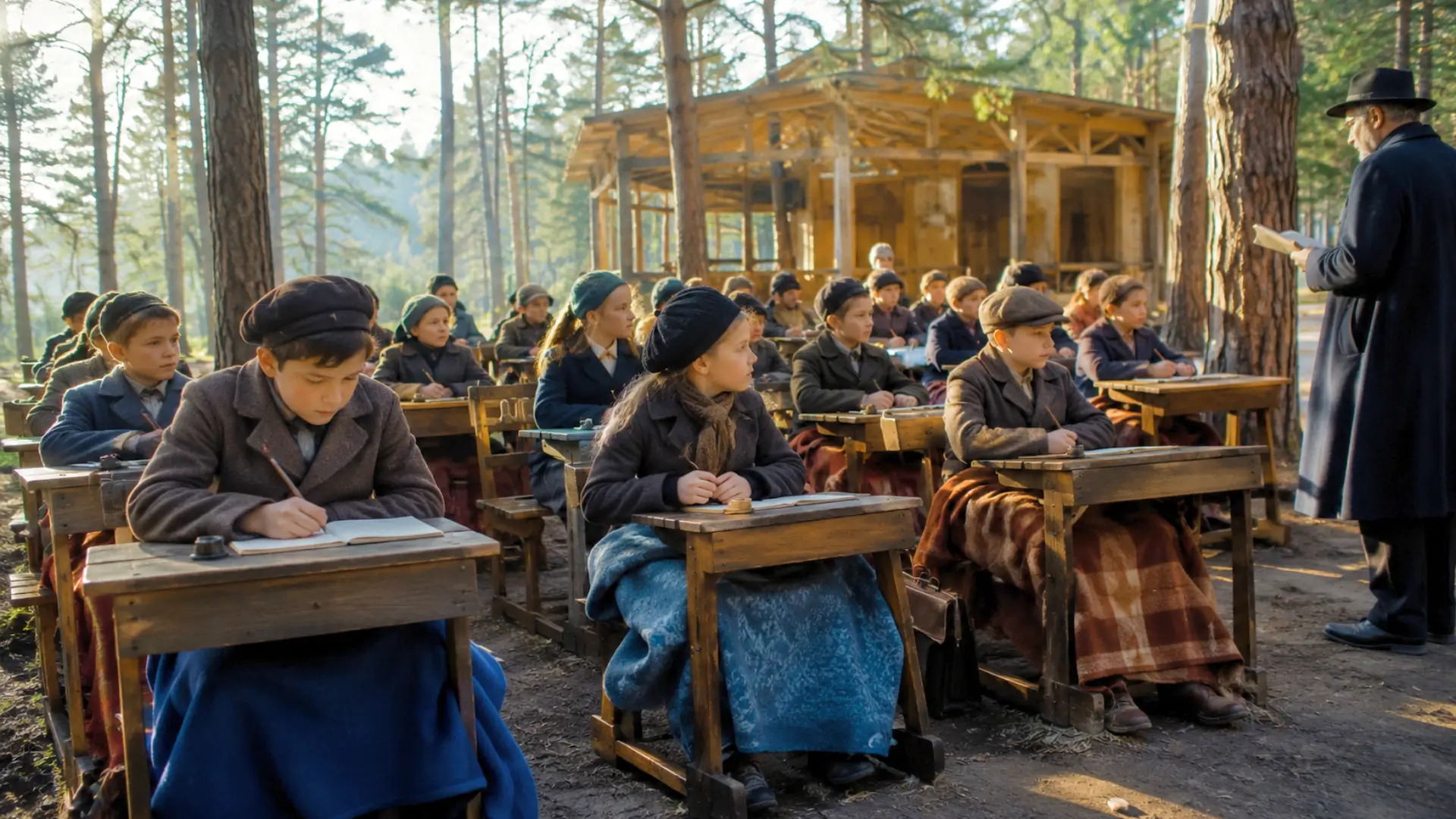
Why were children studying outdoors, bundled in blankets even when temperatures hovered near freezing? In Berlin, a pioneering school removed the walls of its classrooms to combat a terrifying enemy: tuberculosis.
A pioneering forest school established in the heart of Grunewald, Berlin, in 1904
On August 1, 1904, 95 fragile children left the crowded streets of Charlottenburg for the pines of Grunewald, located to the west of Berlin. Their new institution bore a telling name: Waldschule für kränkliche Kinder, or the “forest school for sickly children.” Here, desks were set up outdoors, and trees took the place of walls.
The pediatrician Bernhard Bendix and school inspector Hermann Neufert were the driving forces behind this initiative. Architect Walter Spickendorff was given the unusual task of preserving the landscape, keeping the trees intact, and maximizing sun exposure. Meals, exercise, and rest periods were just as crucial to treatment as lessons themselves.
Tuberculosis transforms industrial cities into deadly health environments
By the early 20th century, tuberculosis was one of the deadliest diseases. It spreads mainly in closed, poorly ventilated, and overcrowded spaces. Worker neighborhoods embodied these conditions, compounded by malnutrition and damp living environments. To doctors, many children seemed on the brink of illness.
The Waldschule did not only cater to young tuberculosis patients. Many were anemic, undernourished, or lived with an infected family member. Physicians referred to these cases as “pre-tuberculous.” Sending them into the woods aimed to break free from the stale indoor air while allowing them to continue their education.
At that time, there were no effective antibiotics available for the disease. The first truly effective treatment, streptomycin, would not be introduced for several decades. Physicians thus relied on what they had: ample food, rest, moderate exercise, light, and fresh air. An imperfect medicine, to be sure, but guided by relevant health intuitions.
Open-air classes in winter where constant ventilation is a vital rule
When rain or extreme cold set in, students would retreat to humble pavilions. However, these shelters were nothing like traditional classrooms. With their large openings, they ensured nearly constant ventilation. Children remained bundled in coats, hats, and blankets, continuing their lessons while icy air flowed through.
This structure was not solely reliant on outside air. Days combined learning, playtime, nourishing meals, and long rest breaks. Initial reports noted a general improvement in the students’ conditions, although it remained challenging, by modern scientific standards, to isolate the specific effect of the forest from that of rest and nutrition.
The experiment quickly attracted the attention of doctors, educators, and policymakers. Comparable institutions began appearing in Belgium, Switzerland, Italy, France, Hungary, and Sweden. The movement also made its way to North America. Within a few years, outdoor classrooms emerged as an international response to urban diseases.
A Berlin experiment that quickly inspires outdoor schools worldwide
These schools later evolved with modern architecture. Some featured movable walls, terraces, or fully glazed rooms. Their goal remained the same: to invite sunlight and ensure constant airflow. Schools were no longer thought of as closed boxes but as genuine public health tools.
Antibiotics, vaccination, and improved housing have gradually reduced tuberculosis in industrialized countries. However, the disease has not disappeared; the World Health Organization estimates that it caused 1.23 million deaths in 2024. Ventilation also remains essential against various respiratory infections.
More than a century after Charlottenburg, schools are greening their courtyards, experimenting with outdoor classes, and paying more attention to indoor air quality. The 1904 institution did not provide a miraculous solution, but it raised an ever-relevant question: does a school building truly protect children when it separates them from air, sunlight, and nature?