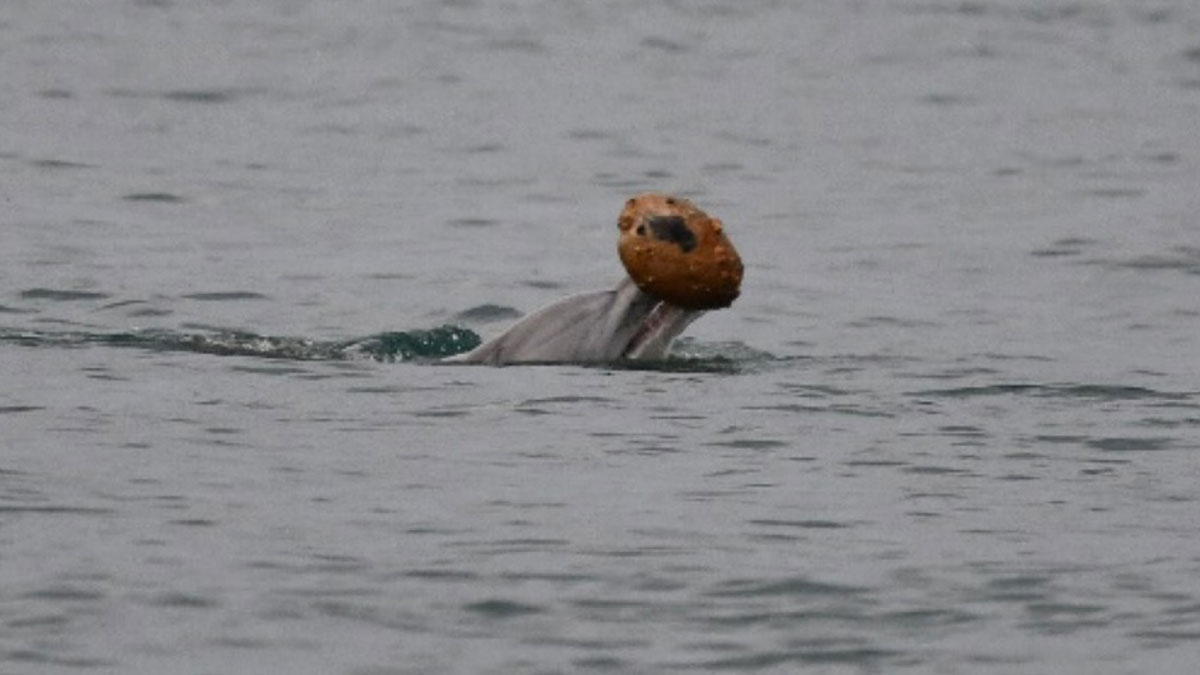
Scientists off the coast of Australia have captured remarkable footage of dolphins using a unique hunting technique, showcasing their intelligence and social nature.
The “shelling”
This intriguing behavior, observed in the waters of Queensland, involves dolphins employing a large seashell as a hunting tool. They grasp the shell in their mouths and pursue schools of fish. Once they trap their prey, they swim to the surface to consume it.
According to a recent study published in Marine Mammal Science, the first reports of this “shelling” behavior originated from Shark Bay along the western coast of Australia, indicating that this skill is shared within the dolphin community and likely extends to other geographically distinct pods.
The researchers noted, “We observed a young dolphin attentively watching its mother as she resurfaced with a shell and a fish trapped inside. When the fish escaped, she discarded the shell and continued eating.” Just minutes later, the juvenile picked up the same shell and held it in exactly the same manner as its mother.
Alexis Levengood from the University of the Sunshine Coast emphasizes that this represents the first evidence of maternal social learning regarding tool use in hunting among dolphins. “Their use in non-human species helps illuminate our own evolution and its underlying mechanisms,” she states.
Remarkable cases of cultural transmission observed in other species
One of the most fascinating examples of cultural transmission in animals was recorded last year in Zambia, where researchers documented a new fashion trend among chimpanzees dubbed “fashionistas.” This behavior persisted long after the original trendsetter, a chimp named Julie, had passed away and involved the insertion of grass strands into their ears and other body parts.
Forty years ago, killer whales in the northeastern Pacific were observed wearing dead salmon on their heads, a behavior again reported in recent years, though the motivation remains unclear.
Since 2020, these cetaceans have also made headlines in Spanish waters. Over a six-year period, they have sunk eight boats, generally by damaging their rudders.