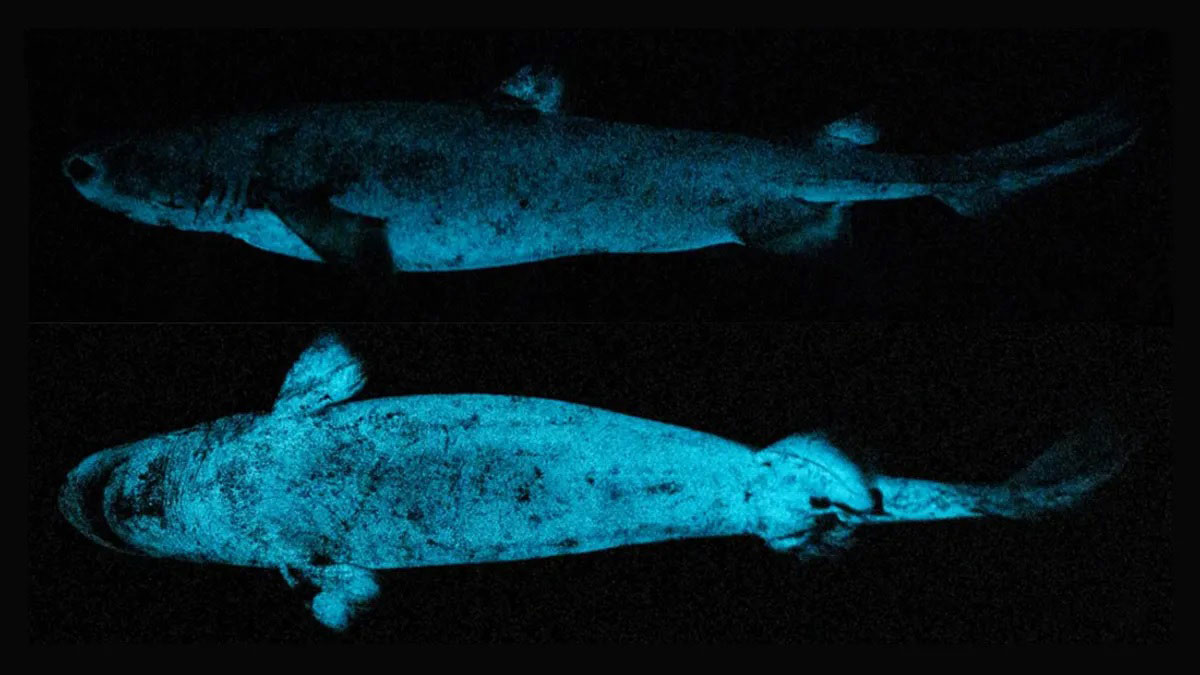
Many species thriving in the ocean’s dark depths depend on bioluminescence to fend off threats or attract mates. For the kitefin shark, these light displays aid in hunting instead.
Camouflage offensive
The kitefin shark, scientifically known as Dalatias licha, is the largest luminescent vertebrate, growing up to about 5.9 feet long and weighing around 17.6 pounds as adults. Its belly, fins, and sides are adorned with millions of tiny light-producing organs called photophores, which emit a distinctive bluish glow.
While many deep-sea creatures use such luminescence to blend into their surroundings and evade predators, the kitefin shark turns this strategy on its head to ambush its prey, as evidenced by recent experiments.
In a study published in iScience, researchers utilized eight kitefin sharks that had been accidentally caught and placed them in dark tanks. By using various optical instruments, they precisely measured the light profile of the sharks’ skin and compared it with that of the surrounding waters where these sharks typically dwell, which is around 1,575 to 1,770 feet beneath the surface.
The results revealed that the light emitted by the sharks closely matched the intensity of sunlight reaching such depths. The observed wavelengths, leaning more towards green than dark blue, indicate that this optical camouflage is suited for waters with significant concentrations of suspended chlorophyll particles.

A matter of angle
This research also highlights the significance of the angle at which the kitefin sharks’ photophores emit light.
The authors of the study explain that for animals camouflaging for defensive reasons, emitted light usually disperses in all angular directions to evade predators. However, as the kitefin shark attacks from above, its vertical light emission effectively masks its silhouette.
The researchers assert that the new optical data support the “spotlight” hypothesis, where a broadly spread lateral brightness aids the kitefin shark in illuminating the area where its prey resides.
In 2021, two other bioluminescent shark species were discovered in New Zealand waters.