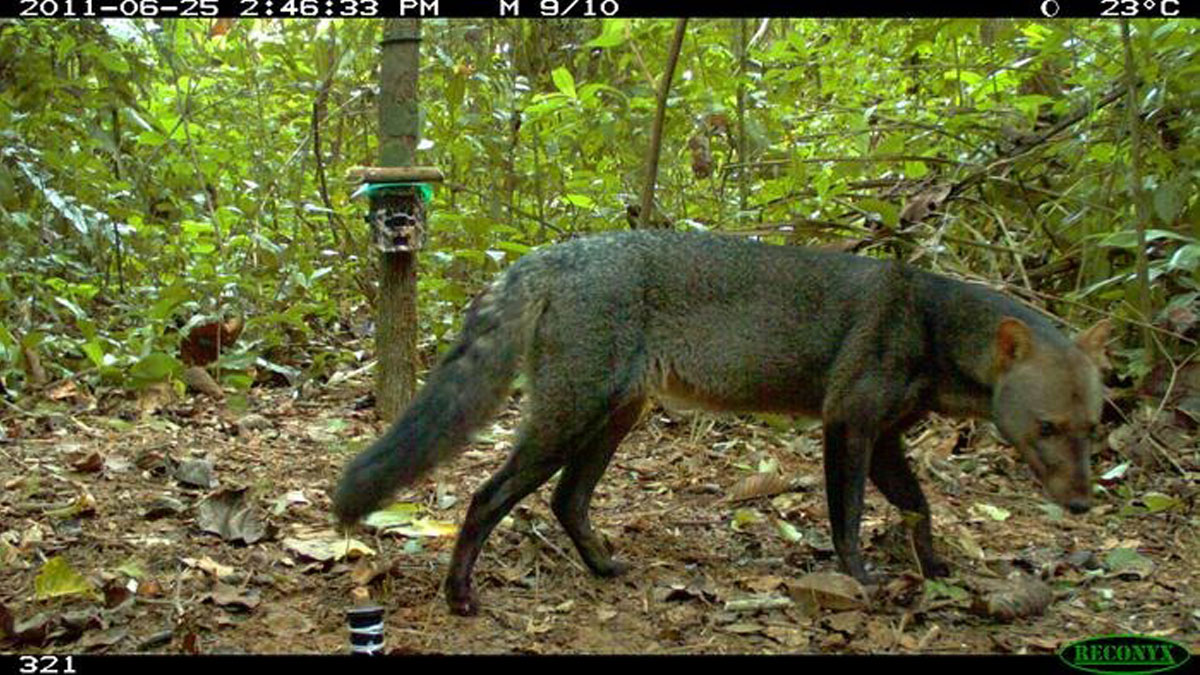
Thanks to an extensive network of camera traps, researchers from the Wildlife Conservation Society have gained unprecedented insights into a rather elusive Amazonian canid known as the “ghost dog.”
Atelocynus microtis
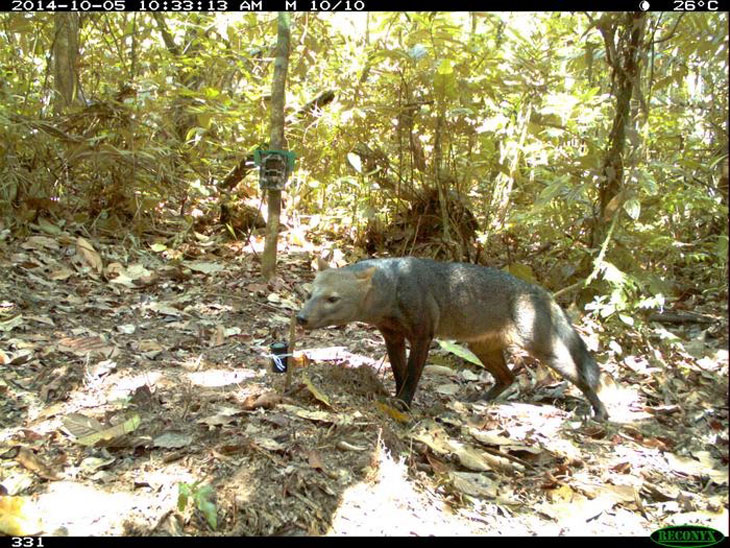
Initiated over 25 years ago, this long-term study has utilized dozens of cameras scattered across the wild plains of Bolivia and Peru, including the Grand Madidi-Tambopata and the Llanos de Moxos. The project has successfully captured nearly 600 images of the short-eared dog (Atelocynus microtis). Other predators identified in the area include jaguars and ocelots.
The authors of the recent study, published in the journal Neotropical Biology and Conservation, note that prior knowledge of this stout canid was very limited. Most information was derived from a handful of museum specimens and direct observations by experienced biologists.
Distinguished by its short, rounded ears, A. microtis has a relatively large head, reddish coat, and bushy tail. It is notably set apart from other Amazonian canids by its semi-webbed feet, an adaptation likely linked to its proficiency in swimming, enabling it to navigate through the waterways of its forested habitat.
The images captured over the decades indicate that this species primarily exhibits diurnal behavior, with peak activity between 6 AM and noon. Researchers suggest that their relative absence during dawn and dusk may be a strategy to avoid competition from nocturnal predators.
An unexpected range
The species’ distribution has also surprised researchers. While previously believed to be extremely rare, these recent observations suggest a density of about 15 individuals per 100 square kilometers, which is greater than some large Amazonian predators, including jaguars, in certain regions.
The lack of knowledge surrounding the bush dog can be attributed to the remote and wild nature of its habitats. This does not guarantee the species’ long-term survival, as it is currently considered near threatened by the International Union for Conservation of Nature.
The researchers assert, “Protecting the canopy of the Amazon rainforest through the establishment of protected areas, along with sustainable management of indigenous lands, is now essential.”
The “ghost dog” of the Amazon belongs to the American subtribe Cerdocyonina, which includes other wild canids like the crab-eating fox, which is not technically a fox, and the maned wolf.