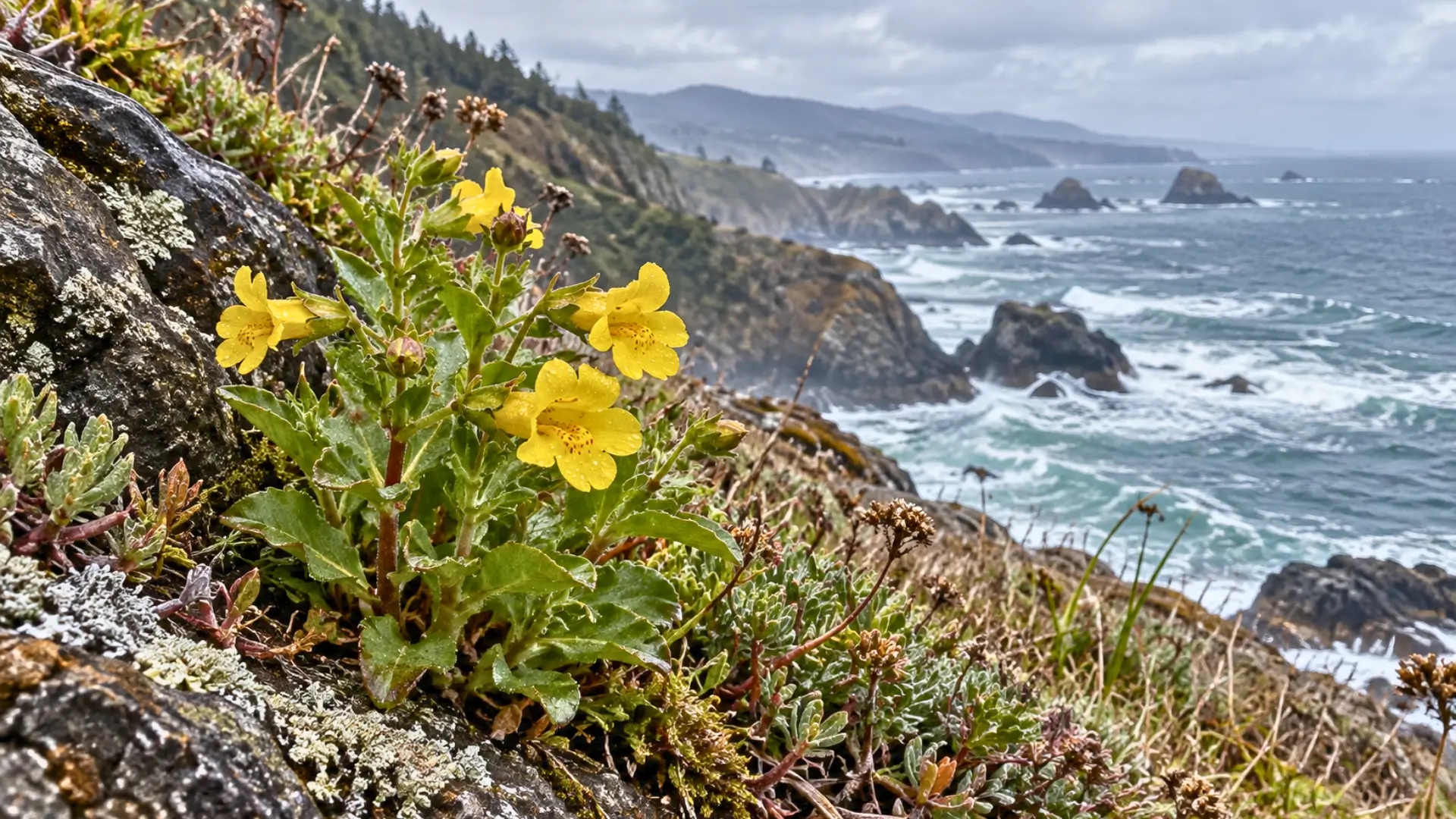
On the rugged cliffs along the Pacific coast, a delicate yellow flower thrives despite constant salty seawater exposure that can harm most plants. Researchers have uncovered that this resilience results from a complex set of defenses, activated much like a plant security system.
On the pacific cliffs, a seemingly fragile flower confronts an invisible enemy
The yellow mimulus may not look robust at first glance. This petite plant thrives along the Californian and Oregonian coasts, where winds continuously bring in salt-laden sea spray. For many other plants, these droplets can damage leaves, disrupt cells, and speed up dehydration.
This phenomenon raises questions. Populations of the same species found inland fare much worse with salt exposure. Biologists at Michigan State University decided to investigate the differences, comparing coastal and inland populations. Their findings, published in 2026 in the American Journal of Botany, reveal a more complex adaptation than anticipated.
When salty water lands on its leaves, mimulus almost shuts the door on sodium
To simulate oceanic stressors, scientists sprayed the plants with salty water, mirroring natural conditions. After exposure, inland leaves showed a sodium concentration 2.8 times higher than those of coastal leaves, pointing to a significant difference.
Coastal mimulus have developed a primary defense strategy. They restrict sodium entry after salt water settles on their leaves. Researchers analyzed the stomata and the leaf surfaces, observing how water interacts with them. However, the exact mechanism still requires further investigation.
Even when salt gets in, its tissues resist longer before succumbing
Next, researchers circumvented the initial barrier by cutting leaf fragments and subjecting them directly to sodium. The coastal populations demonstrated even greater resilience, with cells showing superior salt tolerance and delayed necrosis.
These findings were also published in the American Journal of Botany. This combination of attributes reshapes our understanding of the plant. The mimulus does not just possess “impermeable” leaves. It employs multiple levels of protection. It blocks some salt, retains more water, and limits damage, creating a layered defense strategy.
Even more surprising, the plant appears to have adjusted its timing to the ocean’s wrath
Another study unveiled a third tactic. Coastal populations tend to flower later in the season, timing their bloom for calmer weather. Spring brings stronger winds and more harmful sea spray, leading to reduced flowering and seed production.
Evolution has not only transformed the mimulus’s physiology; it seems to have also refined its reproductive timing. The plant avoids the harshest sprays, restricts sodium intake, and tolerates what remains. Three distinct adaptations answer a shared threat. This discovery extends beyond a mere flower of the Pacific.
The looming rise in sea levels and increased storm surges could heighten plant exposure to salt. Saltwater intrusion is already threatening certain agricultural soils. Understanding these defenses could aid in selecting more resilient crops. Researchers are now on the lookout for the genes responsible for these adaptations.