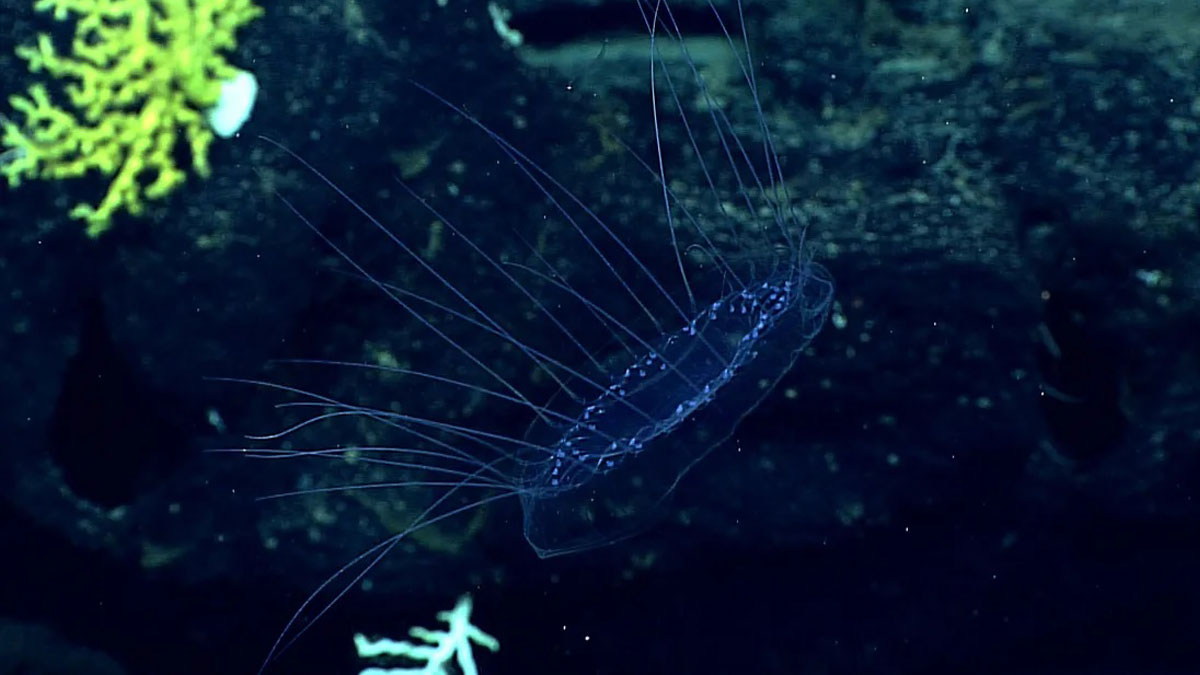
A recent series of dives off the coast of Southern California has uncovered fascinating new species of jelly-like invertebrates, including jellyfish and siphonophores.
Under the ocean
During a ten-day mission, the research vessel David Packard explored the Monterey Bay and the waters around the Channel Islands. The primary aim was to investigate life forms thriving thousands of meters deep in the “midnight zone,” a perpetually dark environment where pressures are hundreds of times greater than those at Earth’s surface.
To study this elusive fauna, teams from the Monterey Bay Aquarium Research Institute (MBARI) used a remotely operated vehicle equipped with a camera designed for minimal light conditions, capturing the dim bioluminescence emitted by these deep-sea creatures.
Meanwhile, each morning, divers in specialized suits collected ctenophores and other species living closer to the surface, while trawlers were employed to catch species that migrate deeper at night.
Among the spectacular creatures observed, as seen in the video below, were “blood-belly” and “plate” jellyfish, along with several species of ctenophores and a new siphonophore of the Erenna genus, which is closely related to jellyfish. According to the MBARI announcement, this siphonophore is notable for its intricate dangling structures that resemble tentacles.
Essential adaptations
With their absence of fragile organs, these gelatinous life forms can endure extreme pressures. Notably, many of the deep-sea jellyfish possess specialized enzymes that help them withstand remarkably cold temperatures.
On the other hand, the myriads shrimp found in the Gulf of California rely on a robust exoskeleton. They also lack eyes, which wouldn’t serve much purpose in the midnight zone.
Previously, a giant phantom jellyfish and nearly thirty new organisms were documented off the Atlantic coast of Argentina.