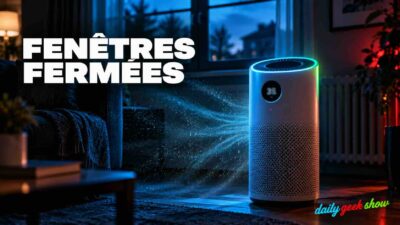
The Levoit Core 300S air purifier reacts quickly to changes in the environment, adapting to activities in your home while keeping the air clean.
The halo turned red when the cat jumped off the couch
No technical specifications can capture this subtlety. The Levoit Core 300S operates quietly in automatic mode, its ring glowing blue. But when the cat gets up, stretches, and leaps from the couch, the halo shifts to orange and the fan speeds up on its own. The built-in laser sensor is anything but passive.
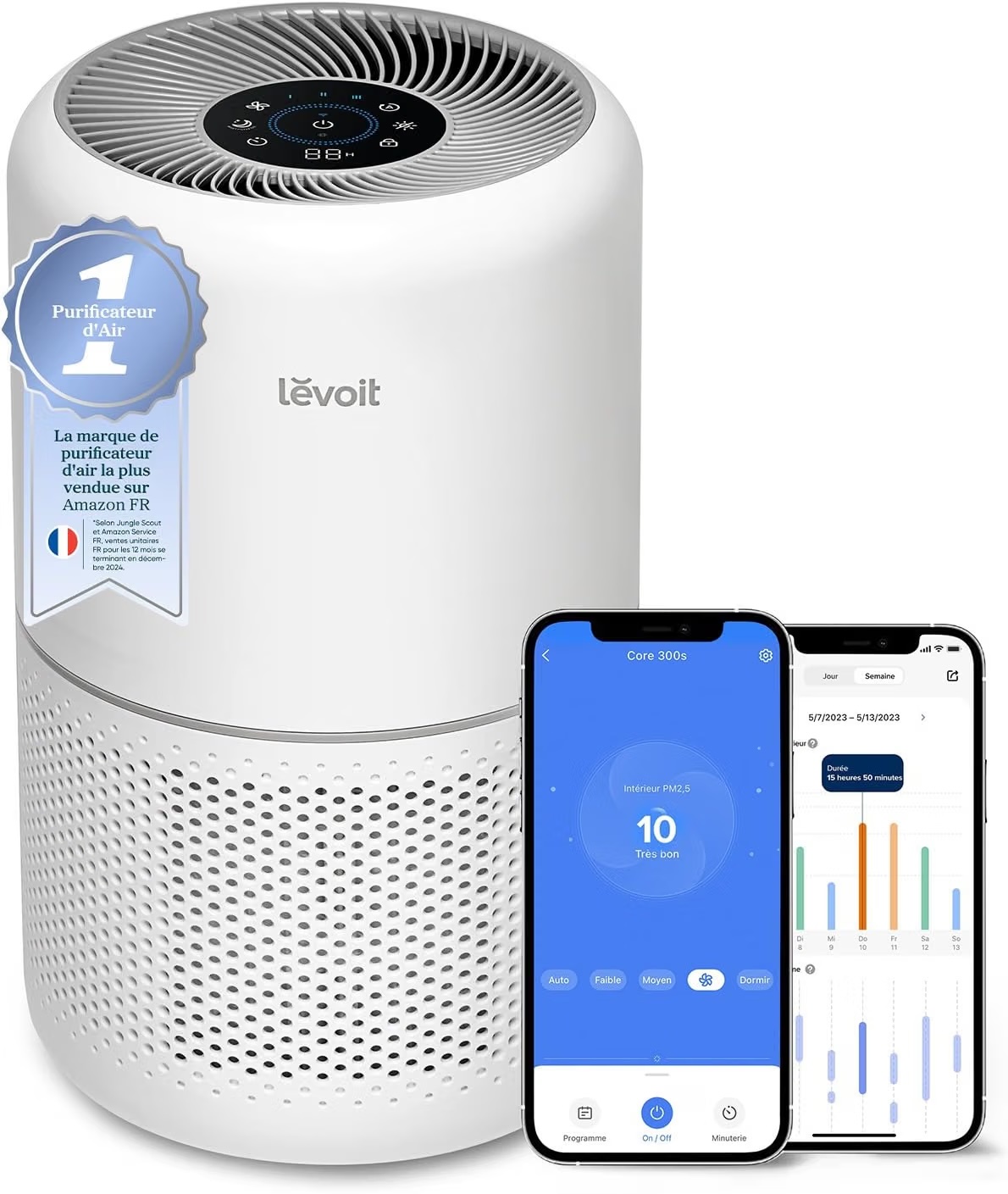
The Core 300S is a compact, connected air purifier from Levoit, a California brand under the VeSync group. It features three-stage mechanical filtration, a Clean Air Delivery Rate (CADR) of 240 m³/h, an integrated particle sensor, and the VeSync application, priced at €149.99 on Amazon as of September 7, 2026.
Full technical specifications
| Spec | Value |
| Model | Levoit Core 300S (ASIN Amazon FR B0FDL66FYH) |
| Filtration type | Three-stage mechanical filtration with a single cartridge: nylon pre-filter (hair, large dust particles) + HEPA H13 filter + activated carbon |
| Announced CADR | 240 m³/h (141 CFM) |
| Announced coverage area | Up to 50 m² (1 air change/hour) · 41 m² filtered in 12 minutes · about 20 m² at 4.8 air changes/hour |
| Sensor | Laser AirSight Plus, real-time PM2.5 measurement, displayed by a four-color halo |
| Modes | Standby, automatic, 3 manual speed settings |
| Announced noise level | 22 to 50 dB |
| Power | 2 W (standby) to 23 W (maximum speed) |
| Dimensions | 22 × 22 × 36 cm (manufacturer’s description) |
| Weight | 2.7 kg (manufacturer’s description) |
| Connectivity | Only 2.4 GHz Wi-Fi (no 5 GHz), VeSync app for iOS and Android, compatible with Amazon Alexa and Google Assistant |
| Physical controls | Touch panel on top, child lock, display off |
| Timer | 1 to 24 hours |
| Ozone | None – purely mechanical filtration, no ionization or photocatalysis |
| Certifications | ECARF (European allergy label), CE, RoHS, Energy Star, CARB, ETL, FCC |
| Replacement filter | Core 300-RF (ASIN B07RSZSYNC). Variants: anti-smoke (B09GM2198L), anti-animal allergens (B07RV1XLV4), antibacterial (B07RSZF32W) |
| Filter lifespan | 6 to 12 months as projected by Levoit · 6 to 8 months measured by independent labs |
| Filter price | Original Levoit two-pack compatible third parties noted at €29 (14.50 €/unit) on September 7, 2026 |
| Price at test | €149.99 new on Amazon France on September 7, 2026 · €107.51 refurbished on Amazon second-hand · starting at €91.05 from other sellers |
| Warranty | 2-year manufacturer warranty (2-year legal compliance warranty in France, cumulative) |
| Amazon FR rating at test | 4.4/5 from 450 reviews – 76% 5-star, 11% 1 and 2-star ratings |
Design and ergonomics
Unboxing takes just two minutes with no assembly required. The only important detail is marked by a sticker on the lid: the filter comes in a plastic bag that must be removed before the first use. It’s a common oversight, and failing to do so means the purifier could run uselessly for days.
Sporting a matte white cylinder that stands 36 cm tall and has a diameter of 22 cm, its size is comparable to that of a slightly taller office wastebasket. Next to a sofa, it blends in with the surroundings, lacking flashy chrome grills, constant blue LEDs, or ostentatious logos. In this regard, Levoit outshines many competitors in the same price range, which often lean toward an appliance aesthetic.
The touch panel on top consolidates all controls: power on/off, speed, auto mode, sleep mode, timer, child lock, and display off. The icons are backlit and completely disappear in sleep mode, which solves the annoyance of having an illuminated device in a bedroom.
The colorful halo around the base is an excellent design feature. With colors indicating air quality -blue, green, orange, red -you can easily see the status from across the room without reaching for your phone. This proves more helpful than the PM2.5 graph on the app.
However, there are a couple of ergonomic drawbacks. The molded handle on the back makes moving it from room to room easy, but the short power cord limits placement options. Levoit recommends leaving 38 cm of clearance around the device, which can be hard to achieve in a furnished living room, even though performance depends on it.
Everyday usage
Living room of 30m² with a cat, continuous automatic mode
This was the main test setup: four days of uninterrupted operation in automatic mode, with the unit placed on the floor 150 cm from the couch in a 30 m² room at 20°C, with windows opened for 60 minutes daily.
The purifier operates intermittently rather than continuously. In steady-state, it runs at speed 1, nearly silent. Speed increases correspond to identifiable events: the cat shaking off, jumping down from furniture, vacuuming, or closing a window in the evening after cooking. The sensor settles back to blue after a spike in activity.
As for cat hair, the nylon pre-filter noticeably fills up within a week in a household with a cat. It can be cleaned with a vacuum cleaner, which is crucial for maintaining the lifespan of the full cartridge, although this important detail is not mentioned on the product page.
Nighttime in the bedroom: sleep mode lives up to expectations, but the advertised figures don’t
This test was moved to a bedroom for 2 nights with sleep mode activated and the display turned off. The noise becomes a continuous soft hum that you stop noticing after a couple of minutes. The closest point of comparison is that of a laptop fan at rest from one meter away.
However, the stated 22 dB appears to be laboratory-derived, not reflective of real living room conditions. Independent testers report measurements ranging from 28 dB (Tom’s Guide) to 41 dB (AirPurifierFirst) in sleep mode, depending on measurement distance and room background noise.
A limit that isn’t found on any specifications: at speed 3, the Core 300S becomes quite loud. Independent recordings hit 60 dB or even 65 dB, which is similar to the noise level of a lively conversation. Nobody would let a purifier run at this intensity in an occupied space, meaning the 240 m³/h CADR applies to an impractical usage scenario.
Pollen season and respiratory allergies
The functionality that prompted the purchase. The Core 300S is ECARF certified, a label issued by the European Centre for Allergy Research Foundation in Berlin, which ensures an appliance measurably reduces airborne allergens for the stated coverage area. This certification is the only one displayed that holds value for European allergy sufferers.
Litter box and cooking odors: the real limitation
The activated carbon in the Core 300S is a thin layer integrated into the cartridge, rather than a block of granules. Regarding cooking odors, the purifier does show a slow but real effect: it takes about 10 minutes for the smell of a dish baked in the oven to fade, even at manually boosted speed 3.
As for litter box smells, it’s not a standalone solution. The technical reason lies in the AirSight Plus sensor, which only detects particles, not gases. A room can smell strong yet still register a blue halo. Levoit acknowledges this in a footnote on its own product page, recommending manual switching to high speed for odors. To put it bluntly, the automatic mode is ineffective for this issue.
Users on Amazon France have noted a significant effect on odors from both litter and cooking, likely due to room size and the speed used: in smaller spaces at high speed, the carbon works fine; in an open living area on auto mode, it doesn’t.
VeSync application and actual power consumption
Connecting requires the VeSync application and a 2.4 GHz Wi-Fi network; unified dual-band routers can cause issues, sometimes necessitating a temporary separation of bands. One Belgian user reported a laborious yet successful pairing process.
Once connected, the app provides PM2.5 history, remaining filter lifespan, scheduling, and remote control. It’s functional yet basic: it lacks VOC measurements, data export, and has an interface that frequently promotes Levoit offers. The device remains fully operable without the app, which is commendable.
On the consumption side, independent measurements show 1.1 W in standby, 3.8 W in night mode, 6 W at speed 1, 10.4 W at speed 2, and 21 to 23 W at speed 3. In regular use on automatic mode, largely at speed 1, expect about 8 W average, which translates to approximately 70 kWh annually. At the regulated blue EDF rate (0.2001 €/kWh as of August 2026), that’s around €14 per year. The worst-case scenario, running at speed 3 continuously, peaks around €40 annually.
What others are saying
The Core 300S has been tested extensively, mainly in English. French-speaking reviews are shorter and seldom provide detailed figures, making this test significant.
Consensus among independent laboratories focuses on three points. Performance on particles is confirmed: HouseFresh found a measured CADR of 126 CFM for smoke, 134 CFM for dust, and 154 CFM for pollen, with PM1 levels returning to zero in a 20 m³ room within 45 minutes. AirPurifierFirst notes a 94% improvement in air quality in an 18 m² room, with PM2.5 levels dropping from 106 to 6.7 µg/m³. The unit’s energy efficiency is also widely acknowledged, consuming 1.6 times less power than the non-connected Core 300 model while delivering superior performance.
The most significant divergence concerns noise levels. While Levoit claims 22 to 50 dB, testing shows results ranging from 38.9 to 54.5 dB(A) for RTINGS, 41.4 to 65.2 dB(A) for AirPurifierFirst, and 28 to 60 dB for Tom’s Guide. The discrepancies arise from varying protocols, including microphone distance, room background noise, and A-weighting adjustments. Understand the trends rather than fixate on absolute figures: quiet in sleep and speed 1, loud in speed 3 across all testers.
Customer reviews provide insights that professional tests may miss, particularly regarding effectiveness against smoke odors. Several users from France and Belgium have reported success with the device during the summer 2026 wildfires, noting a marked improvement in indoor burnt smells. Conversely, a well-thought-out criticism among negative reviews centers on perceived sensor reliability and the filter replacement indicator, suspected of just being a time counter rather than a true clogging measurement. This concern is valid: it is indeed just a timer.
Who is this purifier for?
The right choice: for allergy sufferers living in a 20 to 40 m² apartment with a pet, seeking a discreet device that operates continuously without thought, and who sleep in the same or adjacent room. The combination of automatic sensing, quiet sleep mode, and an average consumption of 8 W matches this profile perfectly. The ECARF certification is the true selling point here, more so than the CADR.
Compatible with reservations: for households primarily concerned with odor control from litter, cooking, or smoke. The Core 300S does manage this at high speed in a closed, limited-volume room, but the automatic mode will fall short since the sensor cannot detect gases. Manual intervention will be necessary. The same caution applies to large open spaces: the announced 50 m² only equates to one air change per hour, which is inadequate for someone with allergies. Target 25 to 30 m² instead.
The wrong choice: for those looking for a whisper-quiet unit at full power, VOC monitoring, or zero operational costs. With recorded levels reaching 60 dB in speed 3 and a cartridge needing to be changed once or twice a year, it doesn’t fit these criteria. Higher-priced options like Blueair or the Philips series 3000 provide substantial sound level reductions while maintaining equivalent airflow.
Safety, standards, and regulations
The Core 300S is a household electrical appliance: it bears the CE marking under the Low Voltage Directive 2014/35/EU and the Electromagnetic Compatibility Directive 2014/30/EU, as well as the DEEE pictogram for separate collection. It also claims compliance with RoHS regarding hazardous substances.
One important point to clarify concerns the opinion of ANSES on indoor air purifiers. The agency reviewed around 500 devices and concluded that their efficacy and safety are not demonstrated under real conditions. This opinion primarily targets so-called active technologies such as ozonation, ionization, cold plasma, and photocatalysis, which can generate by-products, including formaldehyde, potentially more problematic than the pollutants addressed.
The Core 300S does not fall into this category. Its filtration is entirely mechanical and ozone-free: air passes through a media, period. This distinction does not appear in alarming articles about purifiers, but it is crucial when making a choice.
Two public health principles apply regardless of the device used. A purifier cannot replace ventilation: opening windows remains the only way to eliminate CO₂ and some volatile compounds. Additionally, it does not address the source; a damp home, heavily laden carpets, or poorly placed litter boxes will continue to emit what the device works to filter.
Acknowledged weaknesses
For some, the recurring filter cost may be a dealbreaker. The cartridge is a monolithic block: pre-filter, HEPA, and activated carbon are all bound together, making it impossible to replace only the worn part. Expect to change one or two cartridges per year. A two-pack of compatible filters at €29 does mitigate costs, but third-party filters are not covered by the warranty, and the HEPA media’s quality is unverifiable. Over five years, replacing the consumable may exceed the initial purchase price of the device.
Noise at speed 3 can be a dealbreaker, depending on use. Noise levels can reach up to 60 dB. The claimed 240 m³/h performance is achieved only under conditions not typically used in occupied spaces. This reflects the common gap between the specification sheet and everyday life, which applies to the entire category.
The sensor genuinely only detects particles. There are no VOC measurements and no odor detection. Consequently, the automatic mode remains blind to a whole category of indoor pollutants: cleaning products, paints, new furniture, litter. Levoit states this but tucked it away in a footnote.
Inconsistencies in published data are evident. We see 850 g listed against 2.7 kg and diameters of 16.4 cm versus 22 cm on the same product page. This isn’t a flaw in the device, but a lack of rigor complicating purchasing comparisons.
Realistically, the filter replacement indicator is just a timer. It lights up at the same time whether you live in a Paris studio next to a busy road or a house in the countryside. Treat it as a reminder, not a diagnostic tool.
Minor: Wi-Fi limited to 2.4 GHz. While standard for this class of product, this limitation causes pairing failures with modern dual-band routers. Be prepared to temporarily separate bands if the connection fails.
Minor: short power cord and required clearance. Requiring 38 cm of free space around the unit may seem minor on paper but becomes problematic in a furnished living room. A longer cable would have been beneficial for flexibility.
FAQ
Is the Levoit Core 300S effective against cat hair and allergies?
Yes, for suspended particles: the pre-filter captures hair, the HEPA H13 filter traps dander and pollen. The device holds the ECARF certification, which signifies it effectively aids allergy sufferers. However, it does not handle litter odors in automatic mode, as its sensor detects only particles.
What space can the Levoit Core 300S truly cover?
Levoit claims 50 m², but that’s with just one air change per hour. For someone with allergies, target around 20 to 30 m², which corresponds to approximately five air changes per hour -the truly beneficial regime. Beyond this, you’ll need to ramp up the speed, resulting in increased noise.
Is the Levoit Core 300S silent at night?
Yes, in sleep mode. Levoit states 22 dB, while independent testers record levels from 28 to 41 dB, based on methodology. The practical result is a continuous hum that one stops noticing after two minutes with the display turned off. However, in speed 3, it rises to around 60 dB.
What is the cost of the Levoit Core 300S filter, and how often should it be changed?
The original Core 300-RF filters are sold individually, while two-packs of compatible filters go for around €29. Levoit suggests a lifespan of 6 to 12 months, but independent labs usually find it more around 6 to 8 months. Regularly vacuuming the pre-filter extends this lifespan significantly.
Does the Levoit Core 300S consume a lot of electricity?
No. It ranges from 3.8 W in night mode to 23 W at maximum speed. Under typical use in automatic mode, the average runs around 8 W, leading to about 70 kWh and €14 annually based on the regulated rate of 0.2001 €/kWh effective since August 2026.
Final verdict
Actual performance: 4/5. Independent measurements confirm the advertised CADR for particles, and the sensor’s real-world performance is convincing: it reacts to appropriate events without false triggers. The point deducted stems from the disconnect between the 240 m³/h figure from specifications and the realistically usable rate, along with the lack of effective treatment for gases and odors in automatic mode.
Design and ergonomics: 4.5/5. This is the product’s standout feature. Its discreet size, matte finish, and useful halo all contribute positively. Touch controls are complete with child-lock and display-off features. The half-point deduction is due to the short cable and 38 cm clearance requirement, which complicates installation in furnished rooms.
Value for money: 3.5/5. Priced at €149.99 for a CADR of 240 m³/h is reasonable, yet competition is narrowing the gap: the Xiaomi Smart Air Purifier 4 Compact shows 230 m³/h at €88.77, Philips series 600 drops to €115.36 with a lower CADR of 170 m³/h, and the Blueair Blue Pure 511i Max aligns at €145.69. Factor in consumables -one to two cartridges yearly -and the five-year operational cost doubles the initial purchase price. The score might be higher around €120, a level the unit frequently achieves during sales.
Durability: 3.5/5. Backed by a 2-year warranty, Levoit has been established since 2017 with robust European distribution and filter availability, even for specialized versions. Two caveats exist: the monolithic cartridge prohibits partial replacement and impacts environmental waste considerations, plus a filter indicator that essentially measures nothing. Build quality is adequate, meeting industry norms.
Ease of use: 5/5. There’s no assembly or configuration needed to start; the only potential issue is the plastic bag enclosing the filter. The automatic mode operates immediately upon powering on, and the device is entirely usable without the app, with the colored halo serving as an effective interface. This is the sort of appliance you install and forget about, which is precisely what you want from it.
Overall score: 4/5.
Recommended for those with respiratory allergies living with a pet in a 20 to 40 m² space while seeking a subtle device that runs permanently without drawing attention or increasing their electric bill. In this regard, the Core 300S meets expectations, with its ECARF certification being the only true value indicator for European allergy sufferers.
Advised against if your primary concern is odor rather than particles, if your space exceeds 40 m² significantly, or if you want maximum airflow for your expenditure. In these cases, there are more suitable options available, some of which are also more cost-effective.
One unresolved question remains -one that no purifier can answer: while such devices can improve indoor air quality, they cannot replace daily ventilation or manage the source of pollutants. There was a hope that the integrated activated carbon would do more to tackle day-to-day odors -a genuine disappointment considering the device excels in most other regards.