Spiders are often hailed as the masters of camouflage, and a newly discovered species takes this skill to another level by imitating a fearsome fungal parasite.
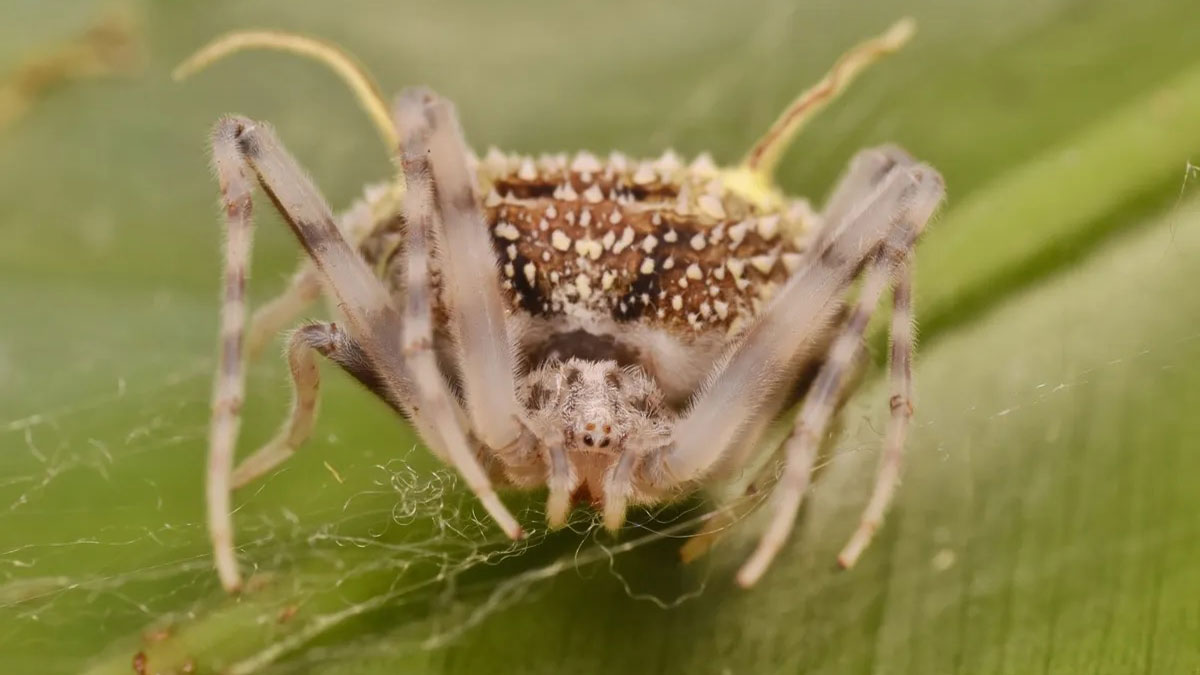
Taczanowskia waska
This remarkable ability was highlighted when scientists observed a specimen perfectly still beneath a leaf, initially believing it had fallen victim to Gibellula, a group of pathogenic fungi closely related to the infamous Cordyceps, the star of the video game The Last of Us.
These fungi infiltrate their hosts with their mycelium, a network of root-like filaments, growing within their tissues. Eventually, the infected spider develops small structures resembling antennae, which release spores that can infect other spiders.
Named Taczanowskia waska, this new species is found in the tropical forests of Ecuador. Its clever disguise likely aids in evading both predators and potential prey.
According to the authors of a study published in Zootaxa, “The pale coloration of the abdomen, sprinkled with small white spikes, perfectly mimics the mycelium of the fungus.” They further noted, “Its two tubercles, with a yellowish, cotton-like covering, closely resemble the stromata of Gibellula.”
Citizen science and international collaboration
The arachnid was first photographed by a participant on the online platform iNaturalist. A few specimens were later collected and compared to those from museum collections around the world. A close match was found with a specimen collected in Bolivia in 1903 and preserved in Germany.
The observation of similar attributes suggests that at least four other spider species, including two new to science, may be mimicking fungal infections with astonishing detail.
Previously, researchers had noted that certain Cyclosa spiders create “giant scarecrows,” helping them avoid a grim fate.