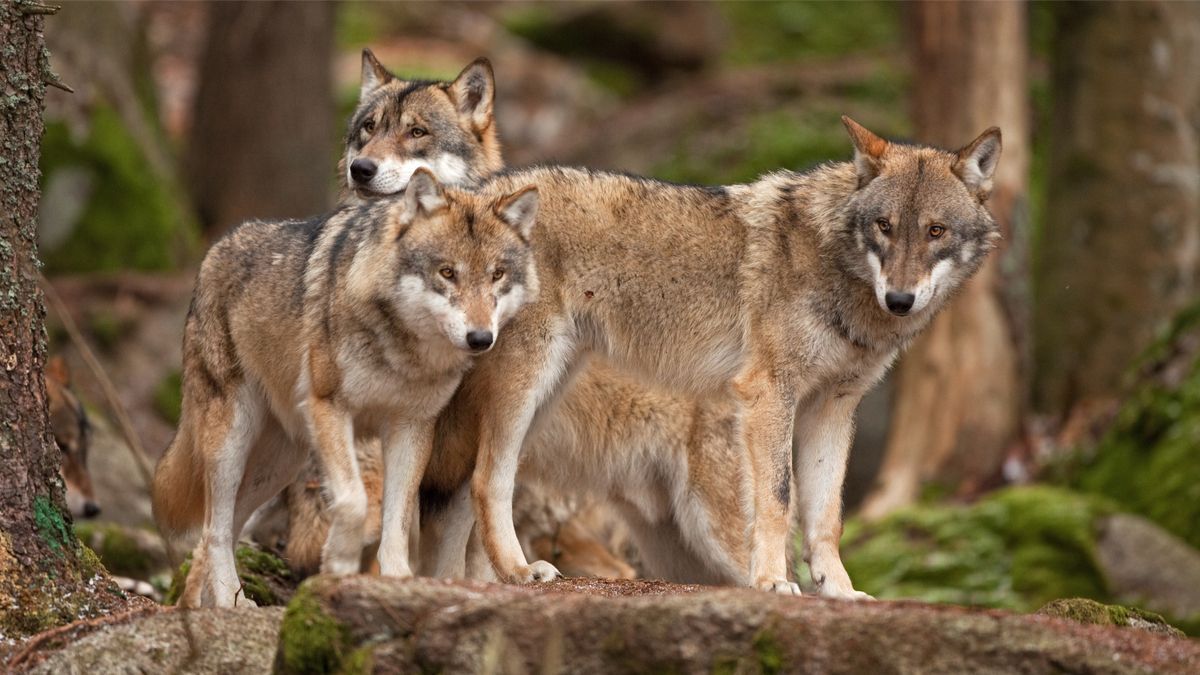
In Poland, trail cameras have captured surprising predatory behavior: a wolf pack attacking a bison, the largest land animal in Europe.
Rarely documented interactions
Weighing up to 900 kg, the European bison (Bison bonasus) was once widespread across the continent. However, excessive hunting and human expansion in the 19th century led to its extinction in the wild by the early 20th century. It wasn’t until the 1950s that reintroduction efforts began. Today, the estimated population stands at around 9,000 individuals.
Until recently, scientists had recorded only a handful of interactions between these large herbivores and the gray wolf, whose populations in Europe increased by approximately 58% from 2012 to 2022.
While reviewing footage from motion-sensor cameras in the Białowieża Forest -the birthplace of the bison’s reintroduction in Europe -Robin Wijnands from the Polish Academy of Sciences and his team documented an impressive attack in September 2025. In the early light of dawn, a group of seven daring wolves targeted a herd of 11 bison, including a newborn calf.
During a 20-minute assault, some wolves distracted the adult bison while others attacked the calf, biting it on the neck at least twice. Despite the bison forming a protective circle around the young one and successfully warding off the wolves multiple times, the footage did not reveal the fate of the calf.
Not necessarily bad news
Given the abundance of more accessible prey in Białowieża, the research team did not anticipate witnessing such predatory behavior. While this suggests bison are more frequently targeted by wolves than previously thought, it is not necessarily detrimental to the conservation of these large herbivores.
The study authors note that bison can damage crops and disrupt habitats of other declining wildlife species. “A higher frequency of such predation could even help stabilize their populations in Europe,” Wijnands suggests, as he plans to assess the potential ecological consequences of these observations.
It is also worth mentioning that in 2022, the United Kingdom welcomed European bison for the first time in 6,000 years.