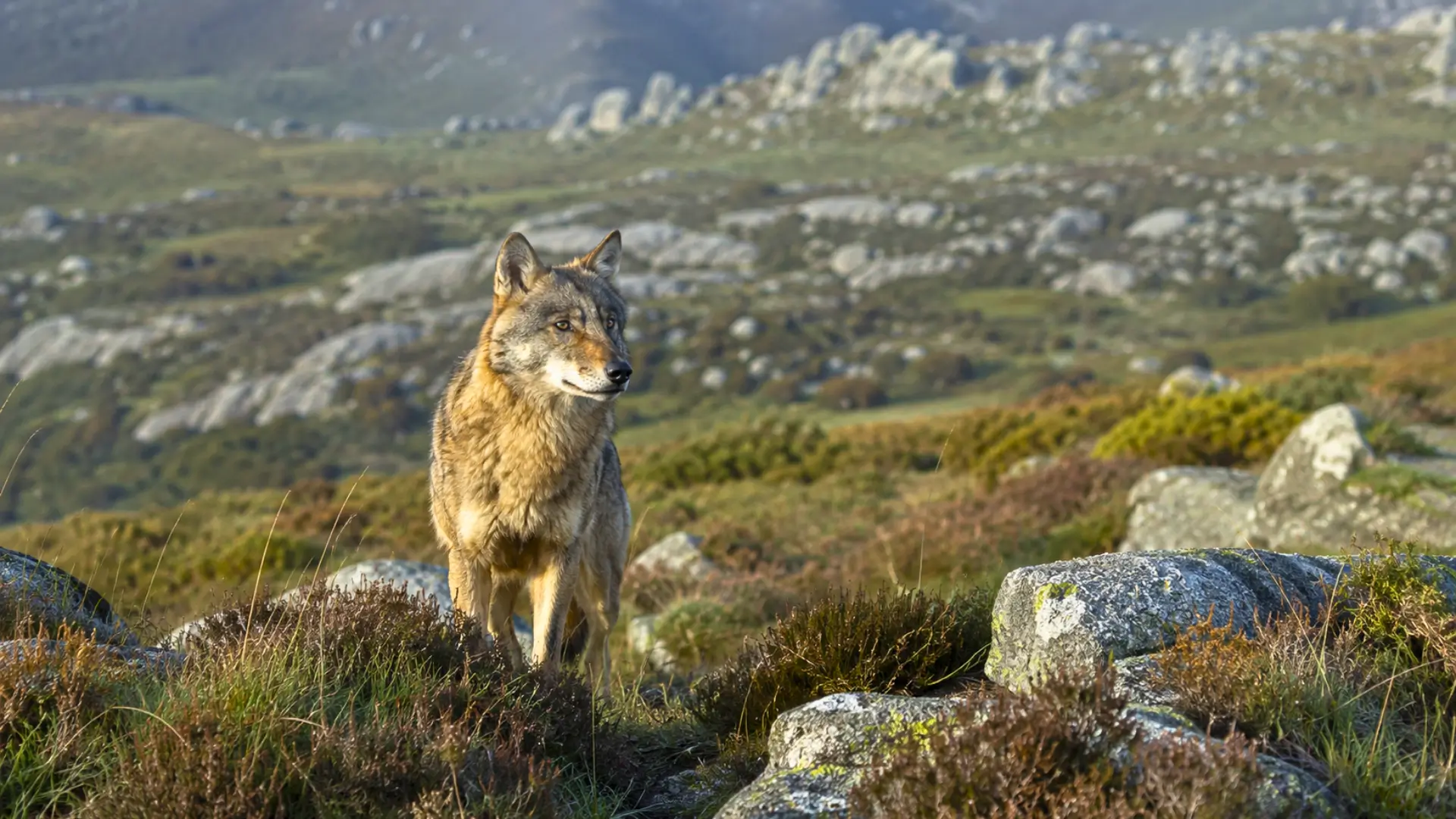
In the spring of 2022, a wolf emerged in the Arrée Mountains, surprising all who encountered it. This almost surreal moment unveils a broader story: a predator returning from Italy, quietly reshaping the wild landscape of France.
In Brittany, a wolf sighting signals a larger trend
The wolf, in the French imagination, belongs to forests of yesteryear and illustrations from the 19th century. When an individual was photographed in the Arrée Mountains in May 2022, the effect was almost cinematic. This scene not only astonished naturalists but also challenged long-held geographical beliefs.
Confirmed by government services and reported by the Regional Natural Park of Armorique, this event marked the first documented wolf sighting in Brittany in over a century. This detail transforms the narrative: it is not just a rumor or a misidentified large dog, but a wild animal reclaiming territory all the way to the tip of the peninsula.
Even more fascinating is what this sighting reveals without uttering a word. A young dispersing wolf can travel hundreds of kilometers in a matter of months, often much further. The wolf spotted in Brittany epitomizes a significant truth about recolonization: it does not follow expected geographical reliefs but extends into new territories.
From Mercantour to the western regions, the wolf’s presence reshapes France’s landscape
The story begins officially on November 5, 1992, when two wolves were identified in Mercantour after decades of absence. Initially, this seemed a localized and fragile phenomenon. Yet, in less than thirty years, the situation has transformed dramatically. The French Biodiversity Office currently estimates the population at 1,082 individuals by 2025, supported by 97 permanent presence zones, including 80 packs.
This impressive figure conveys more than mere numbers; it signals that the wolf is no longer a rare visitor in the Alps. It roams, establishes itself, and explores new territories. Now, observations are confirmed well beyond the southeast. The wolf is tracked as far as Hauts-de-France, Normandy, and Brittany. The map of the wolf increasingly resembles a network rather than a solitary alpine spot.
In newly affected areas, the wolf’s arrival disrupts farming practices
Consequently, this expansion fundamentally alters the discussions surrounding the wolf. In the alpine massifs, cohabitation with wolves has been an ongoing reality for years, complete with tensions, know-how, and necessary infrastructure. Conversely, in recently affected areas, farmers find themselves caught off guard. They often lack protection dogs, suitable fencing, or the habit of night vigilance.
Here, the abstract statistics turn into tangible realities. In Finistère, reports of livestock damage have been mounting since 2022, indicating that this Breton appearance was no mere anomaly. Nationally, the OFB highlights that by 2025, 87 percent of livestock attacks occurred in unprotected areas. Thus, the colonization front also represents a lack of preparedness.
In Aisne, Haute-Marne, and other northern departments, monitoring groups are proliferating. These groups track signs of wolf activity and anticipate the impact on farming. Wolves do not arrive alone; they bring with them expertise, administrative tensions, presence maps, and compensation issues. At the core remains a recurring question: are we ready to coexist with them?
The wolf’s return sparks significant changes in French rural areas
The wolf’s resurgence is not merely a charming tale of nature reclaiming its place. It actually reveals a transformed country. Populations of deer and wild boars provide ample prey. Simultaneously, some rural areas are becoming less populated or secluded. As human activity diminishes, tranquil corridors gradually reemerge, often without political intention.
This also reflects a reconnected Europe for large predators. The wolf genetically identified in Brittany in 2026 originated from a pack in the Hautes-Fagnes of Belgium, demonstrating that these flows extend beyond Italy. Moreover, this movement enhances genetic diversity, fostering a more interconnected and mobile European population that cannot easily be confined by old mental boundaries.
However, a significant fragility remains. A report from the MNHN, CNRS, and OFB, presented in September 2025, indicates that the wolf’s future also hinges on permitted culling and management practices. The species is advancing, but at a slower pace than before. The true surprise in the coming years might rest less in new sightings and more in the role that France chooses to afford this magnificent creature.