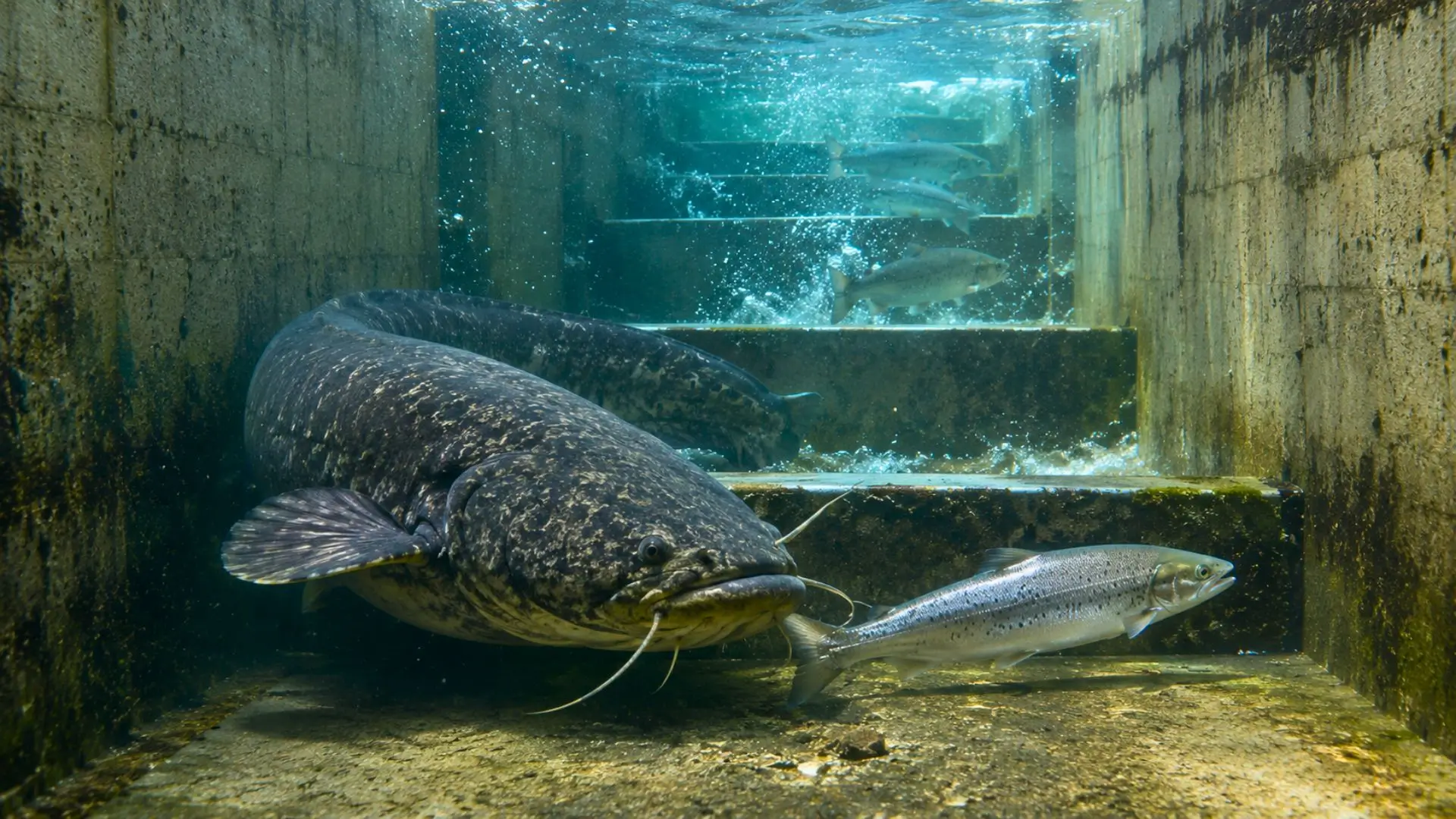
The fish ladder at Golfech was designed to protect the biodiversity of the Garonne River. However, it has turned into a deadly trap, with catfish employing ruthless hunting strategies that threaten critical migratory fish populations.
Catfish thrive in a perilous environment
In 1987, EDF inaugurated the Golfech fish pass to mitigate the ecological impact of a hydroelectric dam. Unfortunately, it has created a two-meter-wide bottleneck that severely restricts the escape routes for salmon, as revealed by a study in PLoS ONE. The extreme confinement makes it easy for catfish to launch their attacks.
Research from 2016 indicates that while predators outside of this narrow passage find it difficult to catch their prey, the predation rate inside escalates to 35 percent. This grim statistical reality turns what should be a challenging environment into a veritable banquet for the predators.
Behavioral adaptations of a formidable predator
Since they were first spotted in the structure in 1995, these catfish have gradually learned to navigate the fish pass and refined their hunting strategies. These long-lived fish have even developed the ability to swim upstream within the passage, intercepting migratory fish directly.
This adaptability is especially striking as it alters the species’ internal clock. While catfish are typically nocturnal hunters, many of these fish have begun to hunt during the day, between 8 a.m. and 5 p.m., aligning their activities with the migratory patterns of their prey. This temporal flexibility highlights their remarkable adaptive intelligence.
Physically, the size of the catfish also poses a barrier. Some individuals can reach lengths of 2.7 meters and weight up to 130 kilograms. Other species, like shad, are not spared either. In 2019, their attack rate exceeded 37 percent, and stomach analyses confirmed that shad make up a significant portion of the catfish’s spring diet.
Environmental pressure on endangered salmon populations
This predation pressure falls heavily on an already beleaguered salmon population. In New Aquitaine, the numbers fell by half by 2025, threatening the renewal of generations with fewer than 600 breeding individuals recorded. This historic decline is mirrored by a 70 percent habitat reduction since 1900.
The Loire salmon population, once thriving with up to 100,000 annual passages in the 19th century, has dwindled to fewer than 1,000 today. The losses at Golfech further compromise the resilience of these fish, while disruptions in oceanic cycles add pressure during their marine phase.
Navigating a human-altered ecosystem
Managing this ecological crisis pits various river users against one another. In 2024, a national council proposed banning the release of catches to help curb the catfish population. However, targeted removal efforts have yielded disappointing results.
Locally eradicating catfish has proven ineffective, as new predators quickly fill the void left by those removed. The core of the issue lies with the dam itself. The risks posed by global climate change exacerbate these structural anomalies.
Rising temperatures in the Garonne River favor the catfish, while cold-water species suffer. Additionally, an increasing mortality rate in the North Atlantic since 2024 has contributed to observed population declines. Thus, the future of migratory species hinges not only on local challenges but also on larger, more complex environmental factors.