
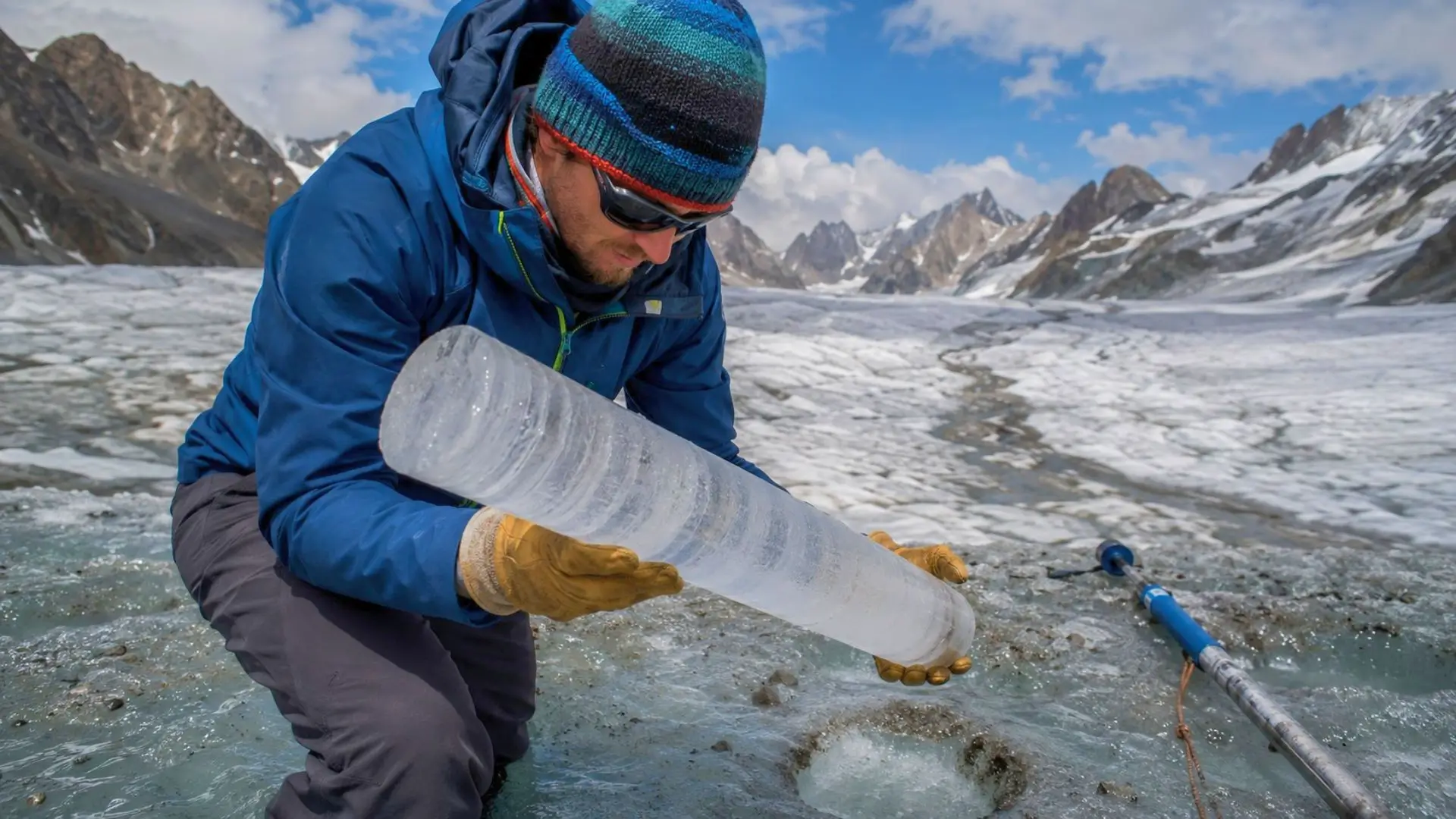
In the high mountain peaks, rapid warming threatens an invisible heritage.
How glaciers preserve the history of our atmosphere
Every winter, successive snowfalls accumulate on the peaks, transforming over time into dense ice under their own weight. This natural process captures tiny air bubbles from the atmosphere, creating a continuous and highly accurate record of historical weather patterns.
By analyzing the composition of these gas bubbles, climatologists can precisely measure historical greenhouse gas levels. Other trapped elements, such as volcanic ash or pollen, help reconstruct past temperatures and environmental disruptions.
In the Alps, these ice cores represent rich natural archives spanning thousands of years. They offer unique insights into Europe’s climate long before modern technology, serving as invaluable scientific references for researchers.
Why rising temperatures disrupt chemical signals in the ice
Rapid warming at high altitudes speeds up the surface melting of glaciers. The resulting liquid water seeps through the porous snow, trickling deep into the underlying layers. As it moves, this water dissolves and displaces the chemical elements deposited over millennia.
This phenomenon severely disrupts the chronological order of the data. Previously distinct time-related information begins to blur, complicating the task of interpreting the scientific samples. Scientists liken this disaster to ink dissolving on a precious ancient manuscript.
The race against time for glaciologists to preserve intact ice samples
To combat this inevitable degradation, research teams are undertaking high-altitude rescue expeditions. They extract long ice cores from the most exposed summits, frequently working under extreme weather conditions to secure these endangered archives.
Once collected, these precious samples must not melt. Scientists arrange for their rapid transport to ultra-secure storage facilities. Some initiatives aim to preserve these ice blocks in natural freezers located in the coldest polar regions.
This vast global ice library will enable future generations to study climatic history. Researchers of tomorrow will use much more advanced measurement tools than ours to extract new information from these preserved samples.
What is the real impact of these archives’ disappearance on future climate models?
The loss of this data directly hampers contemporary research. To anticipate future climate disruptions, scientists must understand how the Earth’s climate responded in the past. Without these precise historical benchmarks, the reliability of future projections is significantly weakened.
Beyond the technical loss, these ancient ice samples represented the last physical testament to a world unaltered by human activity. Their accelerated disappearance tragically illustrates the harsh reality of the environmental crisis by erasing tangible evidence of past climatic upheavals.



