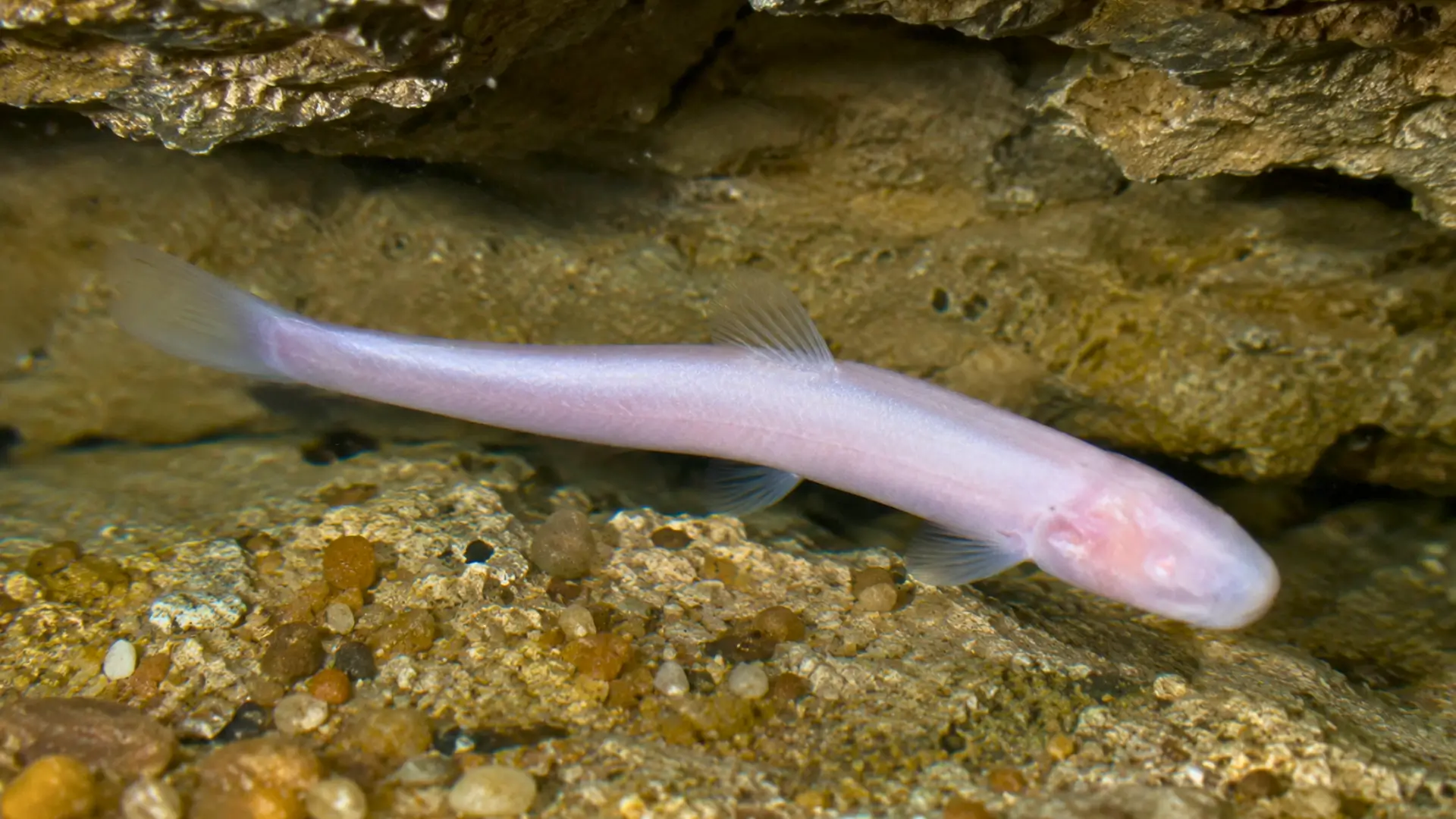
How could a completely unknown fish evade scientists for over forty years in a cave that has been regularly studied? Blind, almost translucent, and confined to a single underground network, this recently identified creature could be among the rarest vertebrates on the planet.
A cave under constant observation reveals an unknown fish
In February 2025, researchers revisited Bobcat Cave, located beneath the Redstone Arsenal near Huntsville, Alabama. Despite being well-known to biologists who have monitored the site for decades, this exploration took an unexpected turn when a pale shape darted through the beam of their flashlights, breaking the established routine of their work.
The fish resembled other cave-dwelling species previously identified in the area. However, several distinctive features caught the attention of Matthew Niemiller, a biologist at the University of Alabama in Huntsville. The unique shape of the head, fins, and body suggested an evolutionary narrative waiting to be uncovered in this lightless habitat.
Scientific analysis reveals a new cave species
Following this discovery, researchers returned to the cave to collect samples. They photographed the fish, took measurements, and conducted scans alongside in-depth genetic analyses. The findings exceeded their expectations: it was not merely a local variant but rather a new species, distinct enough to warrant the establishment of a new genus.
The name Demogorgonichthys arcanus raised some eyebrows. The term “Demogorgon” references a mythical creature popularized by Dungeons and Dragons and later by the series Stranger Things. The Latin term arcanus means “hidden,” aptly highlighting the long-standing concealment of this fish within its subterranean habitat.
Despite its somewhat alarming nickname, the demon fish exhibits no known aggressive behavior, nor does it possess any monstrous traits. Its pale body and absent eyes are simply results of remarkable adaptations to the complete darkness of its environment, where vision offers no advantage, leading evolution to favor other sensory strategies.
Two lineages of fish adapted to subterranean life coexist in the same cave
Further genetic analysis revealed a surprising twist. Demogorgonichthys arcanus shares its cave with Typhlichthys subterraneus, another cave fish. However, the two species are not closely related. They belong to different lineages and have evolved separately within the same underground ecosystem.
This finding reshapes our understanding of subterranean ecosystems. Caves are not simplistic, homogenous environments solely populated by “degraded” animals hindered by the absence of light. Instead, cave fishes are remarkable specialists, capable of detecting vibrations and water movements with astounding precision.
As of now, scientists have only observed this new species within Bobcat Cave. Its extremely limited range could make it one of the rarest fish in the world. Fortunately, the site is protected due to other threatened species, such as the Alabama cave shrimp, offering hope for its conservation.
A minuscule habitat threatened by surface changes
Nevertheless, this protection does not eliminate all risks. The health of subterranean waters is directly reliant on surface conditions. Urbanization and pollutants can quickly infiltrate these habitats. As Huntsville rapidly expands, ensuring the quality of the groundwater becomes crucial for these invisible yet vulnerable species.
The fish’s diet remains largely unexplored. Young individuals may consume small crustaceans, while adults likely eat any accessible prey. To learn more, researchers employ scanning technology to analyze their stomach contents, avoiding the dissection of such rare creatures.
Published in Scientific Reports, this discovery serves as a powerful reminder. Even in places studied for years, unexpected secrets continue to lurk. If a new lineage of fish can remain hidden for forty years in a well-known cave, how many other forms of life are still eluding our detection just beneath the surface of our world?