What if a leaf coated in dew is actually drinking? From giant sequoias to cultivated crops, scientists are uncovering that water can enter plants directly through their leaves, transforming our understanding of how they feed.
A long-held one-way view of water movement
The traditional understanding of how plants acquire water is deeply ingrained. Roots draw up water from the soil, vessels transport it upwards, and leaves release a portion back into the atmosphere. This simplistic model, widely taught in textbooks, overlooks a significant aspect of water transport that is far less recognized.
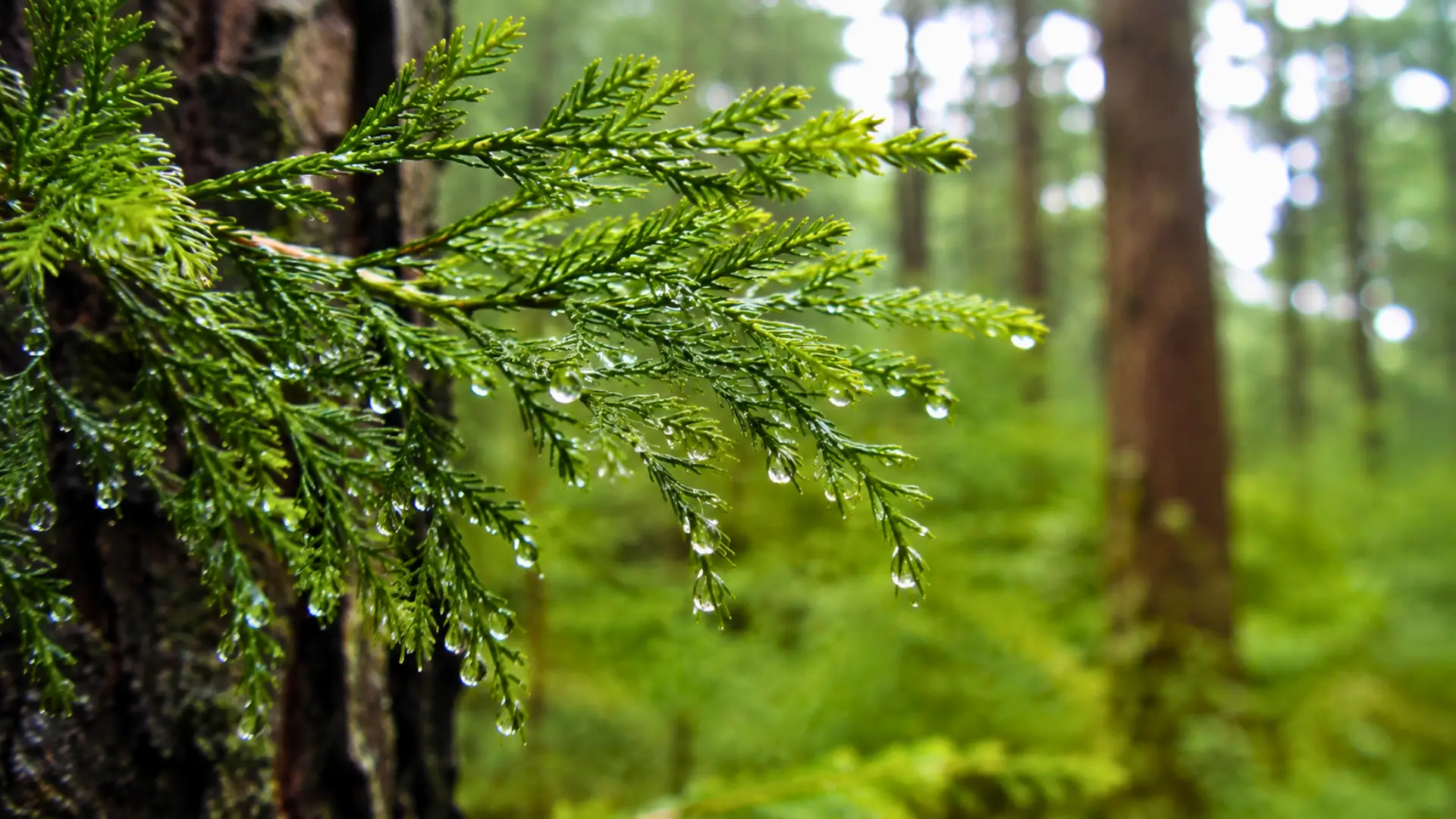
When fog, light rain, or dew coat the leaves, certain plants can absorb this moisture directly. This process, known as foliar absorption, has been documented across nearly all major plant families and in various ecosystems, as highlighted in a scientific review published in New Phytologist.
In the coastal sequoia forests of California, data is particularly striking. A study in Oecologia found that around 80 percent of dominant species were capable of soaking up water through their leaves, with moisture content increasing by 2 to 11 percent after exposure.
Microscopic entry points hidden beneath a drop of dew
A leaf is not simply an absorbing sponge. Its waxy cuticle serves as a barrier against water loss. However, it features specific openings. Depending on the species, water can enter through stomata, breach certain areas of the cuticle, or utilize specialized structures like trichomes and hydathodes.
Once water gains entry, it relies on other mechanisms for movement. Aquaporins, proteins embedded in cell membranes, play a critical role in facilitating water transport. Research has linked their activity to foliar absorption in specific plant species, meaning that what is often seen as a simple drop of water triggers an intricate hydraulic system on a microscopic level.
Sequoias displaying specialized water-absorbing leaves
Coastal sequoias offer even more fascinating insights. Researchers from UC Davis discovered that these trees possess two distinct types of leaves serving different functions. The outer leaves focus mainly on photosynthesis, while the axial leaves are much more adept at absorbing water that collects on the tree.
The efficiency of this process can be monumental among these giants. It is estimated that a large sequoia can absorb up to 14 gallons, roughly 53 liters, within the first hour of wet leaf surfaces. With some individuals boasting over 100 million leaves, the canopy acts as a colossal collection surface.
Fog additionally provides a key benefit. By moistening the air and reducing evaporative demand, it minimizes water loss through transpiration. In essence, conserved water can be as significant as water that is directly absorbed. Therefore, in these dry-summer forests, just a few hours of mist can dramatically shift the hydrological balance of the vegetation.
Implications for agricultural practices and crop resilience
This exceptional ability is not limited to remarkable trees. Recent studies have turned attention to agricultural plants as well. For example, with wheat, stomata partially remain open at night, and this nocturnal conductance can account for as much as 18 percent of daytime stomatal losses. Experiments using oxygen-18 isotopes have also indicated that water deposited at night can penetrate into the leaves.
This line of inquiry becomes especially pertinent in the context of increasing drought occurrences. Understanding which plants are most adept at capturing dew and fog could inform the selection of more resilient crops. However, this strategy hinges on atmospheric moisture levels. A critical question arises: what happens to plants that can “drink” from the sky when the sky no longer provides sufficient water?