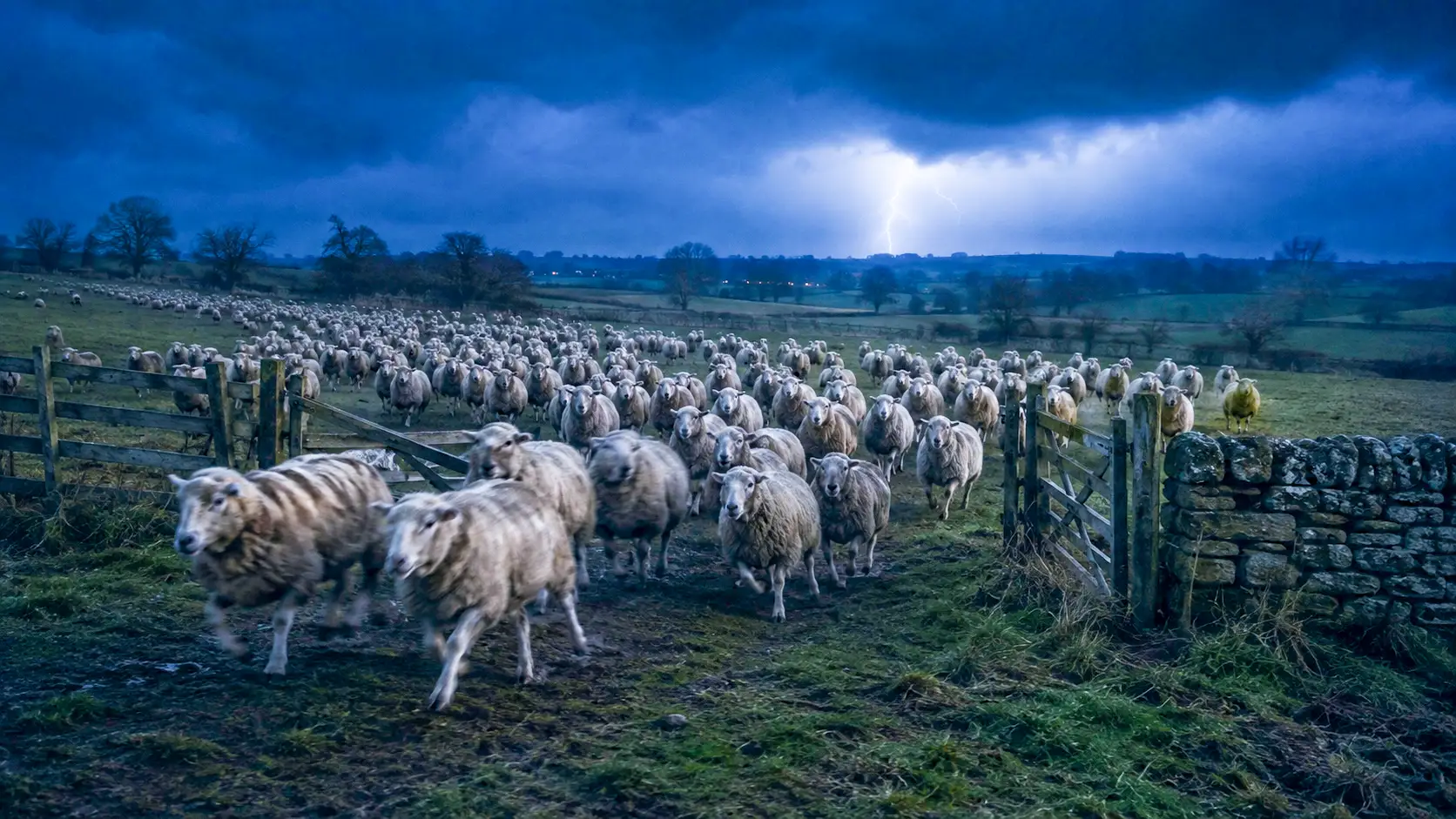
In the quiet countryside of Oxfordshire, an extraordinary mystery unfolded over a century ago, one that still captivates scientists today.
The night of the sheep panic in Oxfordshire
On November 3, 1888, around 8 PM, the tranquil Oxfordshire countryside erupted in chaos as tens of thousands of sheep began to run frantically. There was no visible predator to blame, and the exact cause of this sudden uproar remains unclear. The affected area spanned approximately 518 square kilometers of English countryside.
Weeks later, on November 20, the Times of London reported the incident, shedding light on the collective panic that had spread across the region surrounding Reading. This was not an isolated incident affecting a single flock but rather a widespread phenomenon impacting multiple farms.
Widespread destruction in the wake of panic
The aftermath of that fateful night was tangible. Overcome by an uncontrollable fear, the sheep broke through fences and trampled entire fields in their desperate flight. Many found themselves displaced, wandering aimlessly across the landscape, sometimes traveling several kilometers from their original enclosures. The Times described the night as heavily dark, with occasional flashes of lightning contributing to the confusion, but this partial explanation seemed insufficient for such a massive effect.
The recurrence of the phenomenon in 1893
This strange event could have faded into memory as a one-off incident, but in 1893, the same region experienced another wave of collective panic. This repetition caught the attention of ornithologist Oliver Vernon Aplin, who decided to investigate further.
Aplin quickly suspected that there was a recurring cause rather than just a coincidence. Witnesses from that night recalled an eerily dark cloud that enveloped the countryside, creating an unsettling sense of confinement. This detail would become central to Aplin’s later conclusions.
Aplin’s investigation and the lingering mystery
Aplin’s hypothesis delved into the intrinsic nature of sheep. According to the RSPCA, these animals lack defensive strategies apart from fleeing in groups. Introduced to the UK around 4000 BC, sheep have retained their flocking instinct for millennia.
In 1921, Nature published Aplin’s conclusions regarding this mystery. He proposed that particularly dark nights could disrupt the sheep’s nocturnal vision, causing them to collide and trigger a chain reaction of panic among the flock.
However, Aplin’s theory left one crucial question unanswered: how could mere darkness simultaneously affect sheep herds spread over such a wide area? More than a century later, the mystery continues to perplex time.