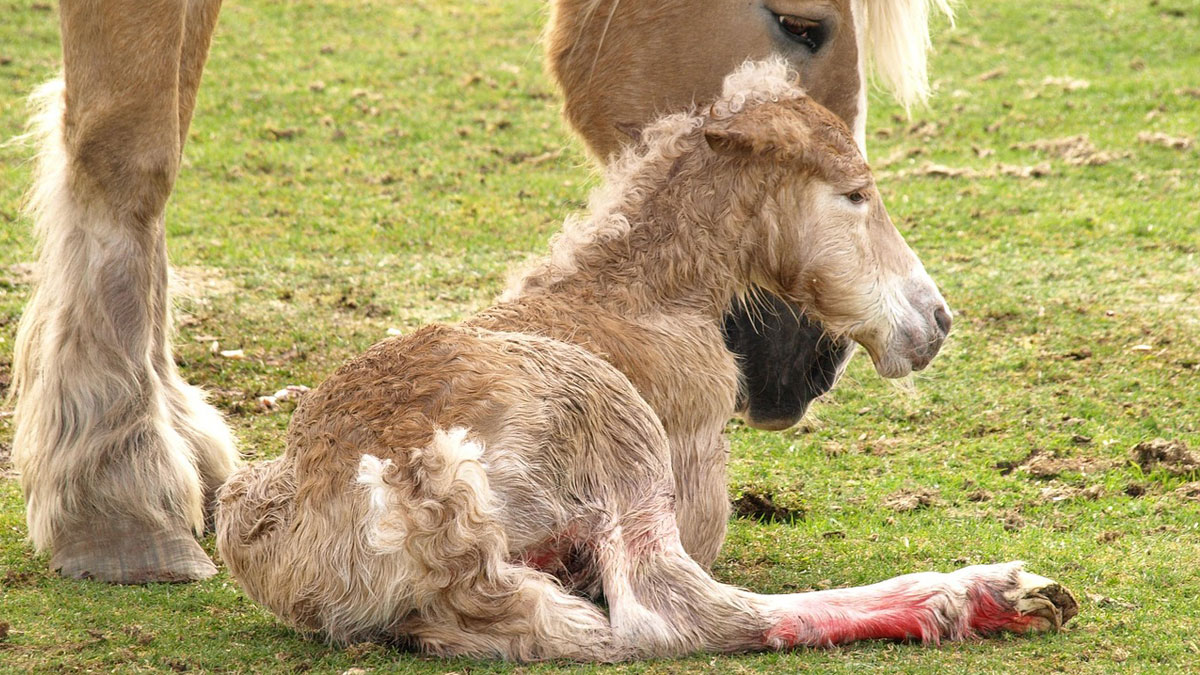
When foals are born, they exhibit peculiar soft structures beneath their hooves that serve to protect their mother’s tissues during gestation and delivery.
An essential protection
This temporary tissue, known as eponychium, is found in other ungulates such as cows, deer, and even rhinoceroses, but it is particularly well-developed in equines, where it is referred to as “slippers.”
During their time in the womb, these jelly-like membranes provide a crucial function. Once the foal is born, exposure to air causes this perioplic membrane to harden and retract, eventually forming a ridge similar to the skin band at the base of human nails.
Underneath the hoof, its intriguing fluffy appearance does not last long. As the foal rises to its feet and starts moving, these “fairy fingers” wear away quickly, revealing the underlying hardened part.
Newborn foals are born with what horse lovers call “fairy fingers” or “golden slippers.” The scientific name for these soft, rubbery coverings is eponychium. They form around the foal’s tiny hooves before birth, giving each foot a padded, cushion-like appearance.
These golden… pic.twitter.com/AxKgvdOtPS
– WindTalker (@nmlinguaphile) September 27, 2025
This covering fulfills a significant role during fetal development by protecting the uterine tissues from the foal’s hoof strikes. Additionally, during birth, it reduces the risk of damage to the birth canal.
An adaptation to avoid predators
The in utero development of hooves in herbivorous mammals is linked to their position in the food chain. Since birthing and the expulsion of the placenta can attract predators, it is vital for newborns, who are especially vulnerable, to be able to move around shortly after birth.
Although only one species of wild horse remains today, which nearly went extinct in the mid-20th century, these equids were once frequent prey for wolves, bears, and big cats.
Interestingly, horses also have peculiar growths on their limbs that are evolutionary remnants from their past.