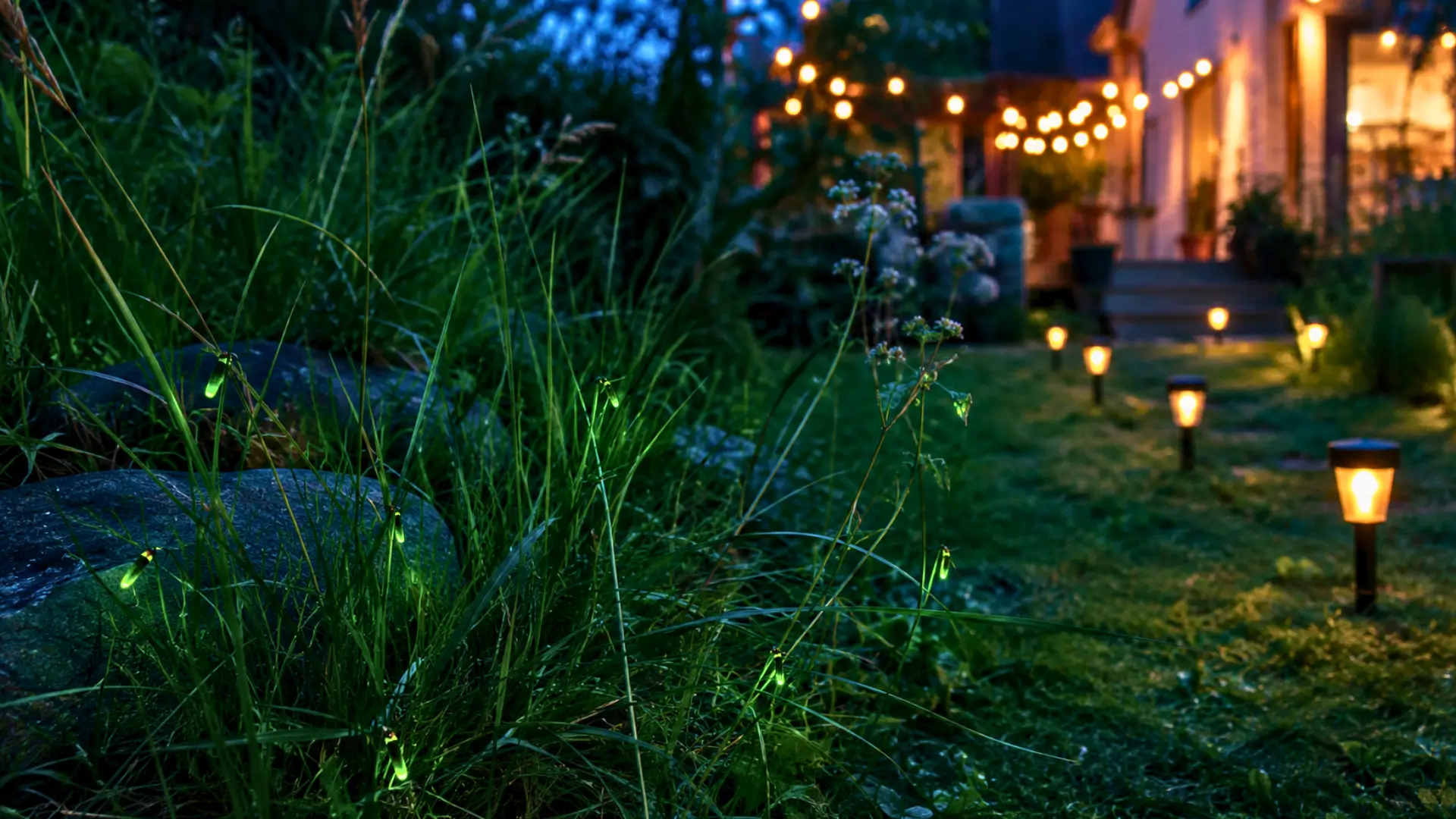
Every June, gardens light up with decorative lights meant to enhance the ambiance of evening gatherings. However, at the same time, another glow fades -a glow from fireflies. Intriguingly, this disappearance can sometimes occur just a few meters away from a terrace.
Firefly reproduction relies on near-total darkness
As soon as the first warm evenings arrive, a secret display begins. The female firefly climbs a stem, slope, or tall grass and emits a green glow that serves as a romantic signal. This delicate interaction depends on a narrow window of time, often confined to just a few nights of almost complete darkness.
This remarkable light is not a whimsical flourish but instead results from a precise chemical reaction involving luciferin and luciferase. These two molecules are central to the phenomenon of bioluminescence. In ideal conditions, this light communication occurs beautifully in the dark. However, it becomes muddled the moment artificial light intrudes.
The male firefly’s sole task is to detect this faint signal in the expansive night. Recent scientific studies indicate that even minimal levels of artificial nighttime lighting can hinder this search. Thus, it is not merely a nuisance; an entire courtship ritual can be delayed, diverted, or even thwarted.
Decorative solar lights confuse a vital signal
What is most striking is that the threat lacks overt signs. It does not come with sirens or blinding spotlights. Instead, it appears in the form of a solar lamp purchased for ambiance, a LED string light draped in the garden, or an automatic light left on near a flowerbed. This subtle danger is precisely the kind people often overlook.
For a long time, pesticides were in the spotlight, as firefly larvae feed on snails and slugs. However, today, the Firefly Observatory and various experts highlight light pollution as a major factor in their decline.
Even a small amount of artificial light can disrupt mating
What stands out in studies from recent years is the significant effect caused by light many would consider harmless. Research teams have found that males are less effective at locating females when they are subjected to artificial lighting. To an onlooker, the scene may look unchanged. However, the romantic message becomes nearly indecipherable for the insect.
The irony is palpable. Some garden lights are designed to create a firefly effect, as if nature inspired the product. Yet the decorative version ultimately distorts the living original. Furthermore, the more lighting leans toward a cold white or blue spectrum, the more biologists worry about its effects on the entire nocturnal ecosystem.
This issue extends beyond fireflies. Artificial light alters the movement, predation, feeding, and reproduction behaviors of countless insects. In France, the ANPCEN has long warned about the ongoing expansion of nighttime lighting. Consequently, what initially seemed a mere question of outdoor comfort has transformed into a serious ecological issue, even within private gardens.
Turning off lights and leaving nature alone can make a difference
The good news is that transforming a garden into a nature reserve is not necessary to take action. Simply turning off outdoor lights when they are not needed can restore a beneficial darkness. This is especially crucial between the late evening and midnight. For fireflies, just a few hours without illumination can make all the difference.
Another simple solution is to embrace a little natural disorder. For instance, a patch of taller grass, a less tidy hedge, or a corner left untrimmed can provide perches for females and a better habitat for larvae. A garden that may appear less manicured often becomes a more hospitable space, richer and more quietly alive.
For those who prefer some glow in their landscape, current recommendations lean towards warmer, dimmer lights that are better directed, with timers for automatic shut-off. Again, nothing drastic -just a reimagining of comfort. Ultimately, a question lingers on patios this summer: what is the purpose of decorative lighting if it dims the only light that truly matters?