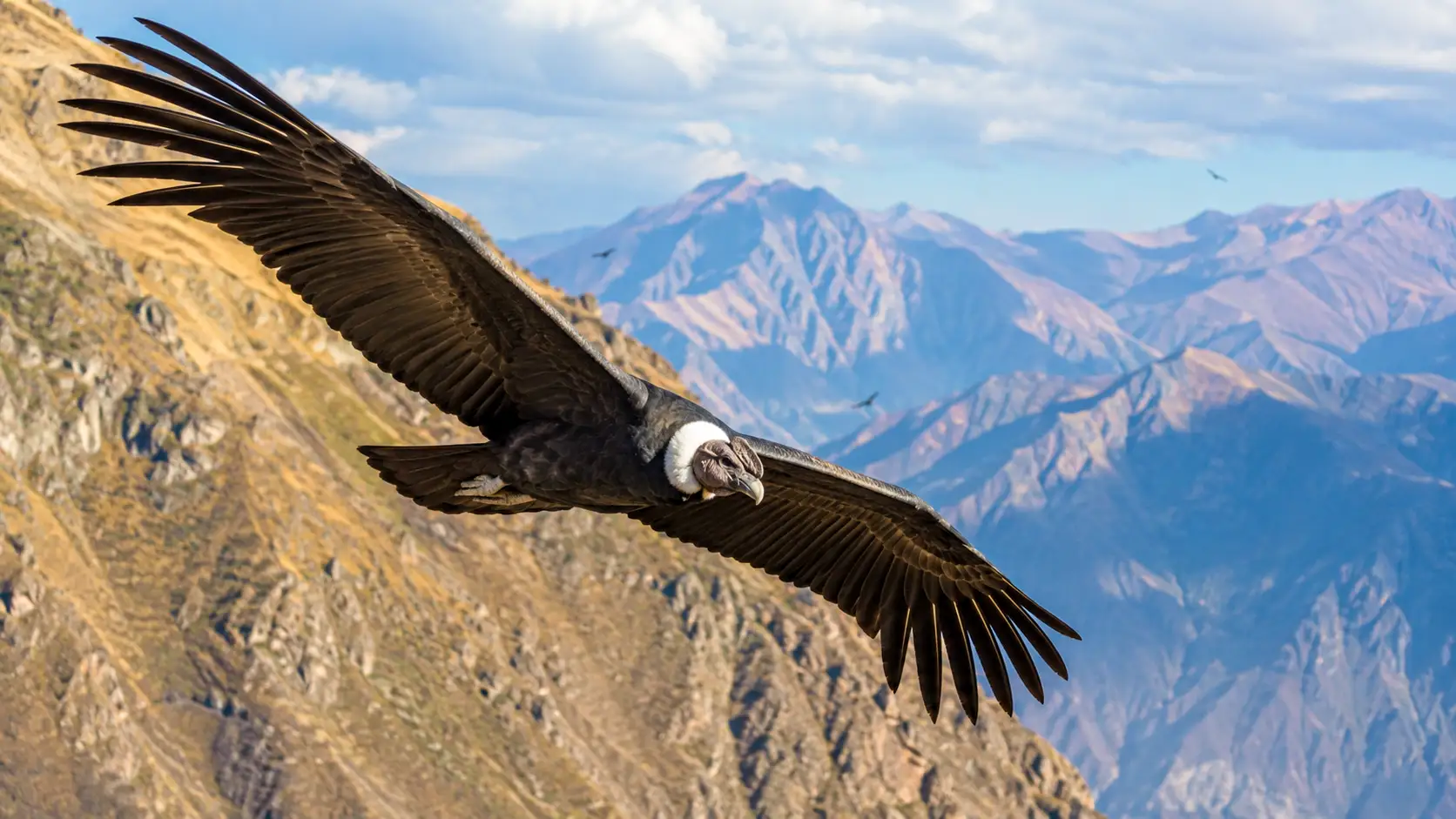
Sharing the skies proves to be incredibly advantageous for birds of prey. By carefully observing their group’s journeys, Andean condors optimize their daily movements. This aerial teamwork significantly reduces their physical exertion during food quests.
A major daily physical challenge for these giants of the sky
The Andean condor covers vast distances across the mountains every day. This magnificent bird is constantly on the hunt for carcasses to feed on, necessitating travel across steep terrains while conserving energy.
To save energy, the condor minimizes its wing flapping. Instead, it alternates between gliding and utilizing thermal updrafts -warm air masses that allow it to gain altitude quickly.
However, the positions of these thermal currents vary throughout the day, and food resources are scattered over large areas. Finding the ideal route requires continuous adaptation from the bird.
Researchers develop a computer model to analyze collective navigation strategies
To gain insights into these soaring behaviors, German scientists have created a customized computer model. This virtual tool accurately simulates the birds’ behaviors, taking into account their altitudes, speeds, and wind variations.
This study was recent published in the Journal of the Royal Society Interface. The research team analyzes the use of social information, comparing solitary flights to those coordinated within a group.
Energy expenditure reduced by up to 41 percent through collective scouting of air currents
The simulations reveal clear benefits for group travel. Observing fellow condors enables them to quickly locate thermal updrafts, allowing the birds to avoid calm zones and save considerable physical effort.
Maximum efficiency occurs when individuals adopt a moderate risk-taking strategy. In the most unstable areas, this approach can decrease energy expenditure by 41 percent, making shared flight extremely advantageous.
Thus, this visual cooperation extends beyond mere group maintenance. It represents a fundamental survival mechanism for these birds. In contrast, an isolated individual tires much more quickly against headwinds.
Biological laws of shared flight that could enhance drone and robot navigation
This groundbreaking model integrates aerodynamic principles with social behaviors. However, scientists aim to expand their research beyond just birds, intending to apply these equations to other animal species for validation.
Moreover, the findings hold direct relevance for the tech industry. The principle of information exchange could inspire the programming of autonomous drones, allowing these machines to operate with significantly reduced energy consumption during their missions.