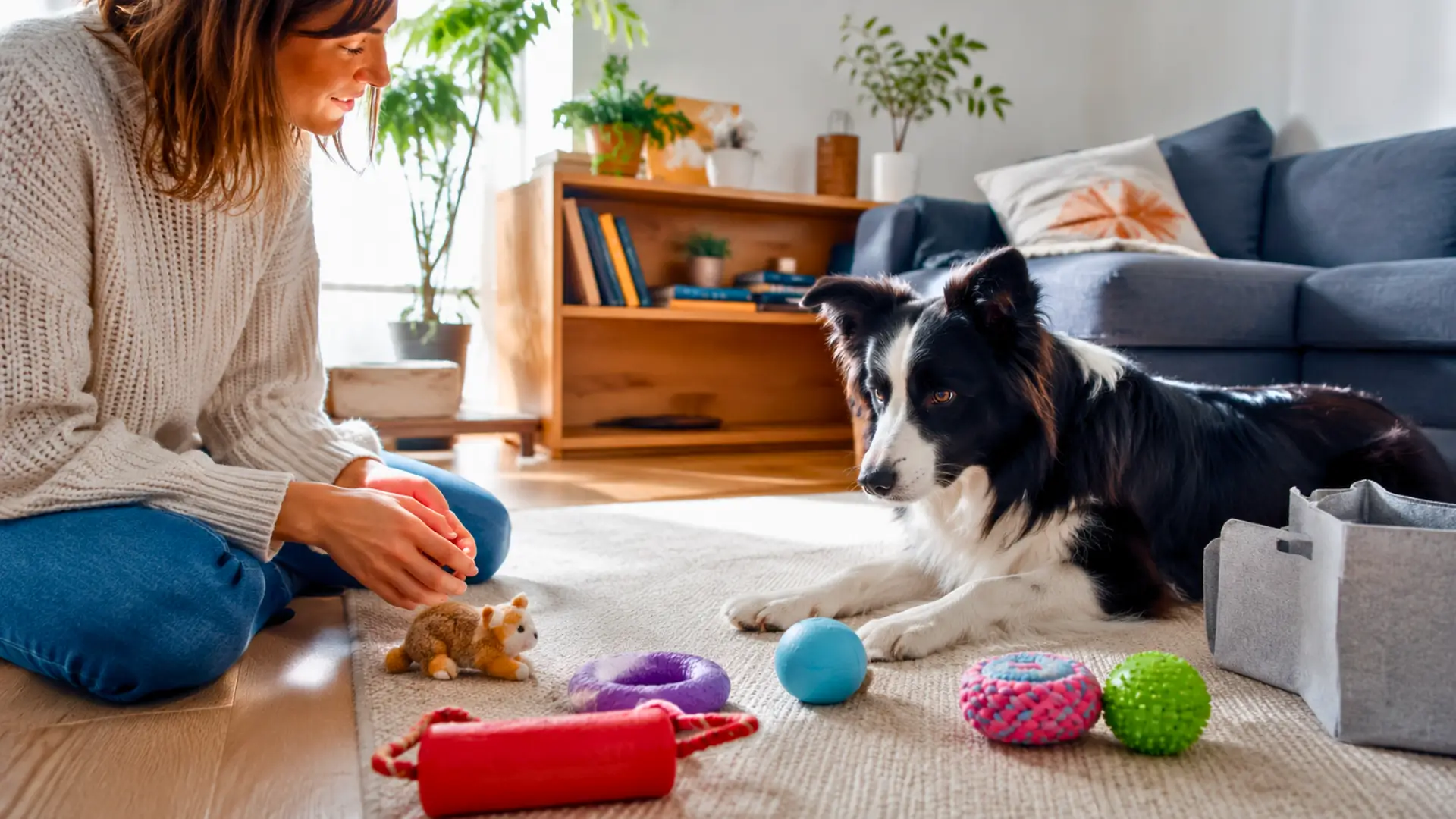
What if some dogs do more than just remember funny names? A study from Budapest shows that a few canine vocabulary champions can also understand how to use unfamiliar toys. This intriguing finding bridges language science, memory, and animal intelligence.
Seven remarkable dogs reveal a rare form of verbal understanding
For several years, researchers at Eötvös University have watched a small group of dogs capable of learning the names of numerous toys. These Gifted Word Learner dogs are exceptional among their peers, providing a unique opportunity to explore the cognitive abilities of our canine companions.
In 2025, the team led by Claudia Fugazza made a fascinating discovery. Over the course of a week filled with play, seven dogs were introduced to new toys without any formal training or repetitive exercises. The goal was straightforward: to see if they could remember objects. However, the results were much more surprising.
Not only did the dogs form associations between a word and an object, but they also demonstrated a remarkable ability to extend a verbal label to a previously unseen toy. They did this not based on resemblance, but on the action it was meant for. This nuance is significant in the field of animal cognition.
The dogs linked unknown objects to their function rather than appearance
This mechanism is one that develops early in human children. A cup is a cup, regardless of whether it is plastic, glass, or ceramic. What matters is the shared function. Observing a dog approaching a similar reasoning shifts the usual perspective. It indicates a level of categorization beyond mere obedience.
In the study published in Current Biology, the dogs had to distinguish toys associated with two specific functions, such as pulling or retrieving. Even when the objects varied greatly in shape, texture, or color, the dogs consistently chose correctly, suggesting that appearance was not the guiding factor.
This finding has intrigued researchers. It indicates that a dog can create a mental link between visually disparate objects, based on a common function. While this is not equivalent to human language, it goes beyond simple associative memory.
Vision, smell, and sensory memory illuminate how dogs categorize toys
This impressive accomplishment relies on more than just vocabulary. Previous studies suggest that dogs are influenced by spatial bias. Many will first notice the location of an object before focusing on the object itself. However, dogs with better visual acuity seem less constrained by this tendency.
Yet, vision is only one aspect of the puzzle. Dogs also utilize their sense of smell, texture, and accumulated play experiences. Researchers describe a multisensory memory that can integrate various cues at once. This sensory intelligence might enable a dog to instantly recognize what can be done with an unfamiliar toy.
Daily play with humans can lead to abstract learning
This spontaneous learning aspect is perhaps the most enticing part of this discovery. The dogs were not trained like laboratory animals. Instead, they learned in familiar settings, through ordinary play sessions with their owners. This highlights how spontaneous learning closely aligns with everyday experiences.
The findings are particularly striking given that only seven dogs were tested, suggesting caution in generalizing too broadly. Yet, the implications are profound. It suggests that some dogs might form practical concepts through social interaction, as if play becomes a subtle laboratory for understanding the world.
This avenue of inquiry is already catching the attention of applied research. Gaining a better understanding of how dogs generalize functions could inform dog training, assistance roles, and even certain research missions. Behind the many plush toys, one question lingers: how many animals comprehend more than we realize, simply because we do not ask the right questions?