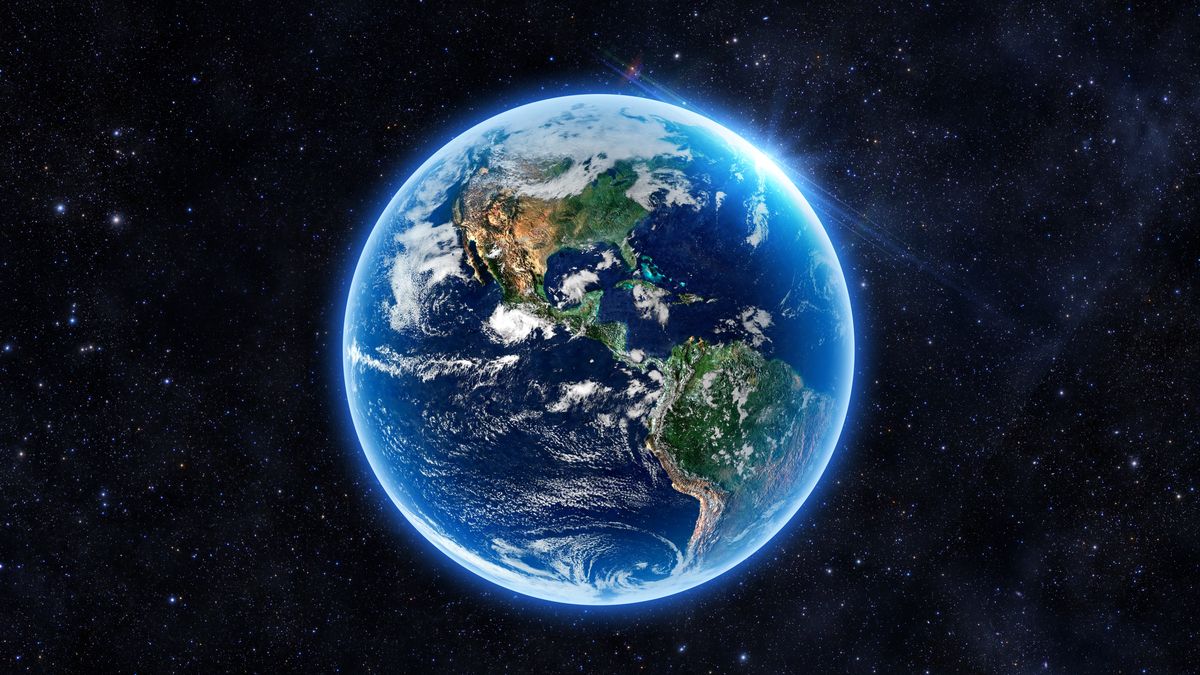
Recently, scientists have identified an invisible line that divides the Earth symmetrically, reflecting the same amount of light in both halves. This discovery, which traverses continents and poles, carries potential implications for climate change mitigation.
East-west symmetry
While it has long been established that the northern and southern hemispheres exhibit similar reflectivity, or albedo, Jianhao Zhang from the National Oceanic and Atmospheric Administration and his team have found a second symmetry line along the longitudes of 27° east and 153° west. Data from over twenty years of satellite observations reveal comparable and stable albedo values during clear and cloudy weather, as well as similar ice-free ocean surfaces in these regions.
Zhang reflects on their initial thoughts, stating, “Initially, we considered this a coincidence. However, the consistent nature of this east-west symmetry convinced us.” He further notes that “given the variability and dynamism of clouds, these similarities are far from trivial.”
Intrigued by how this symmetry line shifts annually, the researchers linked these changes to variations in Pacific sea surface temperatures associated with the El Niño–Southern Oscillation (ENSO), a major driver of global climate variability.
The authors of the study, published in the journal Nature, assert, “This is clearly not a geometric coincidence. ENSO could act as a large-scale adjustment mechanism, helping maintain the east-west symmetry around 27 degrees east longitude.”
Potential implications
Øivind Hodnebrog from the International Climate Research Centre in Oslo emphasizes the significance of this newly identified planetary feature and its potential influence on weather patterns. “Unlike its north-south counterpart, which appears to be weakening due to climate change’s effects on sea ice and clouds, the east-west symmetry remains stable,” he points out.
Understanding the mechanisms behind this symmetry could inform future efforts in solar geoengineering, particularly projects aimed at increasing the albedo of one hemisphere, which may interact with global feedback loops.
As an American researcher concludes, “Before we can advocate for geoengineering to curb climate change, it is crucial to understand how cloud cover, atmospheric circulation, precipitation, and Earth’s reflectivity interact.”
In related research, a prior study has highlighted a significant acceleration in the Pacific Ocean’s circulation over the past three decades.