
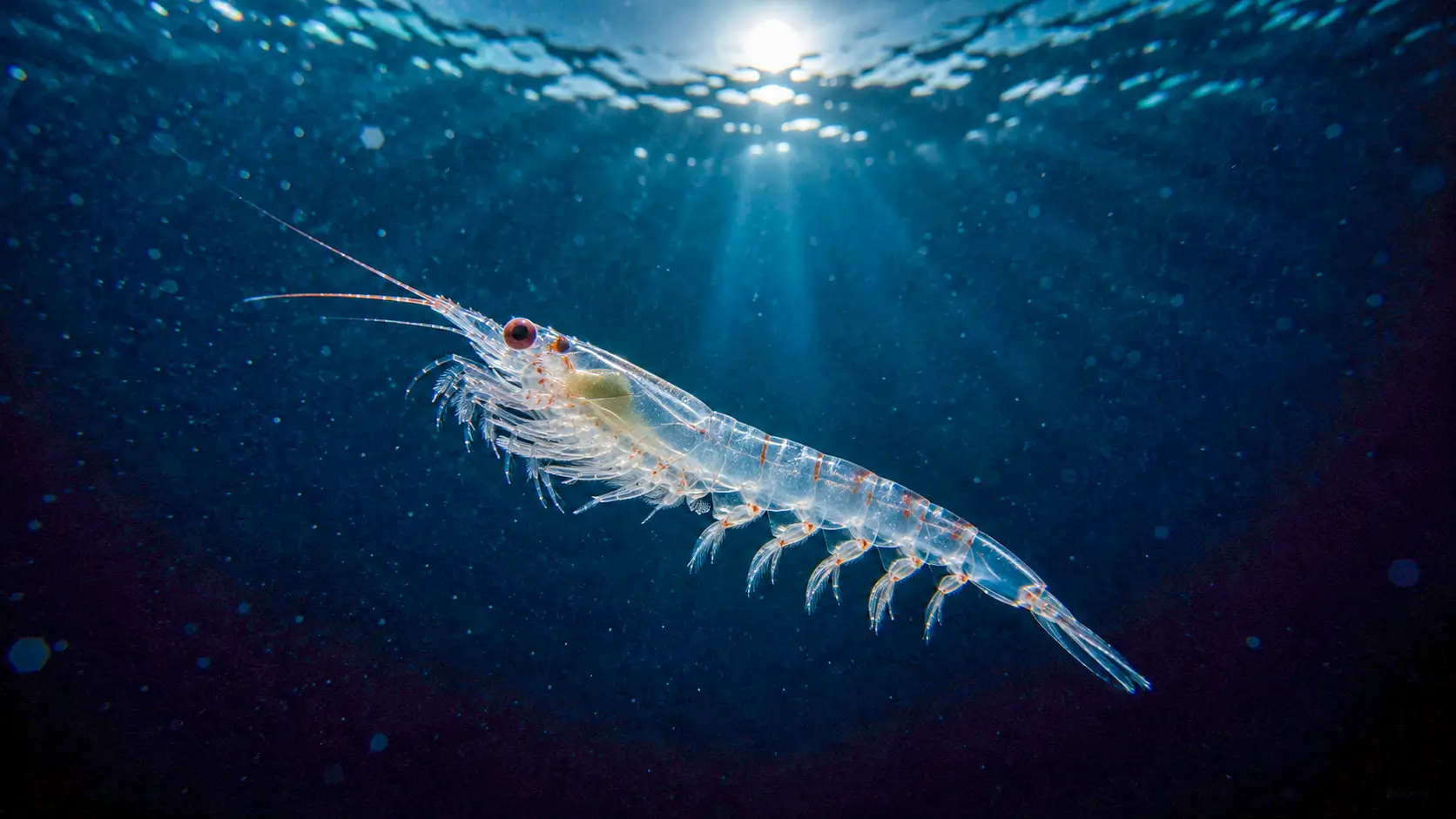
Every night, billions of tiny marine organisms rise to the ocean’s surface, only to dive back down at dawn. This vast and subtle movement plays a crucial role in transporting carbon to the depths and influences the planet’s climate balance.
The world’s largest animal migration occurs each night beneath the ocean’s surface
Each night, an enormous, almost invisible movement takes place in the ocean. Billions of microscopic organisms migrate from the depths to the surface waters, then return before dawn. This vertical migration surpasses any other known animal movement on Earth in terms of numbers.
During the day, these tiny creatures hide hundreds of meters below the surface, safe from predators that hunt by sight. At night, they ascend to feed on phytoplankton, the microscopic algae that thrive on sunlight’s energy.
This daily ebb and flow has been occurring for millions of years, acting like the ocean’s respiration, a rhythm that scientists are only beginning to quantify accurately.
How this nocturnal dance helps oceans sequester carbon from the atmosphere
This process is known as the biological carbon pump. By feeding at the surface, zooplankton absorb carbon present in the phytoplankton, which captures carbon dioxide dissolved in the water. As they descend, these organisms take this carbon into the deep ocean.
In the depths, this carbon is released back into the environment through respiration, excretion, or decomposition of the organisms. It becomes trapped far from the atmosphere for sometimes centuries, rather than returning to the air and exacerbating warming.
Scientists are finally able to quantify a phenomenon long difficult to measure
This phenomenon has been challenging to quantify accurately. While researchers knew it existed and suspected its importance, the actual scale remained unclear due to the lack of appropriate tools to observe vast ocean areas both day and night.
Advancements in observational and modeling techniques have changed the game. Scientists can now estimate with precision the amount of carbon exported to the deep ocean through this nighttime migration, an accuracy that was previously elusive.
This active transport, facilitated by the organisms’ movement, adds to the simple sinking of dead particles to the ocean floor. Therefore, zooplankton do not merely accompany carbon storage; they represent an essential pillar in this process.
Ocean warming threatens this fragile and poorly understood climate mechanism
Zooplankton are sensitive to environmental changes. Rising water temperatures, ocean acidification, and shifts in ocean currents could disrupt this rhythm established over millions of years, with direct repercussions on the climate.
A decline in these populations would weaken the biological carbon pump, reducing the ocean’s capacity to absorb carbon dioxide. Thus, the smallest links in the web of life turn out to be some of the most critical for maintaining climate balance.



