How can fertilizers spread hundreds of miles from the coast end up choking the sea? Beneath the calm waters of the Danube lies a spectacular chain reaction that fuels algae, depletes oxygen, and disrupts an entire ecosystem.
Where the journey begins far from the shore
It all starts in fields far from the beach. Nitrogen and phosphorus promote plant growth, but some of these nutrients escape the roots. With each rain, they flow into ditches, brooks, and rivers. Eventually, the Danube collects these nutrients from its vast watershed and transports them to the Black Sea.
This nutrient transport is not solely agricultural. Wastewater and various industrial activities also contribute to the nutrient influx. According to the International Commission for the Protection of the Danube River, the Danube remains the main river contributor to nutrient pollution in the Black Sea, even though the quantity of pollutants has significantly decreased from historical levels.
When the sea receives too much food, a life explosion leads to asphyxia
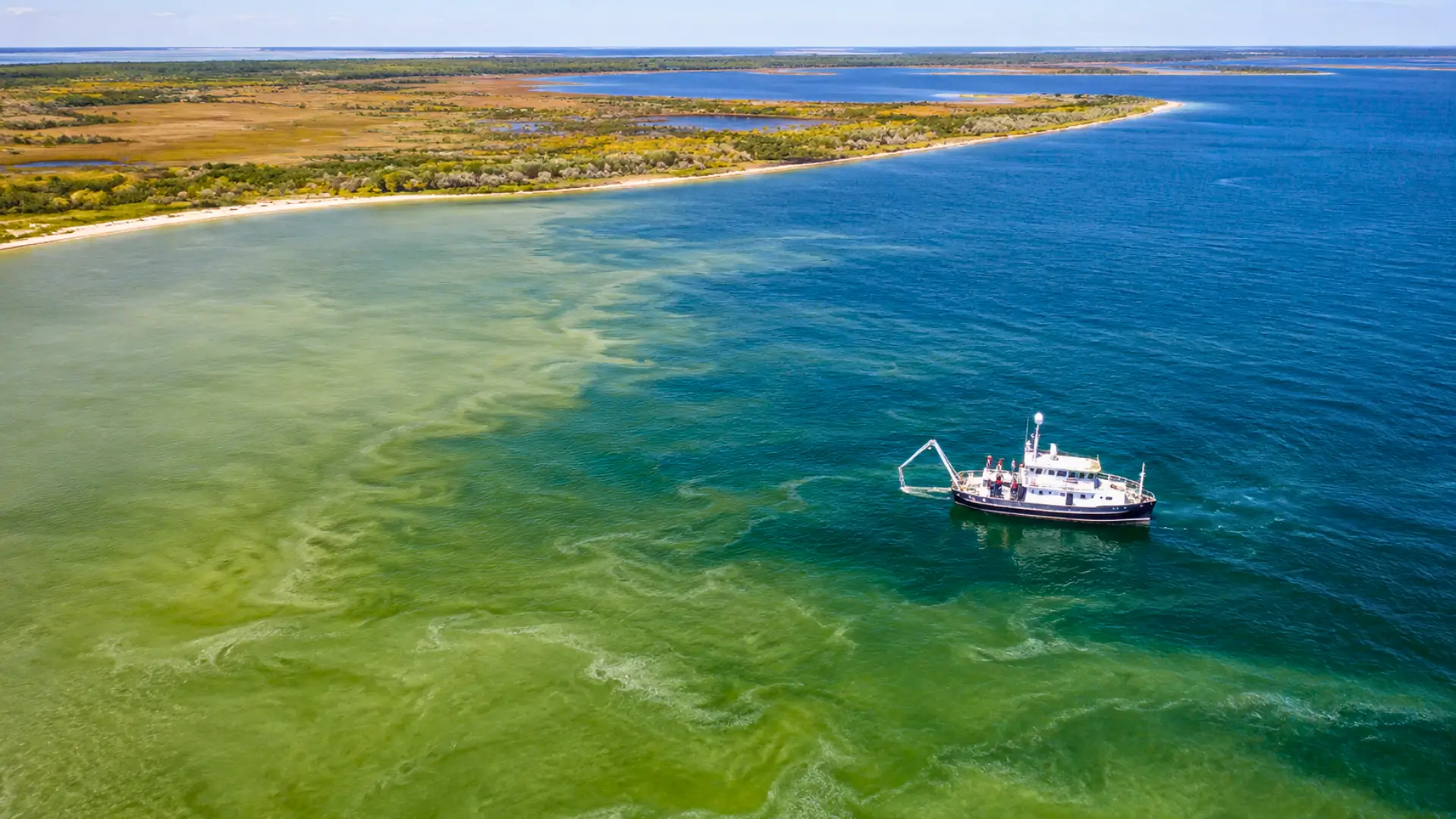
Once these nutrients reach the sea, they act as a massive liquid fertilizer. Phytoplankton takes advantage of this opportunity and can bloom rapidly. This dramatic increase is known as eutrophication. While the surface may appear highly productive, beneath this abundance lies a far less encouraging scenario.
The microscopic algae eventually die and sink in the water column. Bacteria then begin to decompose this accumulated organic matter. This process consumes dissolved oxygen. When the water is warm and stratified, renewal becomes more difficult, while bacterial respiration continues uninterrupted.
This phenomenon has reached impressive proportions in the twentieth century. A scientific synthesis reports that by 1978, seasonal hypoxia could affect around 30,000 square kilometers of the northwestern plateau. Mussel communities and large areas of red algae were severely impacted, revealing how far this ecological imbalance could extend.
Beneath 100 meters, the Black Sea hides a world almost devoid of oxygen
The Black Sea has a unique characteristic that makes this story even more striking. Its deep waters mix very little with surface waters. Below approximately 100 to 150 meters, a vast portion of the basin is naturally devoid of oxygen and contains hydrogen sulfide. This deep environment is incompatible with most marine animals.
Human-induced eutrophication does not create this deep anoxia, a crucial distinction. However, it can cause seasonal hypoxia on the coastal shelf, where fish, mollusks, and bottom-dwelling organisms reside. European surveys show that the Black Sea remains one of the European regions most affected by low oxygen concentrations.
The surprise comes with the return of oxygen, showing that this story can still change
Not everything has worsened, however. Since the 1990s, nutrient inputs have declined significantly. The Danube Commission estimates that emissions have decreased by approximately 30 percent for nitrogen and 50 percent for phosphorus over fifteen years. With less fuel for algal blooms, some coastal areas have started to recover.
A study published in 2026 in Biogeosciences confirms that the peak of eutrophication on the western shelf occurred in the 1980s and 1990s, followed by a gradual decrease linked to economic transformations and pollution reduction policies. Recent research even observes nutrient concentrations approaching levels seen before major eutrophication episodes.
So the problem has not disappeared. Agriculture, wastewater, warming, and stratification continue to exert pressure on marine oxygen, while the European Environment Agency still considers eutrophication a significant issue in the Black Sea. Yet, this story offers a rare insight: when a continent reduces its emissions, a sea can genuinely begin to breathe again.