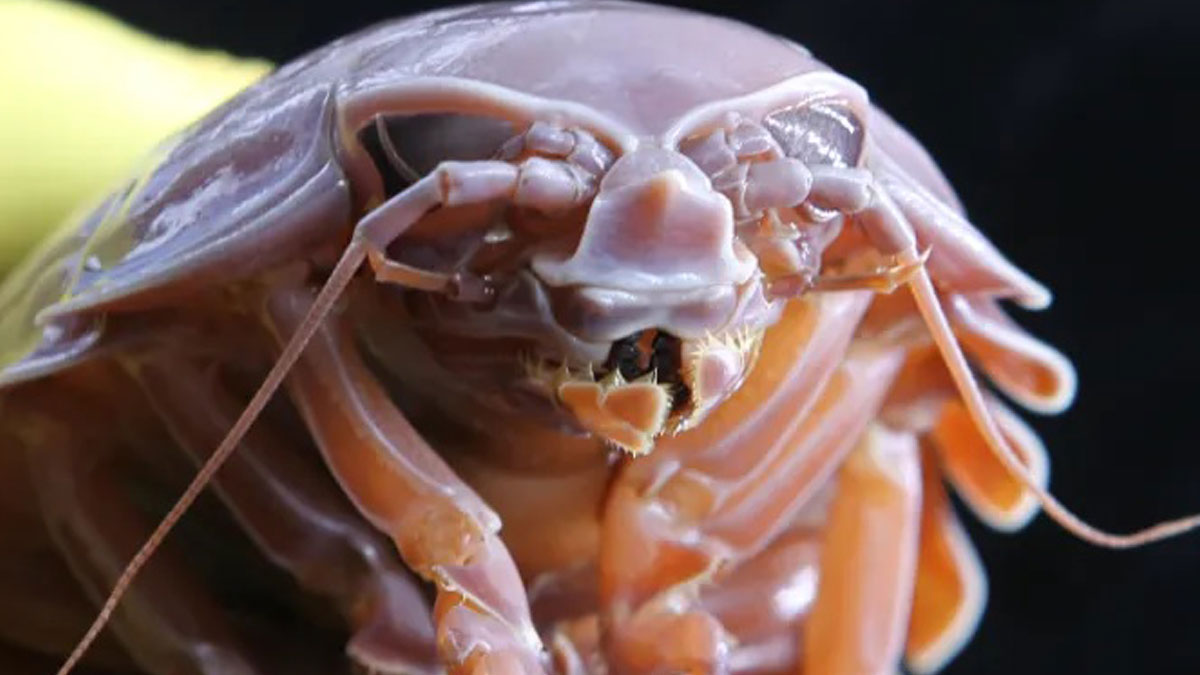
Marine creatures with somewhat unsettling appearances, giant isopods can survive for years without food. A recent study has shed light on their remarkable resilience.
Giant stomachs
True to their name, giant isopods inhabit the deep sea, often found at depths exceeding 2000 meters. Though food sources are scarce in these hostile environments, they can grow to impressive sizes -up to 50 centimeters long. This growth requires a significant amount of nutrients.
Researchers at the Chinese Academy of Sciences conducted a multi-omic analysis, examining the genetic, protein, and metabolic pathways of these creatures to understand their biology better. They then performed functional tests to see if the initially identified adaptations had a real impact on the isopods’ survival.
The study revealed that deep-sea isopods possess stomachs substantially larger than their shallow-water counterparts. This enormous stomach can account for about two-thirds of their total body volume, allowing them to gorge themselves when a feast presents itself, such as the carcass of a large whale sinking to the ocean floor.
Once consumed, the food breaks down into a viscous slurry, which contains relatively few digestive bacteria known as Firmicutes, but a high concentration of Chlamydiae, linked to lipid metabolism and storage. Thus, after a meal, the isopods can turn this food into an energy source that lasts for over five years.
The role of the ND1 gene
By introducing the ND1 gene into the genomes of zebrafish and nematodes, the Chinese team confirmed its essential role in significantly slowing the metabolic and mitochondrial activity of deep-sea isopods.
At average temperatures, ND1 boosts metabolism, which increases energy expenditure. However, when temperatures were lowered to levels typical of the isopods’ habitat, this gene had an inhibitory effect, enhancing food deprivation resistance by 37% in zebrafish.
According to the authors of the study, published in the journal Cell, “This research has unveiled the mystery of the extraordinary famine tolerance in deep-sea isopods and sheds light on the delicate balance between growth and survival in extreme environments.”
Last year, researchers described a giant isopod informally referred to as “Darth Vader.”