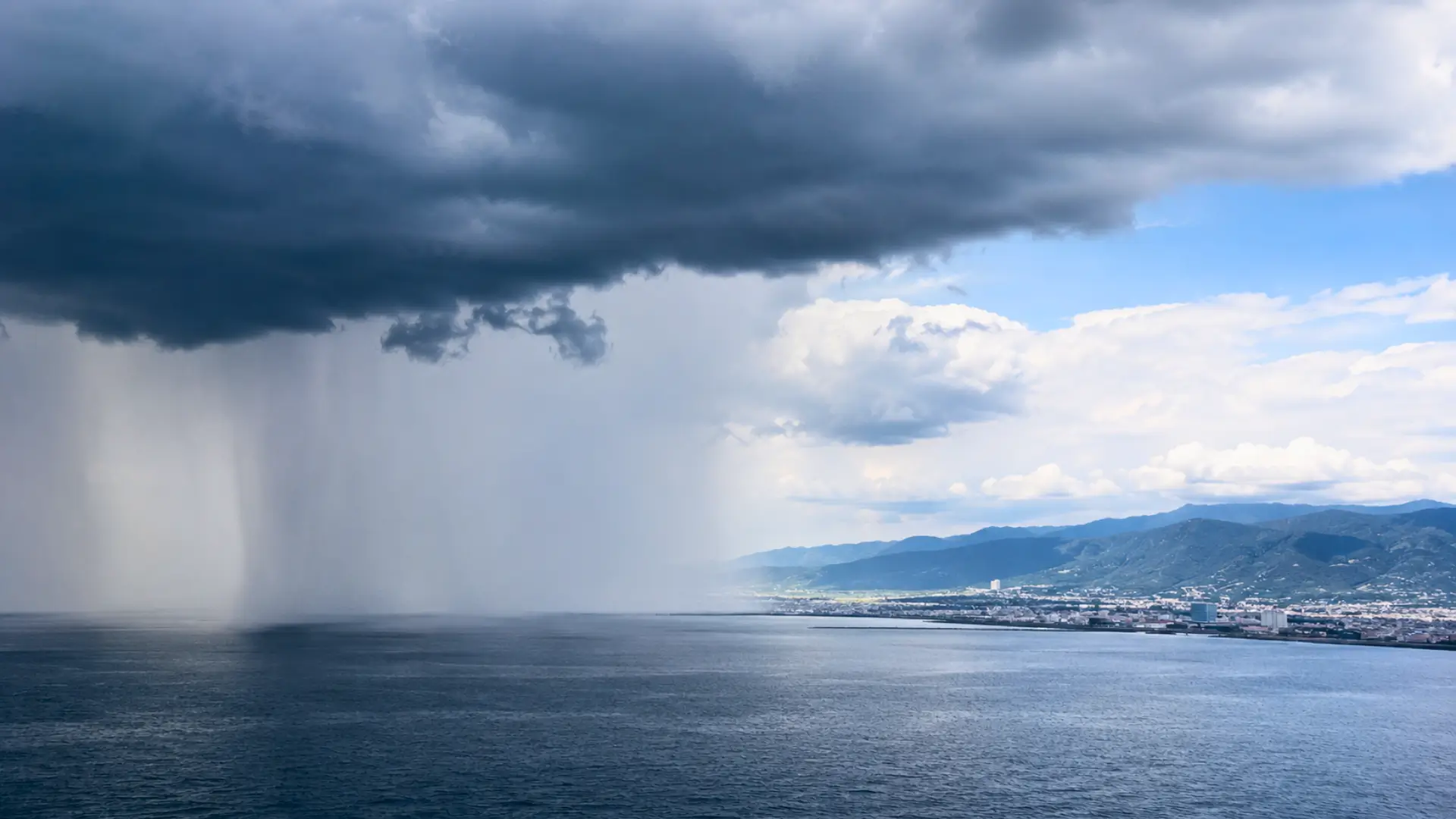
Imagine if preventing catastrophic rain from hitting a city meant making it fall earlier and elsewhere. In Japan, this seemingly counterintuitive idea is moving from simulations to the skies, aiming to mitigate extreme rainfall.
Making it rain over the sea to protect cities: japan’s surprising gamble
Cloud seeding is not a new concept. Since the 1940s, this technique has involved injecting particles into certain clouds to promote ice or rain formation. Japan is now exploring a bolder version of this approach: triggering rain earlier to limit impacts on populated areas.
This strategy is based on a seemingly straightforward principle. Instead of waiting for incoming weather systems to reach land, researchers aim to act sooner, primarily targeting maritime regions. The plan is to slightly alter the development of clouds upstream. The Moonshot program from the Japan Science and Technology Agency is backing these extreme weather research initiatives.
Experiments in Toyama serve as a grand rehearsal for a larger vision
In early 2026, Japanese teams conducted tests around Toyama, focused on snowy clouds under real conditions. These experiments allow for direct observation of atmospheric intervention. The goal is to understand how a cloud reacts to disruption, as computer models often fall short in forecasting such behaviors.
Among the tools being tested is carbon dioxide ice. In a cold cloud, it can rapidly initiate crystal formation, which then grows heavy enough to fall. While the process seems simple, it hinges on numerous factors, including winds, humidity, and the cloud’s structure.
However, it is crucial not to confuse these tests with a separate study published in 2026 in Natural Hazards and Earth System Sciences. This research relied on numerical simulations related to the extreme rainfall in Hiroshima in 2014, suggesting that well-placed seeding could alter precipitation distribution.
Beneath the clouds lies a sci-fi-worthy goal: influencing typhoons
Japan’s interests extend beyond just intense rainfall. The program also targets typhoons. At Yokohama University, researchers are exploring ways to weaken these powerful cyclones, testing light interventions on these robust systems. The purpose is to reduce damage without entirely disrupting the storm.
The Moonshot Goal 8 sets a clear ambition: by 2050, efforts should target certain extreme events, potentially altering their intensity or trajectory. Yet, the intention is not to control the weather but to influence unstable systems through limited actions.
That said, atmospheric unpredictability remains a real challenge. Two nearly identical situations can evolve differently, complicating assessments. If rainfall decreases following an intervention, pinpointing the exact cause can prove elusive. Researchers must often compare results against a scenario that has never existed.
Altering a deluge appears appealing, but the limits are still unclear
An essential question persists: what happens to the water displaced by these interventions? A diverted rain in one area might simply reappear elsewhere. Thus, researchers are also considering indirect effects, alongside social and environmental impacts as part of their analyses. Weather is no longer just a physical phenomenon.
The cloud seeding techniques vary based on the substances utilized. Some use silver iodide, while others rely on carbon dioxide ice. Each method raises different questions, prompting the Japanese program to implement strict regulations emphasizing safety, transparency, and public dialogue.
If these studies yield positive results, disaster management could undergo significant transformation. Levees and weather alerts might no longer be the only tools in the toolkit. Intervening in the sky could become an alternative option. However, a crucial query remains: how far can society go in manipulating the atmosphere without losing control?