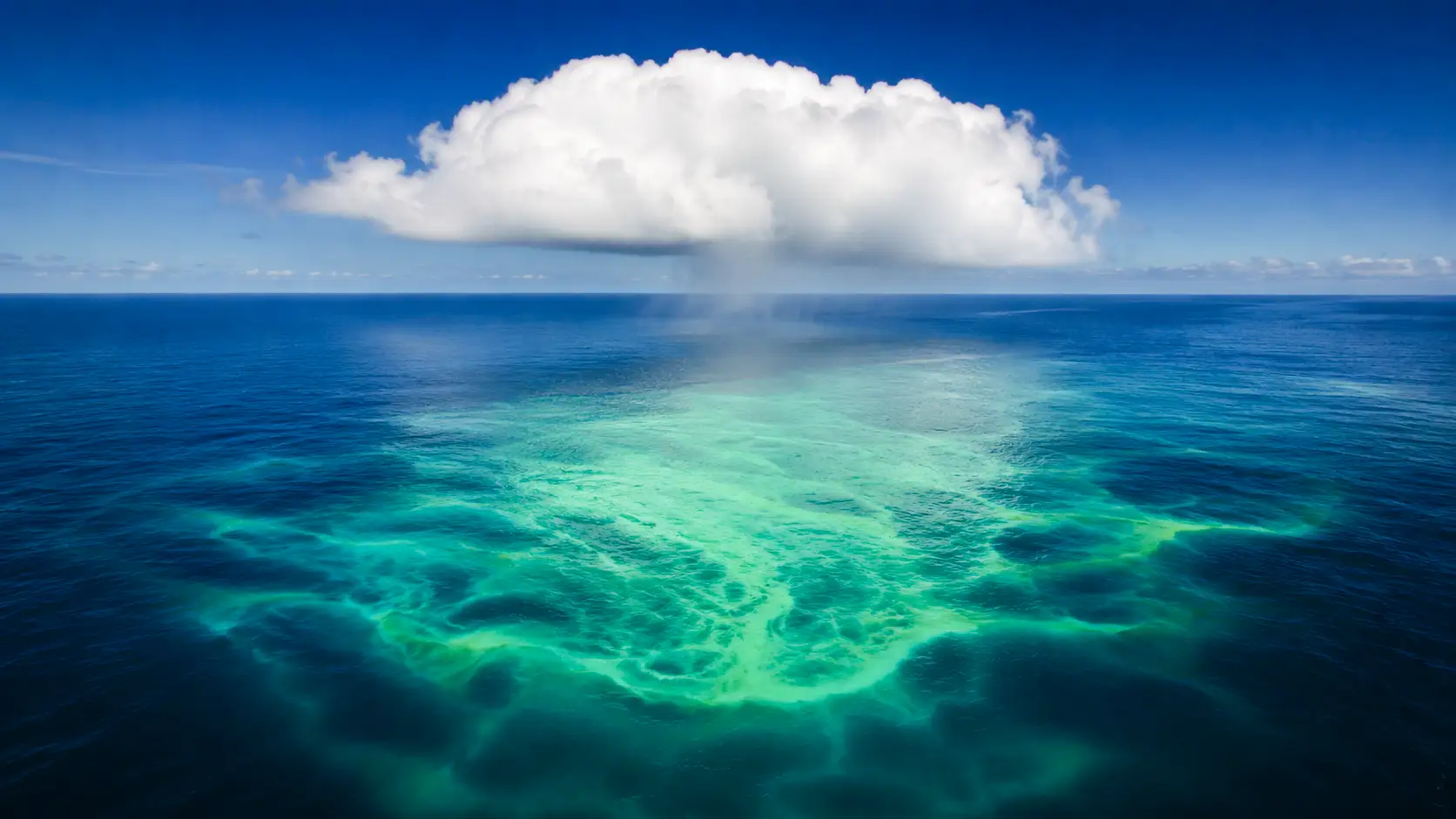
Recent studies reveal that microscopic marine organisms play a crucial role in climate regulation by emitting a specific gas that contributes to cloud formation and impacts global warming forecasts.
Phytoplankton releases dimethyl sulfide, the marine molecule responsible for the characteristic coastal scent
Microscopic plants drifting in the oceans produce a significant portion of Earth’s oxygen. As they grow, these organisms release a unique molecule known as dimethyl sulfide or DMS. This volatile compound escapes from the water into the surrounding air.
This continuous gas release explains a familiar scent experienced by beachgoers. The distinctive iodine smell of the seaside that accompanies summer beach strolls comes from these plankton’s secretions. Without this ongoing biological activity, the marine atmosphere would lack this characteristic aroma.
However, the effects of this gas reach far beyond coastal areas. Once released into the atmosphere, DMS molecules rise up, initiating a series of physicochemical reactions that directly affect the sky.
How does this volatile compound transform into cloud droplets?
For clouds to form, ambient moisture needs something to latch onto. Water vapor alone cannot condense; it requires tiny solid or liquid particles called cloud condensation nuclei. Without these support particles, the sky would remain clear.
When exposed to oxygen and sunlight, dimethyl sulfide undergoes a rapid chemical transformation. It generates sulfur derivatives that cluster together through a process known as atmospheric nucleation. This aggregation creates new seeds that can help condense surrounding water droplets.
In oceanic areas far from the coast, plankton become the main creator of cloud seeds
The air above continents is filled with numerous dust particles and industrial pollutants. In contrast, the atmosphere over distant marine areas is characterized by its remarkable purity. Here, the concentration of suspended particles is particularly low, making every source of condensates strategic.
In these wild regions, plankton plays a vital role. In the absence of other dust, sulfur compounds from DMS become the primary source of seeds for condensation. Modern atmospheric analysis tools now confirm the importance of this biological input.
Previously, scientists struggled to accurately assess this contribution. Recent measurements reveal that marine microorganisms produce cloud nuclei far exceeding earlier estimates. This finding profoundly changes our understanding of the gas balances above the oceans.
Why underestimating this sulfur gas forces scientists to revise future climate simulations
The presence of marine clouds directly influences the planet’s thermal balance. By creating a white screen over dark waters, these cloud covers reflect a portion of solar light back into space. A plankton-rich ocean thus promotes a natural cooling of the surface.
Because past computational models underestimated the impact of dimethyl sulfide, predictions regarding global temperature changes now require adjustments. Accurately incorporating this biological link will enhance the reliability of climate change projections, particularly in remote marine areas.