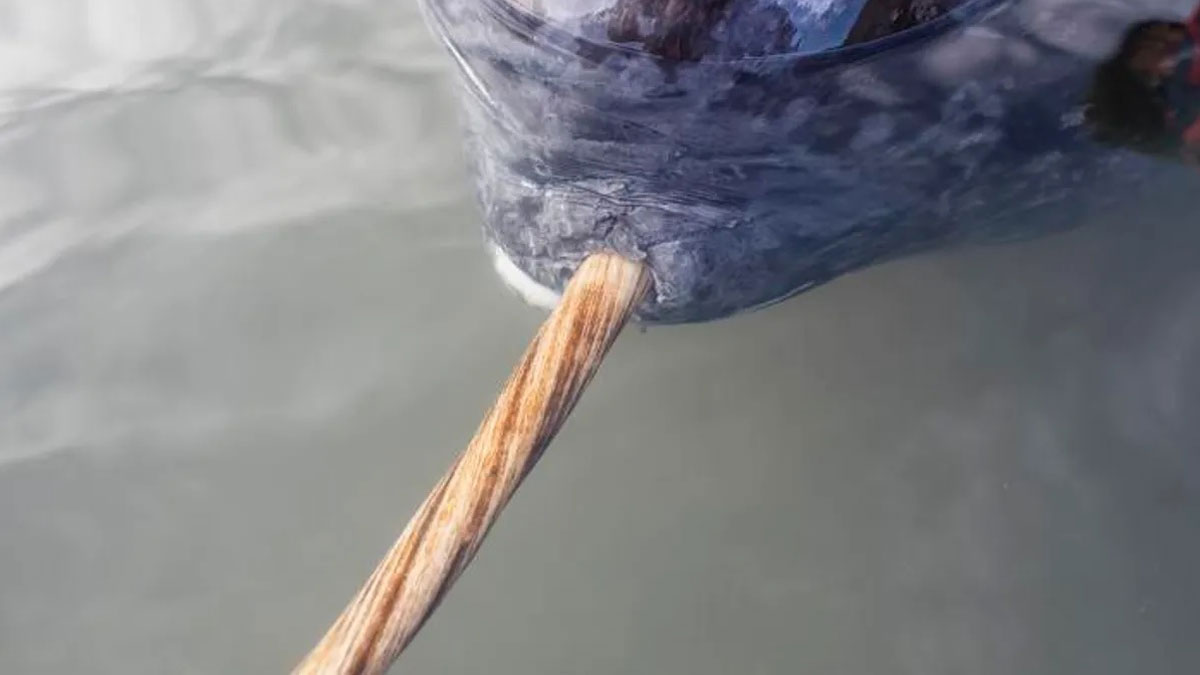
Living in the icy waters of the Arctic, narwhals are remarkable marine mammals known for their unique spiral tusk, which is actually an elongated tooth. Recent research has unveiled the fascinating intricacies of this distinctive structure.
High-resolution 3D model of the narwhal tusk
This extraordinary feature, typically the left canine in males, can reach lengths of nearly two meters. While human teeth are made of collagen fibrils, the narwhal tusk lacks enamel. “The interior consists of dentin, while the outer layer is cementum, which anchors the tooth to the jawbone in humans,” explains Henrik Birkedal from Aarhus University.
In the animal kingdom, spiral structures usually twist in both directions, as seen in the shells of snails. Interestingly, narwhals consistently exhibit a leftward twist.
To delve deeper, Birkedal and his colleagues utilized advanced X-ray imaging techniques to create a high-resolution 3D model of the tusk, revealing details of its structure at atomic, nanometric, and microscopic scales.
The findings indicated that the layers of dentin and cementum oriented themselves in opposite directions, deviating consistently from the tusk’s longitudinal axis, thus creating its characteristic spiral.
Torsion tension
The researchers believe that these opposing forces at the interface between the two tissues enable the narwhal tusk to maintain a straight shape.
“When we sectioned a tusk lengthwise, it began to spiral because the inner layer of dentin is thicker than the outer layer of cementum,” the authors of the paper published in Nature Communications state. “It can twist nearly 180 degrees when this torsion tension is released.”
Another significant finding indicates that, much like tree rings, narwhal tusks may retain imprints of the environmental conditions in which they grow. Since they continue to grow throughout the animal’s life, they could provide unique insights into past climates.
And if you’re wondering, there’s a good reason you won’t find narwhals in aquariums.