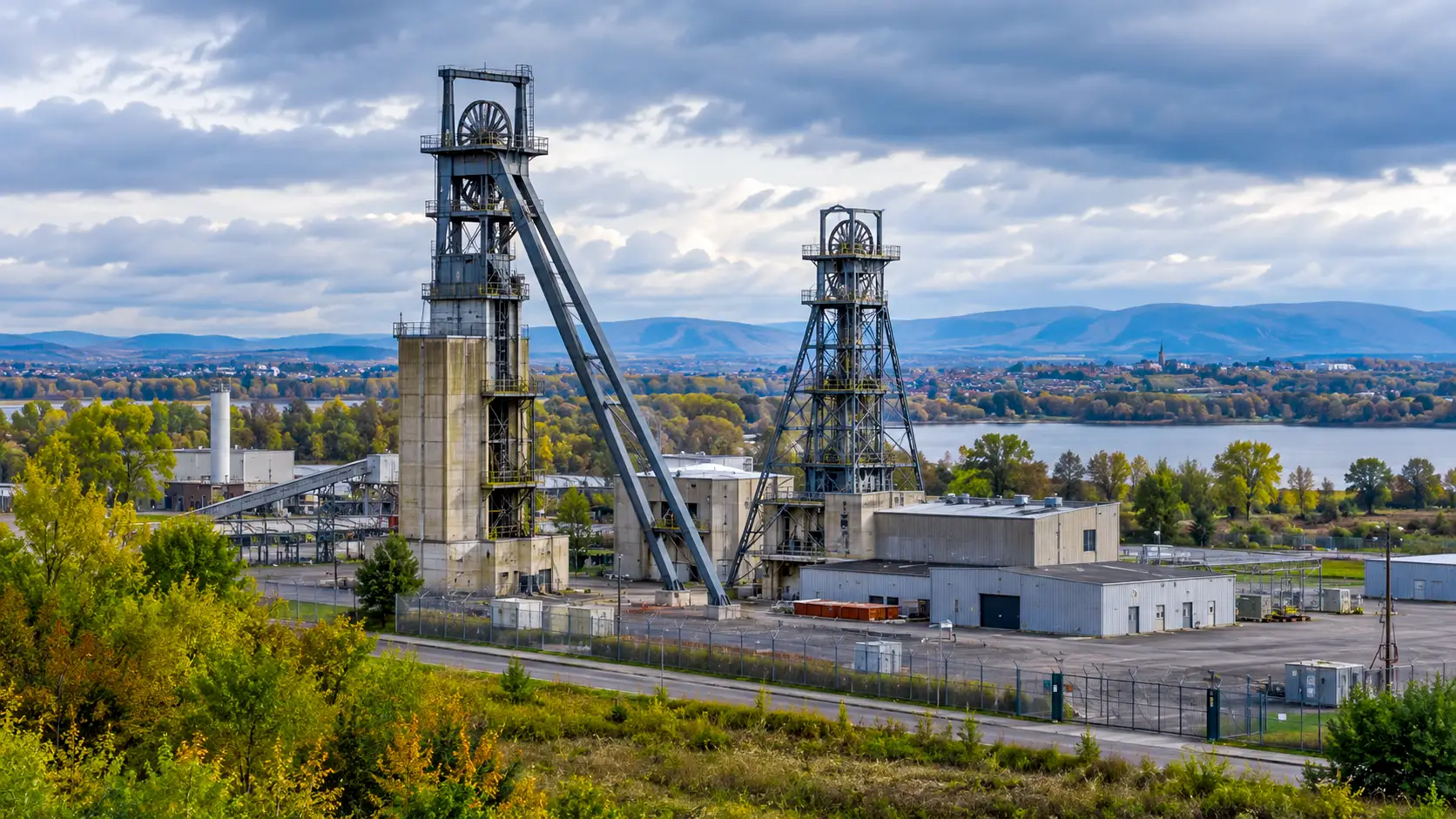
In Wittelsheim, thousands of tons of industrial toxins have been resting underground for over twenty-five years. What was once seen as a temporary storage solution has turned into a permanent geological trap, jeopardizing drinking water for millions.
StocaMine site holds 42,000 tons of toxic compounds beneath Europe’s largest aquifer
At a depth exceeding 500 meters, the former potash mine in Wittelsheim conceals a hazardous chemical mix. The underground layers hold substances such as asbestos, mercury, arsenic, and cyanide, all piled in the abandoned galleries of an old operation.
In 1999, the government approved a technical plan aimed at neutralizing these unwanted materials. Nearly 42,000 tons of industrial waste were deposited deep within the mine, designed as a modern facility to shield the surface from any direct pollution.
However, this toxic reservoir lies directly beneath Europe’s largest aquifer, a vast source of freshwater that crosses borders and supplies millions of households, including those in Germany. Consequently, even the slightest leak poses a serious public health risk for the entire bordering region.
Official promise of reversible storage collapses after a toxic fire underground
Initially, the government advocated for the principle of reversibility. Authorities assured local residents that toxic materials could be extracted if technical needs arose. Thus, the site was presented as a mere temporary stop. Local officials accepted the infrastructure based on this formal commitment.
But a major underground fire struck unexpectedly in 2002, permanently halting the arrival of new chemical loads. The site shifted from its original purpose to emergency management, losing all operational coherence amid the risks of toxic emissions.
Natural subsidence in underground galleries accelerates official decision for permanent sealing
Below ground, geological movement is incessant. The saline cavities face powerful geological subsidence, slowly compressing the walls around the poisoned containers. This constant mechanical stress limits the teams’ operations and renders each descent perilous.
A ray of hope appeared in 2017 when authorities permitted the extraction of 93% of the mercury waste, deemed the most dangerous. Miners successfully brought these highly toxic barrels to the surface without incident, suggesting that full decommissioning of other residues could be achievable.
However, in 2021, the government took a complete turn, declaring a permanent sealing of all remaining stocks. Public experts indicated that time was running short to extract all materials before the shafts collapsed. Thus, the state opted to seal the galleries as a final solution.
Administrative court validates permanent sealing despite strong opposition from alsatian collectives
This decision incited anger among the Destocamine collective and local citizens. Regional representatives demanded the removal of harmful products before complete closure. Nevertheless, the Administrative Court of Strasbourg rejected their appeals in June 2025, thereby granting legal approval to the construction work.
The Ministry of Ecological Transition is now accelerating underground operations. According to state engineers, geological movements will block all human access by the end of the decade. This contentious issue leaves a heavy legacy for future generations concerning the underground residues.