
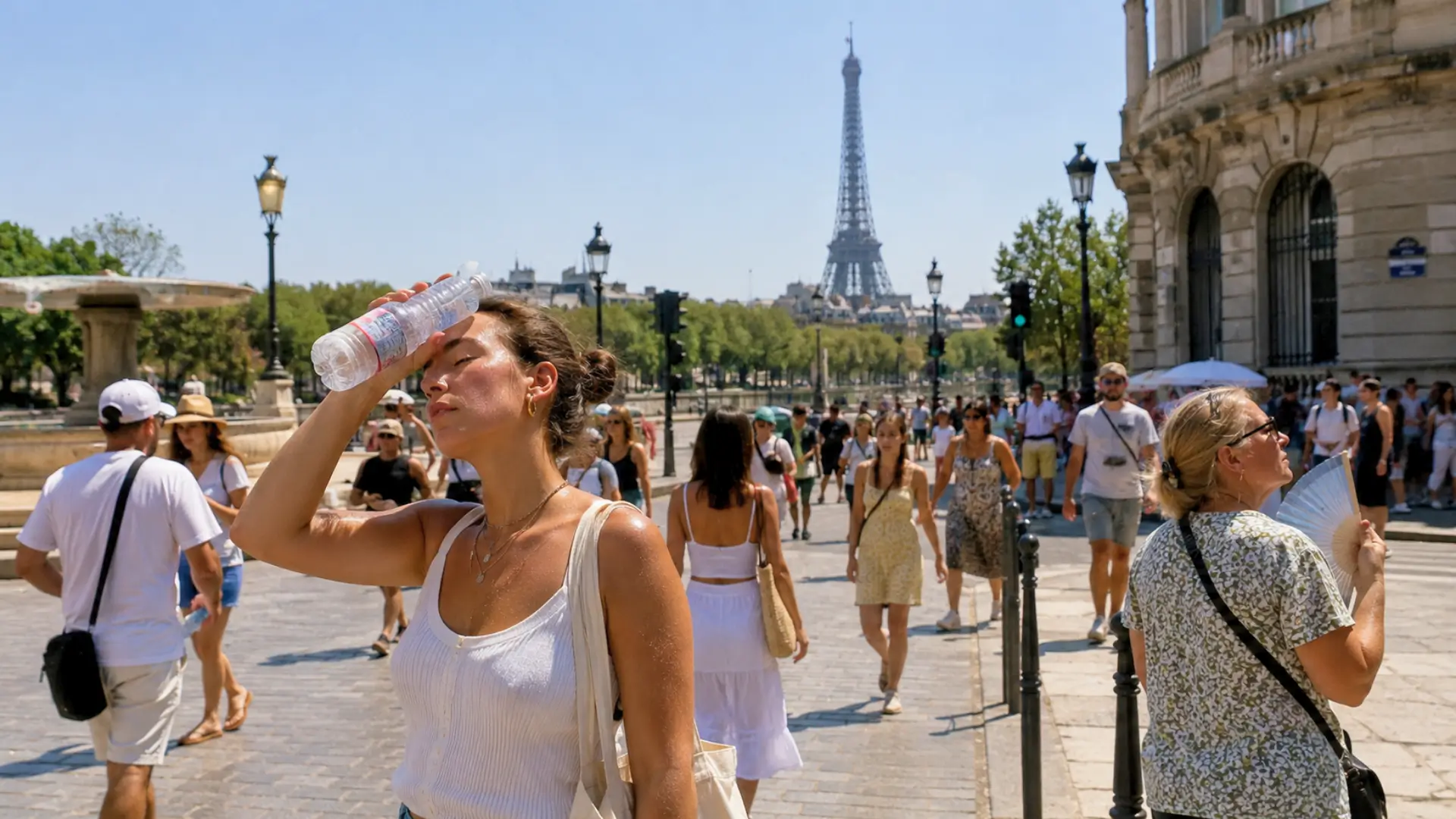
Europe is warming at a faster rate than the rest of the world. This rapid acceleration stems from a series of interconnected factors: drying soils, a heated Mediterranean, retreating snow, and persistent anticyclones. How do these mechanisms gradually transform each summer into a landscape ripe for record-setting temperatures?
Geography and latitude intensifying the warming
On a map, Europe appears surrounded by water. However, its climate is primarily influenced by the vast landmass of Eurasia. Land areas heat up faster than oceans because they store heat less effectively and have less moisture available for cooling through evaporation. This situation provides a disadvantage in the race against rising temperatures.
The continent’s geographical position exacerbates the issue. Extending into high latitudes, Europe experiences an even stronger rise in temperatures. Recent data estimates a rise of around 2.5 °C since pre-industrial times, which is more than double the global average. Areas in Eastern, Central, and Arctic Europe are particularly affected.
To the south, the Mediterranean is failing to serve its traditional role as a natural climate regulator. When it becomes abnormally warm, it releases energy and moisture into the atmosphere, especially at night. As a result, nighttime temperatures struggle to drop, leading to more frequent tropical nights that drain energy from living organisms, heat urban areas, and lessen the relief typically felt after hot days.
Persistent anticyclones intensifying heatwaves and drying soils
While an anticyclone may typically be associated with clear skies, during hot periods, it can act more like an atmospheric lid. Air descends, compresses, and heats up, which leads to fewer clouds, increased sunlight on the ground, and diminished evaporation. The available energy is then devoted entirely to heating the air.
This process can escalate quickly. Moist soils help dissipate heat through evaporation, while dry soil can heat up almost like a solid surface. Each day without rain sets the stage for an even hotter following day. Consequently, heatwaves are becoming longer and more intense, a phenomenon clearly linked to human-induced warming.
Melting snow and ice decrease albedo and accelerate warming
Europe has a particularly vulnerable neighbor: the Arctic. Snow and ice reflect a significant portion of solar radiation. As they melt, darker surfaces are exposed, absorbing more energy. This feedback loop, known as Arctic amplification, makes high-latitude regions the fastest warming locations on Earth.
Researchers are also investigating how these changes might affect the jet stream, a high-speed ribbon of winds that influences weather patterns. Certain wavy configurations may slow down air mass movements, establishing prolonged weather patterns. However, the link is complex, and the Arctic alone does not account for every observed weather block over Europe.
The retreat of snow has similar implications for the Alps, Pyrenees, and Scandinavian mountains. In spring, exposed ground absorbs solar radiation earlier, reducing the mountains’ reflective ability while glaciers and ecosystems face increasing pressure. As a result, the landscapes that once whitened Europe are contributing less to its cooling.
Decreased aerosols revealing previously masked warming
Since the 1980s, European policies have significantly curtailed pollutant emissions. While this has provided substantial health benefits, some aerosols also reflected solar light and aided cloud formation. Their reduction has unveiled a portion of heat that was previously obscured. A clearer sky allows more radiation to reach the Earth’s surface.
These factors do not operate independently. They combine to enhance greenhouse gas accumulation, making extreme weather events more likely on a continent already susceptible to climate change. Data confirms that Europe is the fastest-warming continental region, while threats to health, agriculture, water resources, and economy are increasing. The pressing question remains how quickly society can adapt.



