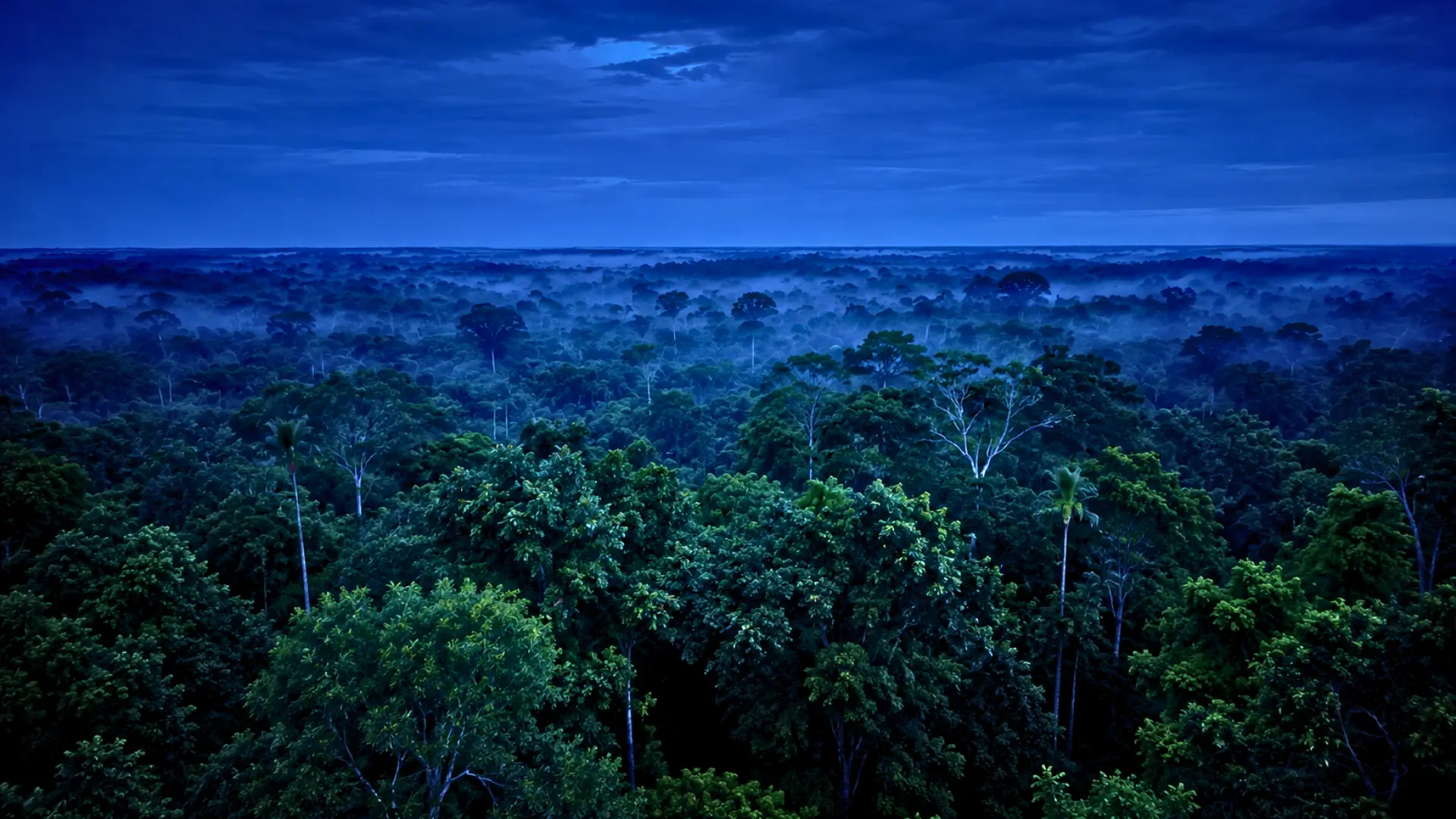
When the sun sets, the world’s largest rainforest ceases to absorb CO₂ and begins to release it. This nighttime respiration has long been overlooked by instruments, potentially altering its true climate impact.
Nighttime respiration reverses the climate role of the Amazon rainforest
During the day, the canopy acts as a giant solar factory. Through photosynthesis, leaves absorb carbon dioxide and convert it into sugars, wood, and roots. However, once darkness falls, CO₂ absorption halts, while trees, roots, and soil organisms continue to respire.
For several hours, the forest thus becomes a natural source of carbon. This is not surprising, as all ecosystems undergo respiration. The critical issue lies in the balance between daytime CO₂ absorption and nighttime release. A small difference in these two massive flows can determine whether a forest is truly a carbon sink.
Flawed measurements have long obscured nighttime emissions
Since the 1990s, towers equipped with sensors have monitored gas exchange above the canopy. This technique, called turbulence covariance, performs well when air is mixed. However, during calm, humid nights, CO₂ can accumulate near the ground or flow into valleys without reaching measurement instruments.
This invisible carbon has long posed a scientific puzzle. Research near Manaus indicated that horizontal air movements could account for more than 70 percent of the nighttime balance during specific calm nights. Thus, the forest wasn’t necessarily breathing more; part of its respiration simply evaded measurement.
Recent observations at various heights within and above vegetation confirm that CO₂ is distributed very unevenly before dawn. This invisible architecture of the forest atmosphere requires researchers to integrate towers, ground sensors, vertical profiles, and circulation models to reconstruct the actual emitted flows.
Nighttime warming intensifies respiration and disrupts carbon balance
Biological respiration is heavily influenced by temperature. As air and soil warm, metabolic reactions typically accelerate. Trees consume more sugars, and microorganisms decompose organic matter more swiftly. Thus, warm tropical nights may elevate CO₂ emissions, even while daytime photosynthesis remains robust.
This mechanism does not instantly transform all of the Amazon into a permanent source of carbon. The basin spans millions of square kilometers and features vast differences in rainfall, vegetation, and land use. However, it does render the balance more sensitive to droughts, heat waves, and forest degradation, especially in already fragmented regions.
The phrase “lungs of the planet” is appealing but misleading. An ancient forest produces oxygen while consuming it through respiration and decomposition. Its climate role primarily hinges on the carbon stored sustainably in trunks, roots, and soils, not merely on a simple alternation between oxygen and CO₂.
A climate role jeopardized by human pressures and climate extremes
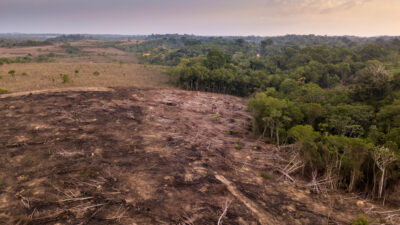
This carbon reserve is currently under stress. A study published in Nature revealed that certain eastern areas of the Amazon are already emitting more carbon than they absorb, due to a combination of deforestation, fires, and warming. Aerial measurements relied on around 600 atmospheric profiles collected between 2010 and 2018.
The 2023-2024 El Niño event further highlighted this vulnerability. Analyses combining satellites, vegetation models, and atmospheric measurements attribute over half of the observed tropical anomaly in terrestrial carbon flows to the Amazon during this period, even though methods do not all provide identical estimates.
Improving nighttime measurements does not diminish the importance of forest protection. Rather, it emphasizes the urgency and feasibility of safeguarding this vital ecosystem. The Amazon is neither a perfect machine nor an inexhaustible reserve capable of counteracting human emissions. Its nighttime respiration serves as a stark reminder that climate relies on fragile balances, sometimes concealed just a few meters beneath still air.