The Aral Sea, once the fourth largest lake in the world, has become a stark reminder of ecological disaster since its drastic shrinkage in the 1960s. Recent research suggests that a partial restoration could not only mitigate carbon release but also generate significant financial gains through carbon credits.
The drying Aral Sea: a source of carbon emissions
In the 1960s, the Soviet Union diverted rivers like the Amu Darya and Syr Darya to irrigate cotton and wheat fields in Central Asia. This led to a dramatic 90 percent reduction in the volume of the once-thriving Aral Sea in just a few decades.
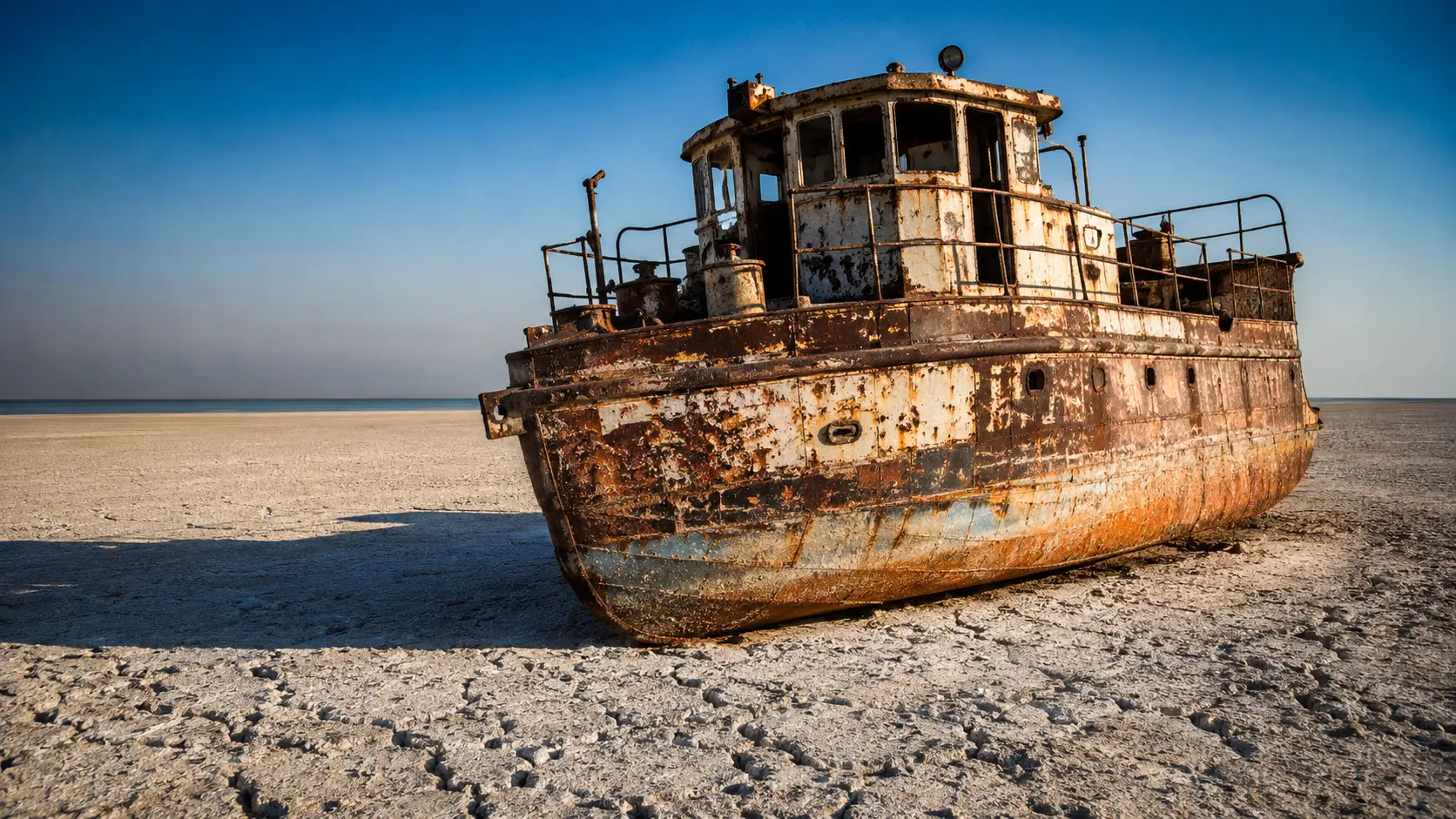
Today, the region is split in two. The northern part remains under protection from a dam, while the southern portion, which constitutes 90 percent of the original area, has turned into an expansive salt desert devoid of any water.
This barren landscape is far from inert. The exposed sediments have released approximately 748 megatons of CO2 into the atmosphere over the last sixty years, according to a study published in the journal Science. This figure ranks the Aral Sea’s desiccation among the world’s foremost environmental catastrophes.
Restoration could prevent further carbon emissions
Natural lakes and seas are storage reservoirs for carbon. Their sediments accumulate organic matter captured from the atmosphere by plants and algae over long periods. Once these bodies of water dry up, their sediments oxidize, releasing stored carbon as CO2.
Interestingly, a significant amount of carbon remains trapped within the ancient lakebed of the Aral Sea. By restoring the water levels, this carbon could be kept in check, preventing the release of an additional 605 megatons of CO2, which is equivalent to three years of emissions from Spain.
A financial incentive beneath the surface
Núria Catalán, one of the researchers involved in the study, emphasizes that the impact of a drying lake extends beyond mere ecological concerns. It disrupts the carbon cycle, a factor that has been largely overlooked in climate assessments up to now.
Rafael Marcé, the lead author of the study, frames the situation differently: there exists a treasure trove of carbon beneath the Aral Sea. When exposed, sediments release CO2, but if submerged again, they could represent part of the solution to climate change.
This potential treasure comes with an economic value. Using the voluntary carbon market prices projected for 2024, researchers estimate that protecting these 605 megatons could generate between 3.6 and 18 billion dollars in tradable carbon credits.
Feasibility of restoring the Aral Sea
Is this scenario plausible? Yes, according to Georgiy Kirillin, a co-author of the study who is engaged in conservation efforts for the northern part of the Aral Sea. There, oxygen levels have been well-maintained since the construction of the dam, which serves as an encouraging sign for the rest of the basin.
The researchers identify several actionable strategies: improving irrigation efficiency, optimizing water transport infrastructure, and enhancing coordination among basin countries. These approaches could make a partial restoration of the Aral Sea a feasible reality.