The swift disappearance of fallen leaves creates an illusion that conceals a major ecological phenomenon. Recent studies of forest litter reveal an incredibly slow decomposition process that transforms forest floor soils into essential carbon reservoirs, crucial for global climate stability.
Field measurements challenge the notion of rapid organic matter recycling
Casual observers often perceive the forest floor as quickly vanishing, believing that insects, fungi, and microorganisms consume fallen material within months. However, meticulous surveys provide evidence that this visual disappearance conceals a much more intricate reality beneath the soil surface.
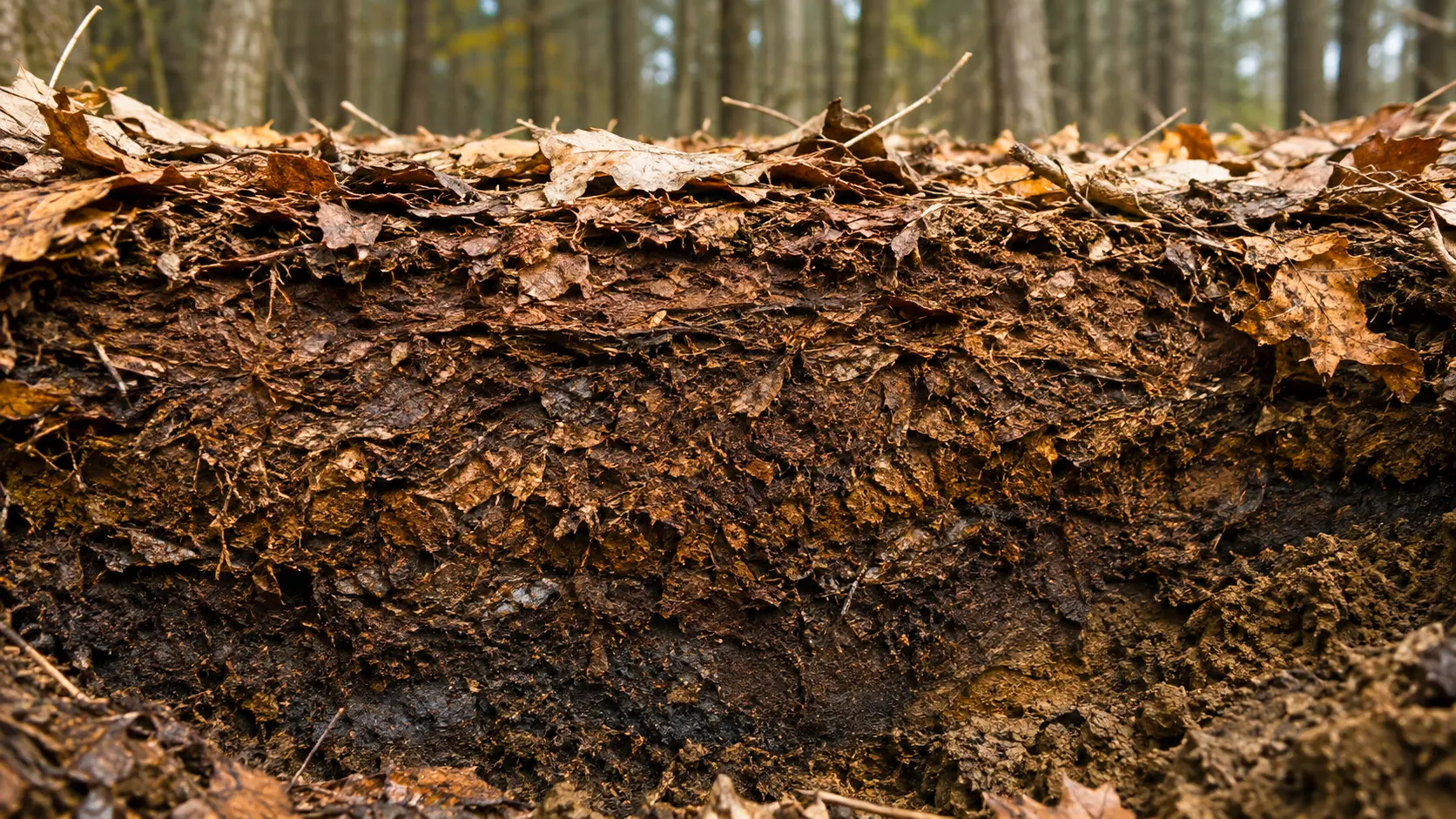
Organic matter does not vanish instantaneously or in a fully degraded form. Instead, leaves accumulate, compress, and gradually fragment. Much of these components remain trapped below the surface, prolonging the retention of forest litter far beyond conventional estimates.
Lignin and local climate slow the natural breakdown of plant debris
The breakdown of debris follows a gradual process over multiple seasons. Initially, simpler components are consumed rapidly by soil fauna. However, the plant structure also contains lignin, a tough material that resists biological decomposition for an extended period.
The pace of transformation relies heavily on environmental conditions, including average temperature, humidity, and tree species variety, which all influence decomposition rates. In cool and humid areas, this process can stretch over several years.
This extended persistence reshapes our understanding of forest understories. Rather than merely functioning as sites for rapid recycling, these environments operate as intricate systems for extremely slow assimilation. Fallen leaves take far longer to fully integrate into the subsoil than simpler models suggest.
Long-term carbon storage in forest soils
This slow rate of assimilation directly impacts soil chemistry. When plants take longer to decompose, carbon accumulated during their growth remains trapped underground. If this material decomposed swiftly, the gas would be released en masse into the atmosphere.
Consequently, forest soils serve as highly effective carbon reservoirs. Each layer of vegetation that takes multiple seasons to transform contributes to the long-term sequestration of carbon. This ongoing process makes the leaf cover a subtle yet powerful shield against atmospheric deterioration.
Revised climate predictions considering forest soil vulnerabilities
The data necessitate climatologists to reassess current calculations. The capacity of ecosystems to retain carbon dioxide might exceed previous estimates. Accounting for the actual resilience of forest litter enables more precise adjustments to climate models.
Nonetheless, this natural balance remains particularly sensitive to thermal disturbances. Rising global temperatures could stimulate increased microbial activity in the soil. Excessive warming would accelerate litter decomposition, resulting in a more rapid release of stored carbon dioxide.
Maintaining the coolness of forest understories has thus become a critical environmental goal. Protecting forest cover is essential for preserving this natural carbon storage. This delicate mechanism beneath our feet reminds us that the stability of the climate is directly linked to the internal dynamics of soils.