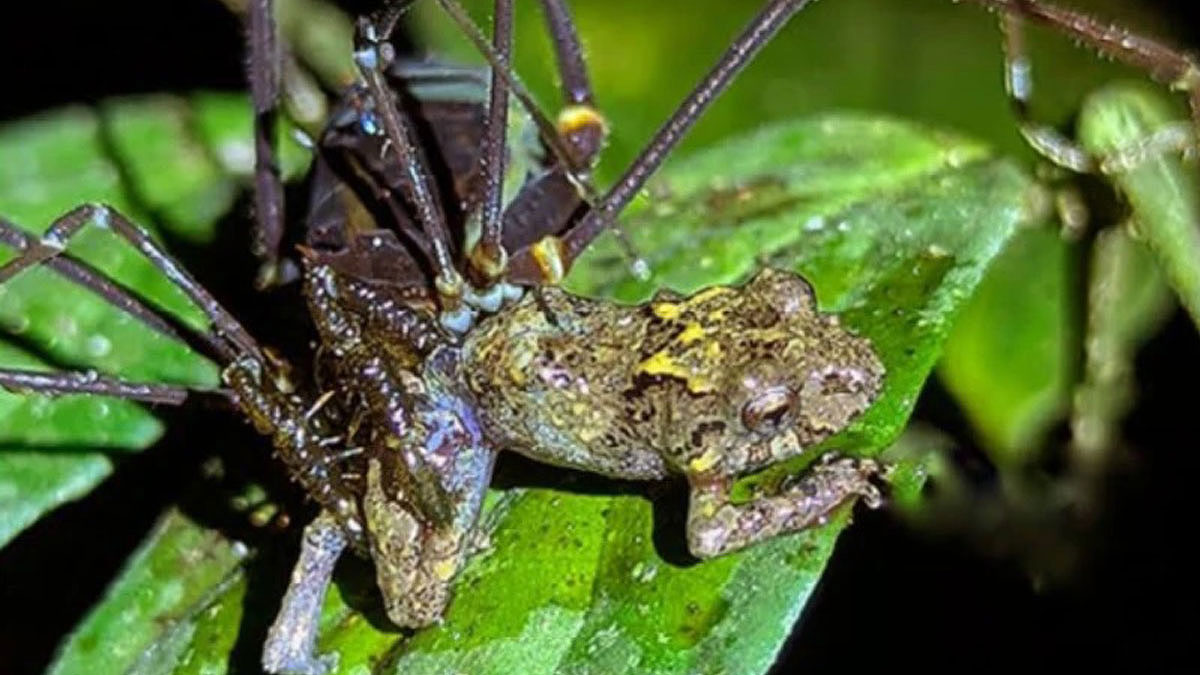
While few instances of similar predatory behavior have been previously recorded, unexpected scenes involving harvestmen and frogs have been observed in the tropical forests of South America.
Opilions vs. anoures
Typically, invertebrates serve as food for larger representatives of their own order or for vertebrates. A recent study published in the journal Ecology and Evolution has revealed a strikingly different narrative for harvestmen, also known as opilions, a group of arachnids characterized by their long, slender legs.
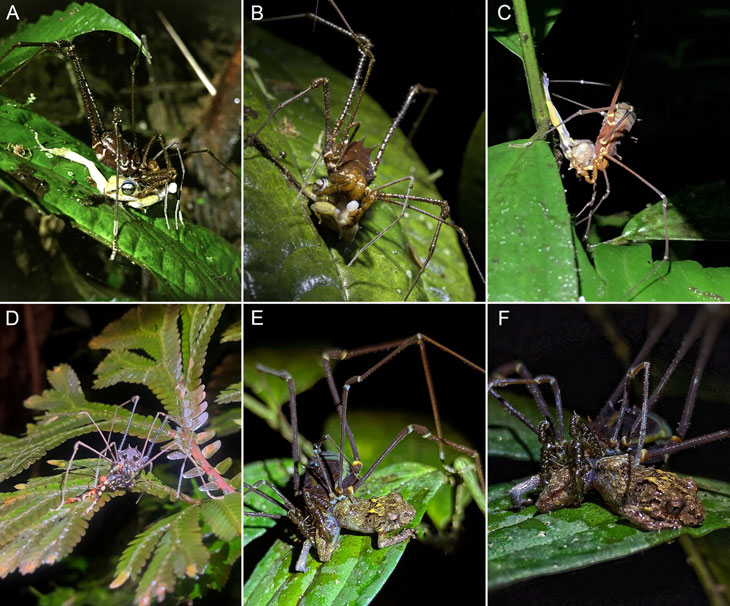
As biologist Luis Fernando Garcia explains, opilions are generally slow and fragile creatures, whereas frogs, particularly anurans, are larger, faster, and agile. This stark contrast makes the four documented cases of predation all the more surprising to researchers.
“It was quite remarkable to see them feeding on relatively large amphibians, and in some cases, immobilizing them even while they were still alive,” the researcher elaborates. “Such observations highlight the complex dynamics of biology and our lack of understanding of interactions within tropical ecosystems.”
De puissants pédipalpes
Often perceived as harmless, these arachnids do not produce venom, suggesting that they utilize their strong pedipalps, which resemble claws, to capture their prey.
“These structures have spiny extensions that allow them to securely hold their prey while feeding,” Garcia explains. “By targeting specific areas, they can restrict movement, similar to what has been observed in predatory beetles of the genus Epomis.”
While it’s possible that the targeted frogs were asleep or weakened due to illness or injury, the scientist notes that one of the photographed frog species is now considered threatened. “Gaining a better understanding of this predator-prey dynamic could thus contribute to guiding conservation efforts,” he concludes.
A few years ago, an unusually rabbit-like species of harvestman was filmed in Ecuador.