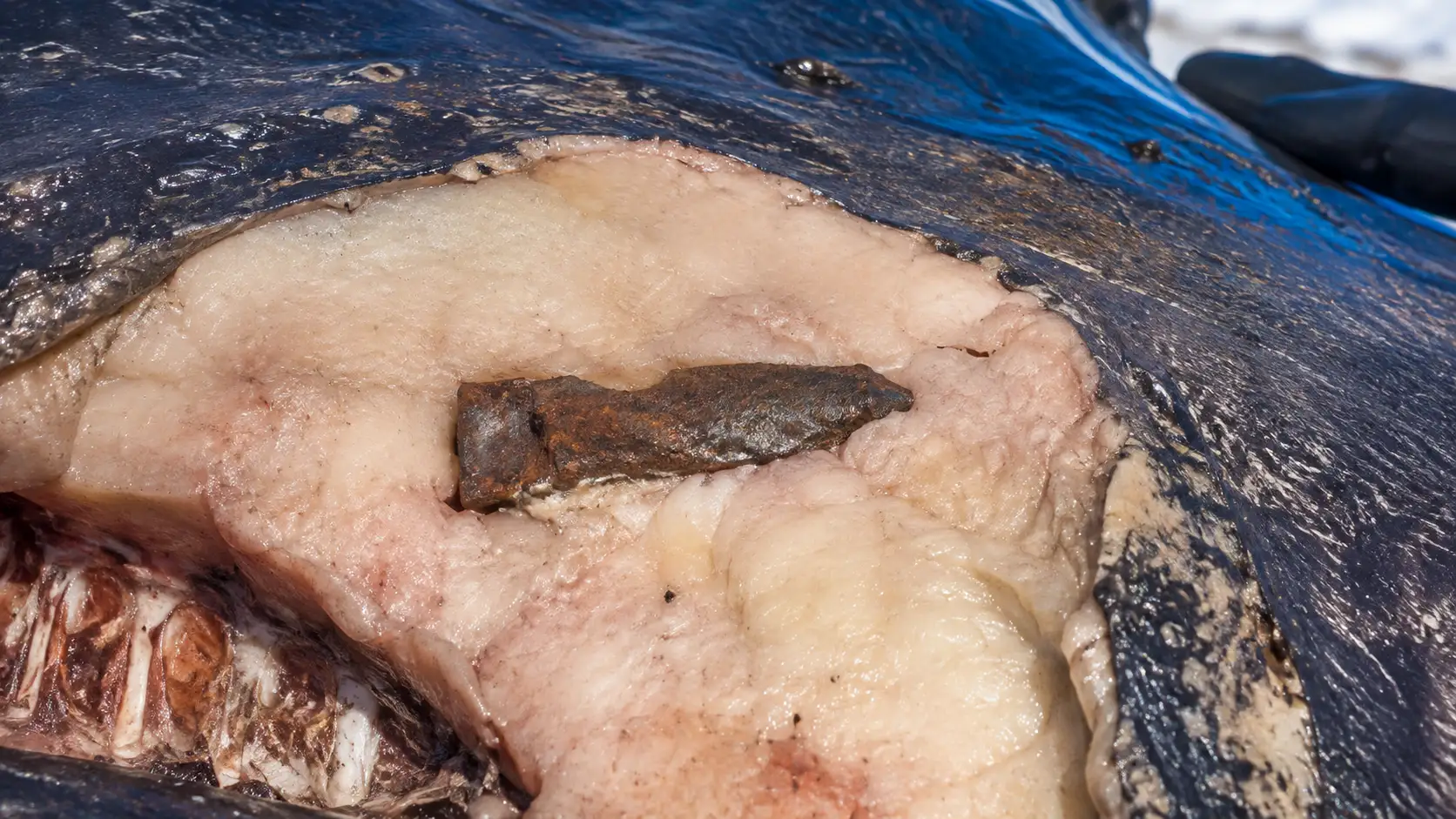
In an unexpected archeological find, a group of Inupiat hunters discovered a piece of an explosive harpoon embedded in a bowhead whale during a spring hunt in 2007. This remarkable discovery has opened up new insights into the lifespan of these majestic creatures.
A seemingly ordinary find in Barrow
The story begins in the spring of 2007 during a tightly monitored subsistence hunt. Captain Arnold Brower Sr. and his crew captured a 49-foot male bowhead whale, weighing about 50 tons, near Barrow. As they began the butchering process, they stumbled upon something unusual.
Amidst the blubber, near the whale’s shoulder blade, a piece of rusty metal caught their attention. While it’s not uncommon for Inupiat hunters to find old artifacts in the whales they harvest, this particular find turned out to be far more significant than they initially thought.
Identifying a long-lost explosive weapon
The key to understanding this discovery lay in the precise identification of the metal fragment. It was lodged in the whale’s bones, likely originating from New Bedford, a historical hub for whaling during the 19th century. Local historian John Bockstoce matched the fragment with items from his reference collection to uncover its past.
His analysis led to a clear conclusion: this fragment matched a patent filed by Ebenezer Pierce in 1879. Manufacturers produced this specific model until 1885, providing a narrow window for dating the event of its use.
Unlike typical harpoons, this was a mechanical weapon that contained explosives, detonation occurring seconds after it entered the whale’s flesh. Further research connected the object to a whaling voyage from San Francisco to Alaska, hinting that this harpoon was fired around 1890.
Evidence of a long-gone hunter
An intriguing detail struck the researchers: the tip of the harpoon bore six small engraved notches, possibly serving as a mark of ownership from an Aleut whaling captain. This implies that nearly a century ago, a hunter had marked this weapon, although little else is known about him beyond his failure to hit his target.
Researchers found a certain irony in this story, as the descendants of that anonymous hunter may very well belong to the same families that captured the whale in 2007. Unbeknownst to them, they may have inadvertently completed a hunt their ancestor initiated more than a hundred years earlier.
Revealing the extraordinary lifespan of bowhead whales
This very narrow manufacturing timeline allowed scientists to estimate the whale’s age at between 115 and 130 years. In fact, researcher Jeffrey Bada’s ongoing studies suggest they could live even longer, potentially up to 211 years.
This is not the first time evidence like this has come to light. In 1980, hunters found a similar harpoon fragment near Saint Lawrence Island, yet its significance was not understood at that time. “No one had any idea of their lifespan,” said a biologist reflecting on the earlier discovery.
Bowhead whales are among the few species known for negligible senescence, with lifespans surpassing 200 years, second only to Greenland sharks. Today, the artifact resides at the Inupiat Heritage Center in Barrow, offering a fascinating glimpse into both the history of whaling and the longevity of these magnificent creatures.