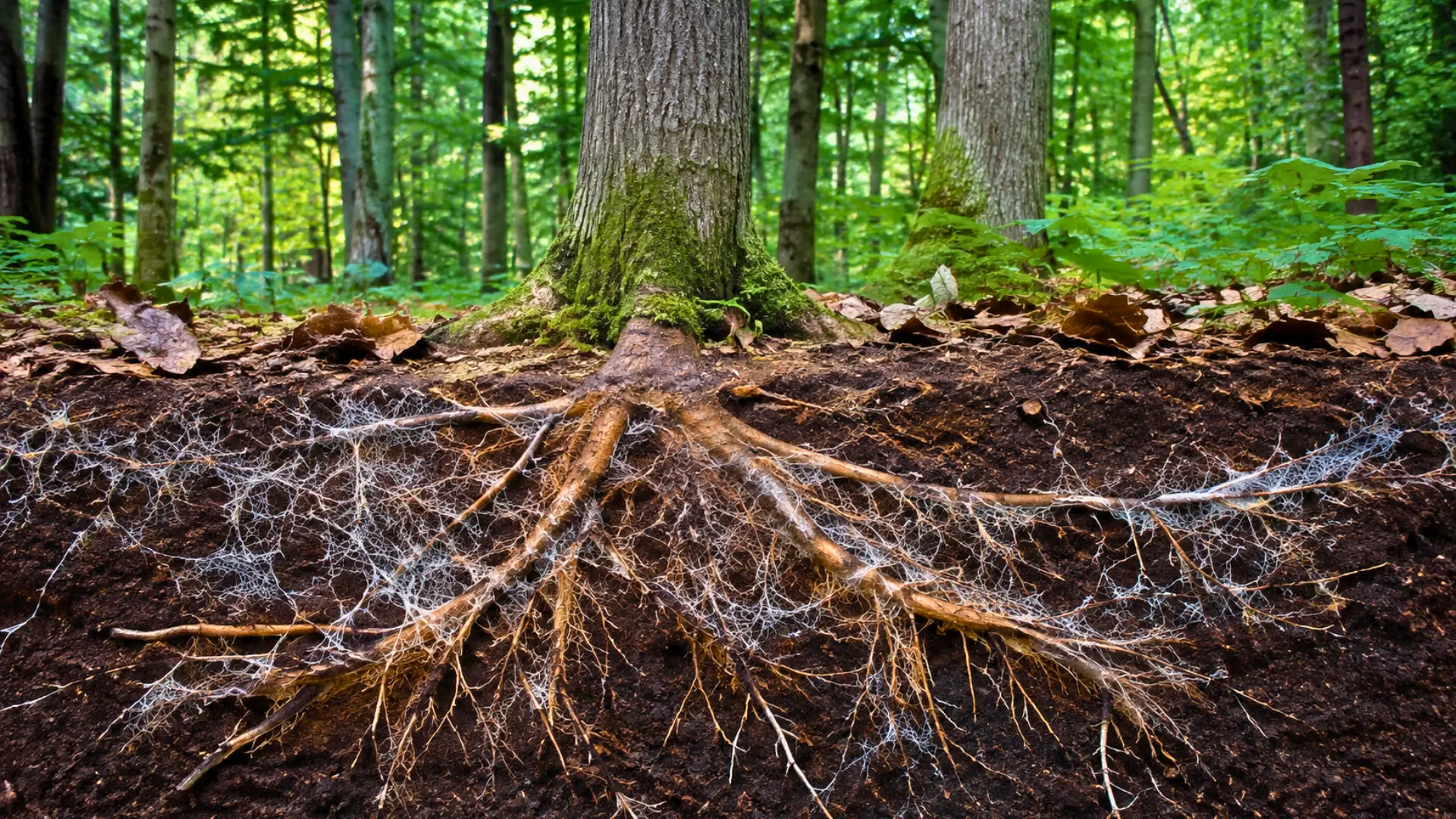
Just beneath our feet, roots and fungi create intricate connections that transport carbon and nutrients between plants. This mysterious “Wood Wide Web” has captivated biologists for decades. But what exactly does it transport, and how far can trees benefit from it?
The ancient alliance between plants and fungi
The story of this complex web dates back much further than modern trees. Approximately 450 million years ago, the ancestors of terrestrial plants were already forming close relationships with fungi. Research published in Science indicates that this ancient alliance may have facilitated plants’ ability to colonize continents.
This partnership is remarkably efficient. Fungi extend tiny filaments, known as hyphae, in the soil, exploring areas that roots alone cannot reach. They absorb essential minerals in return for carbon produced via photosynthesis from the plants, creating a mutually beneficial arrangement.
What’s more fascinating is that a single fungus can connect the roots of multiple plants, forming what researchers call a common mycorrhizal network. This allows several plants to be physically linked underground, sometimes without any visible signs on the surface.
A groundbreaking Canadian experiment reveals carbon transfer
In a Canadian forest, Suzanne Simard and her team sought to track these hidden connections. Their 1997 study, published in Nature, employed carbon isotopes as markers. They investigated paper birches and Douglas firs connected by ectomycorrhizal fungi, leading to a captivating discovery.
The study found that carbon assimilated by one tree could actually be located in its neighbor, with the rate of transfer varying based on light conditions. Essentially, carbon resources can circulate between plants, transforming the forest floor from a mere soil reservoir into a dynamic space for biological exchanges.
Plants can transmit astonishing alert signals underground
But nutrients are not the only things moving through these networks. In 2013, a study published in Ecology Letters connected bean plants through fungal networks. When aphids attacked certain plants, their neighbors, linked to the same network, altered their volatile defense compounds.
This phenomenon resembles a subterranean alert system, albeit with an important caveat: this study involved beans and aphids, not an entire forest communicating consciously. The precise mechanisms behind this interaction are still being explored. Chemical signaling, fungal reactions, and plant responses are all areas that remain to be understood.
The enticing “internet of trees” has a more subtle reality
The term “Wood Wide Web” is undeniably appealing. It suggests trees exchanging resources and warnings much like connected computers. However, scientists are calling for caution regarding this metaphor. A 2023 analysis argues that some commonly held beliefs about these networks might exceed what experimental evidence substantiates.
The concept of “mother trees” is particularly controversial. The notion that old trees deliberately redistribute resources, or even favor their offspring, has much less solid backing than its popularity might imply. Researchers also note that just because carbon transfer is observed does not automatically mean one tree is actively “nourishing” another.
This does not diminish the fascination of the underground world; quite the opposite. Fungi genuinely play a role in the carbon and nutrient cycles, connecting roots and influencing the functioning of forest ecosystems. Yet beneath every stroll through the woods lies something even more intriguing than a plant-based internet: a biological network with rules still largely waiting to be discovered.