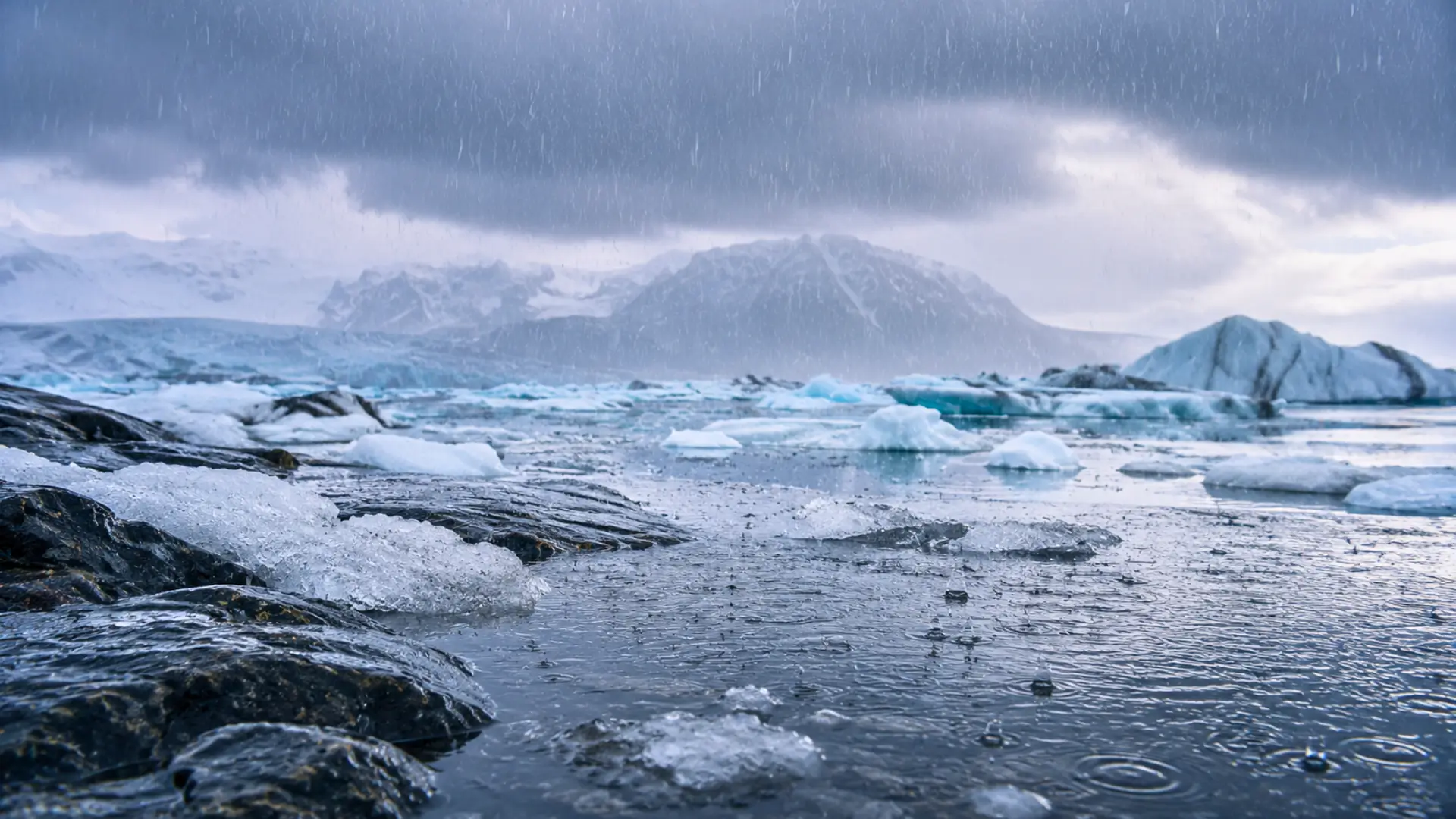
It doesn’t change the color of the sky or rivers, yet it is already found far from factories. TFA, a discreet member of the group of persistent pollutants, is now detected in rain and even in Arctic ice. How did such an almost invisible contaminant accomplish this global journey?
Replacement gases become an unexpected source of persistent pollution
For a long time, fluorinated gases were regarded as a reassuring technical solution. They replaced compounds known to damage the ozone layer, and were widely used in refrigerators, air conditioners, and various industrial applications. Progress seemed evident on paper. However, a different story began to unfold in the atmosphere, one that remained far less visible.
Researchers from Lancaster University in the UK have shown that the breakdown of these gases can produce TFA, a highly persistent acid. This compound then falls to the earth with rain. Their study, published in Geophysical Research Letters, estimates that approximately 335,500 tons have been deposited globally through this atmospheric pathway between 2000 and 2022.
The concern is not just about the sheer volume. Scientists also project that the annual production of TFA from these substances could peak again between 2025 and 2100. Even as certain gases begin to decline, their chemical legacy continues to manifest. This situation resembles a silent trail left behind, highlighting an incomplete environmental victory.
TFA, a subtle pollutant that travels widely and accumulates persistently
TFA belongs to the broader family of PFAS, the “forever chemicals”. These molecules are notably resistant to degradation. However, TFA’s unique characteristic is its mobility. Unlike other contaminants that remain trapped near their source, TFA circulates freely. It mixes with water, infiltrates various environments, and accumulates far from its origin.
This mobility makes tracking its progress particularly challenging. The atmospheric models from the British team indicate that TFA production from certain fluorinated gases has increased by about 3.5 times in just over two decades. While this change may be subtle to the naked eye, its steady rise mirrors those slow-moving threats often recognized too late.
Rain and Arctic ice reveal the true extent of the issue
To validate their calculations, the researchers did not rely solely on theoretical models. They compared their simulations with measurements taken from rainwater and ice cores extracted from the Arctic. This blend of data and real-world evidence transforms the atmospheric hypothesis into a tangible trace left on our planet.
The results are striking. In this region, which is so distant from major industrial hubs, fluorinated gases are identified as the primary source of TFA. In essence, substances emitted from much farther south can travel for years, breaking down along the way and leaving behind their chemical signature on ice that was previously thought to be shielded by distance.
This revelation is perhaps the most illuminating. TFA does not recognize political borders or geographical intuition. Instead, it advances following the logic of winds, rain, and a long timeline. Therefore, when a pollutant designed for commonplace uses finds its way to the Arctic, the concept of “local” almost loses its meaning.
Global monitoring becomes necessary in the face of persistent contamination
The researchers do not describe an immediate dramatic danger. They emphasize instead a sustainable accumulation whose effects remain somewhat unclear. Already, TFA is regarded by the European Chemicals Agency as harmful to aquatic life. Recent studies advocate for increased monitoring as environmental concentrations rise.
Concerns also arise from the timeline. Even with a reduction in HFCs, this source of TFA could persist for decades. Other climate-friendly refrigerants also contribute to this problem. Therefore, the risk is far from theoretical; it is already a pressing issue of regulation.
This is why the authors call for an international mobilization to closely monitor TFA concentrations in the air, water, and soil. The implications extend beyond mere chemistry. They reveal a modern tendency to discover damage only after it has occurred. Solutions designed for yesterday often come with environmental costs that are becoming evident today.