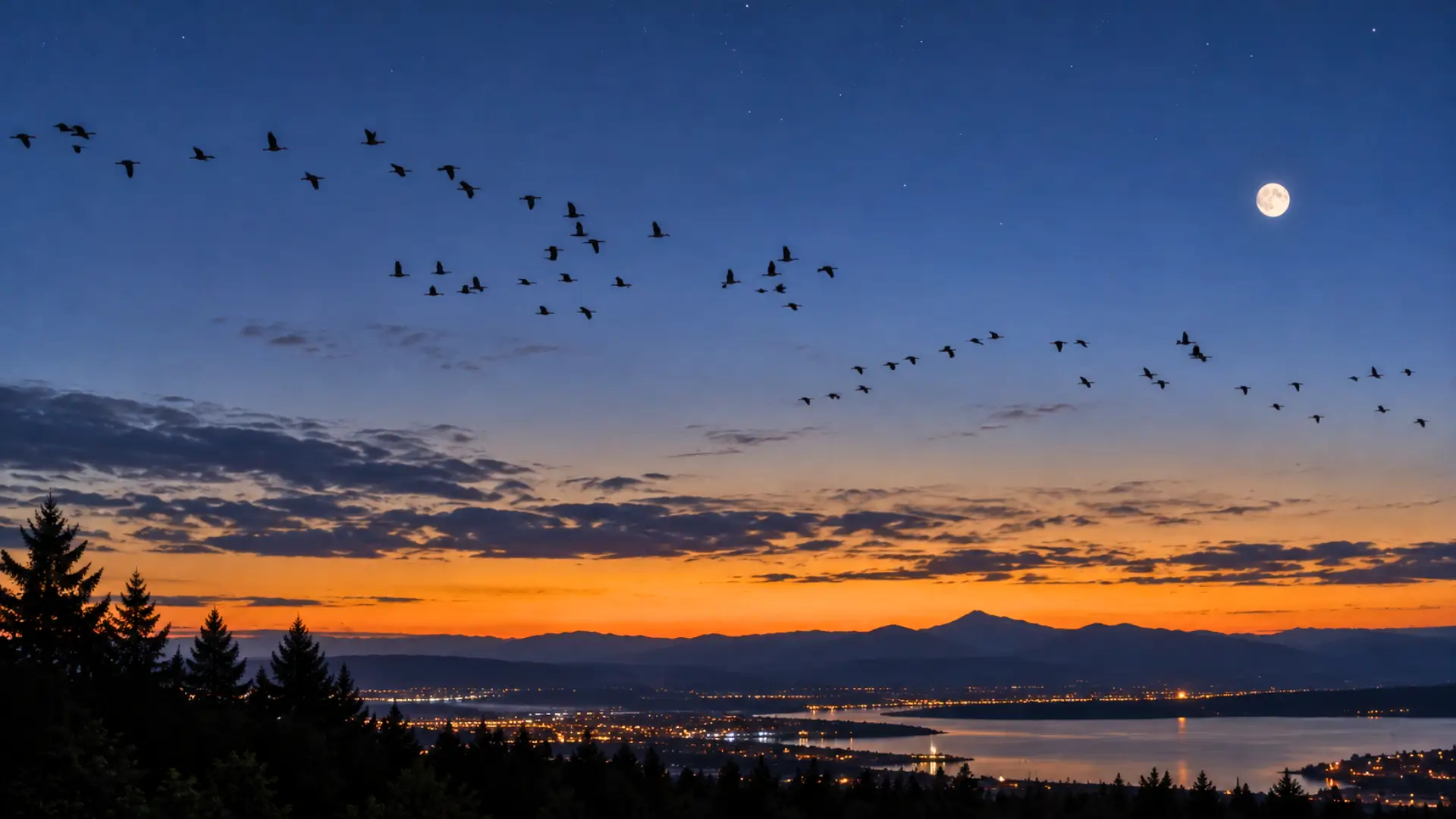
On a a witnessed an extraordinary scene in September 2025 when over 1.2 billion birds took to the skies across the United States in just one night. Remarkably, many of these birds navigated over oceans without stopping. But how do they find their way in the dark, often on their first journey, without maps, GPS, or almost any experience?
Why do more than a billion birds risk such dangerous journeys?
The scene is almost impossible to envision from the ground. On September 25, 2025, BirdCast radar detected over 1.2 billion birds migrating across the U.S. in one night. This remarkable record was made possible through real-time mapping efforts led by the Cornell Lab of Ornithology.
This massive migration is not just a desperate escape from the cold. Instead, it allows birds to follow seasonal resources such as insects, plants, nesting sites, and the long summer days. In spring, northern regions suddenly become highly productive, providing food and space to raise young.
Light triggers departure and alters the body for flight
Long before the landscape turns inhospitable, birds detect something much subtler: changes in daylight. This light signal influences their biological clock and hormonal systems. Some birds exhibit migratory restlessness, known as Zugunruhe, which can be observed even in birds kept in captivity.
Their bodies prepare for a demanding endurance test. Fat reserves soar, and some organs may temporarily alter in size to optimize flight. For animals that must carry every gram into the air, energy efficiency becomes crucial even before they take off.
The Bar-tailed Godwit exemplifies this strategy. Birds nesting in Alaska can reach New Zealand after flying over 11,000 kilometers nonstop across the Pacific. Scientific tracking has documented journeys approaching 11,700 kilometers, achieved without opportunities to refuel.
Under the stars, birds utilize various navigational cues
As night falls and the landscapes become hard to discern, navigation persists. Many species rely on the rotation of the starry sky to establish a north-south axis. Renowned biologist Stephen Emlen’s experiments with Indigo Buntings in the 1960s demonstrated that these birds learn to interpret celestial movements.
This is just one of many tools they utilize. The sun, polarized light at dusk, valleys, rivers, terrain features, and sometimes even scents contribute to their navigation. Even more fascinating, birds can use the Earth’s magnetic field, an invisible reference available even when clouds obscure the stars. The specific biological mechanism behind this ability remains an active area of research.
From weather radar to thermal cameras, unseen migration is becoming visible
For centuries, much of this nocturnal movement eluded human detection. Today, American weather radars have expanded their scope to also detect flocks of moving birds. BirdCast converts these signals into maps that illustrate near real-time migration, showing both intensity and general direction.
In March 2026, researchers advanced the field further. They revealed a method that combines thermal imaging and high-speed photography to identify certain species that migrate at night. Tested in New Jersey, this technique has shed light on birds that would previously have flown unnoticed overhead.
Understanding these aerial highways is also critical for conservation. Nighttime lighting, glass facades, loss of stopover points, and habitat changes now intersect with these migratory paths. Knowing when millions of birds arrive can help mitigate certain hazards, especially by reducing unnecessary lights during major migratory events.