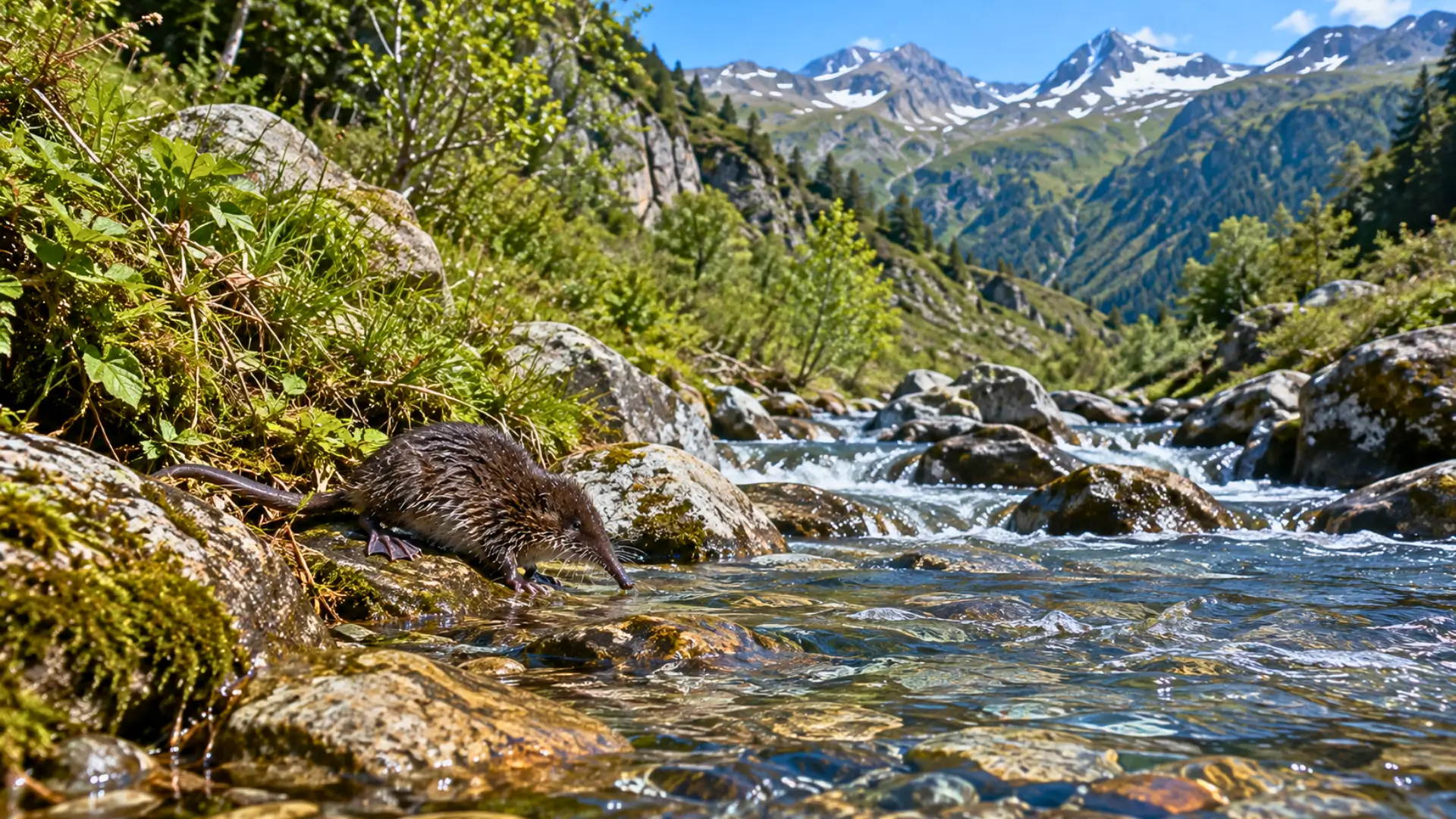
The desman, a small mammal with webbed feet, is rarely seen in the torrents of the Pyrenees. To confirm its presence in certain rivers, scientists are now exploring a surprising method: searching for traces of its DNA left in the water.
The elusive desman in the Pyrenean torrents
The desman of the Pyrenees is a fascinating creature that seems almost mythical. This semi-aquatic mammal features a flexible snout resembling a tiny trunk, along with a long tail and webbed feet that facilitate swimming. Found in freshwater streams throughout the Pyrenees and northwest Iberia, Galemys pyrenaicus is very much real.
However, encountering this animal is no simple task. Preferring to lurk near riverbanks, beneath rocks, and in turbulent waters, spotting a desman is extremely challenging. Even seasoned experts sometimes struggle to catch a glimpse. In 2023, naturalists conducted an extensive effort in the Orlu nature reserve in Ariège, yet they could only capture a single individual.
This difficulty in observation highlights a more serious concern, as the Office français de la biodiversité reports that the desman’s range in French Pyrenees has decreased by more than 50 percent over the past thirty years. Several threats, including habitat loss from riverbank development, dams, altered water flows, and pollution, are driving this decline.
When the animal is elusive, DNA can provide clues
How does one search for an animal that remains practically unseen? Traditionally, naturalists would examine riverbanks for feces or use capture techniques and radio tracking. However, a more intriguing method is gaining traction: environmental DNA, or eDNA. This technique looks for genetic material organisms leave behind in their environment.
In rivers, tiny fragments of DNA from cells, secretions, or organic material can be released into the water. Scientists collect water samples, which are then analyzed in the lab. This method holds the promise of determining the presence of the desman without physical capture. The Office français de la biodiversité has begun sampling in Ariège to evaluate this modern approach with semi-aquatic mammals.
A genetic investigation to protect the “trumpet rat”
This research is not entirely new. From 2014 to 2020, the European project LIFE+ Desman undertook the challenge of better understanding and protecting this species and its habitat, supported by a budget of 2,672,707 euros. Various Natura 2000 sites in the Pyrenees facilitated multiple initiatives under the program.
Though the LIFE program has concluded, ongoing monitoring continues under a new national action plan coordinated by DREAL Occitanie, with animated support from the Conservatoire d’espaces naturels d’Occitanie. The plan aims to enhance knowledge and protect sensitive areas while also developing effective methods to monitor this elusive mammal.
eDNA is not a magical solution. The national plan emphasizes the need to test and refine this method for the desman. A positive detection of DNA can offer valuable insights, but researchers must interpret the absence of DNA with caution, as it does not necessarily mean the species has vanished from a river.
The desman could teach us more than just its presence in a river
Protecting the desman also means reassessing the health of the Pyrenean torrents. This species relies on well-preserved aquatic habitats rich in invertebrates for food and shelter. Its decline signals broader ecological changes affecting everything from water flow variations to habitat fragmentation.
The juxtaposition is striking. While the desman is becoming increasingly elusive, scientific tools are advancing to detect even its most minute traces. Tomorrow, molecules carried in a torrent could one day guide conservation efforts more effectively. The pressing question remains: how long will these traces continue to reveal the presence of living creatures?