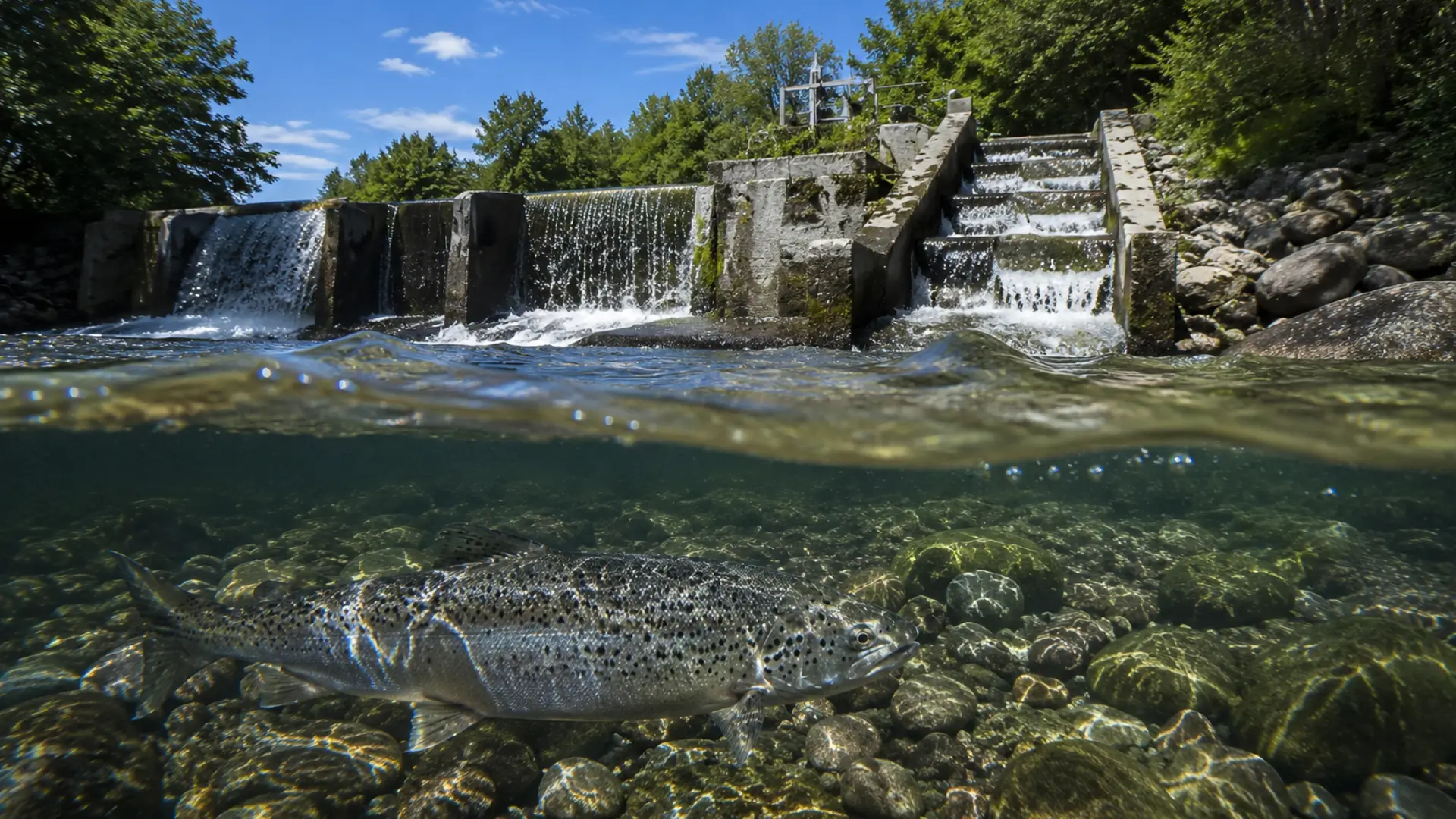
Fish ladders allow approximately seventy percent of fish to pass, which sounds good at first glance. However, the cumulative effect of successive barriers drastically reduces the chances of migration. After ten obstacles, fewer than three percent of fish reach their destination. This raises questions about the ecological effectiveness of such solutions.
Cumulative effects of barriers severely hinder migration
Imagine one hundred salmon making their way upstream to spawn. At the first dam, thirty disappear from the journey. By the second dam, only forty-nine remain. Although the fish ladder works as intended, its effectiveness diminishes with each new barrier, impacting an already reduced population.
After successfully navigating ten barriers, the survival rate falls to just 2.82 percent of the original numbers. This is not speculation but a straightforward calculation. Environmental organizations use this data to illustrate how the cumulative effect of barriers transforms rivers into nearly impassable channels.
There is variability among species. Powerful salmon, sinuous eels, and gripping lampreys have different capabilities and needs. However, every passage consumes energy and delays migration, sometimes causing fish to miss the crucial breeding season.
Extensive fragmentation disrupts aquatic ecosystems
In France, there are more than 100,000 obstacles impeding river flow, according to the French Office for Biodiversity. Dams, weirs, pipes, and vestiges of industrial infrastructure disrupt waterways. While some still generate energy or serve other useful purposes, many remain even after losing their original function.
The problem extends beyond fish movement. A barrier also traps sediments, slows down the current, and can contribute to water warming. Downstream, banks may erode, and habitats can become simplified. A disconnected river loses much of its natural mechanics, affecting the ecosystem well beyond just fish migration.
Dam removal shows rapid ecological recovery potential
In Normandy, two former dams blocked the Sélune River: Vezins, standing 36 meters tall, and La Roche-Qui-Boit at 16 meters. Before removal, only a quarter of the valley was accessible from the sea. The demolition project, completed in 2022, was a nearly unparalleled scientific endeavor in Europe.
The river’s response was swift. After over a century of absence upstream, Atlantic salmon, European eels, and sea lampreys began to return to the basin. Researchers are monitoring this recolonization to understand how species, sediments, and habitats recover following dam removal.
However, dismantling a barrier is not as simple as a bulldozer at work. Accumulated sediments need assessment, local uses must be discussed, and risks evaluated. A poorly planned removal can release pollutants or drastically disrupt local habitats. Thus, it is crucial to distinguish truly unnecessary obstacles from those still serving vital purposes.
Growing but limited movement toward removing barriers across Europe
This movement is gaining momentum. In 2023, 487 obstacles were removed in Europe; by 2025, that number increased to at least 603, reconnecting over 3,740 kilometers of rivers. This growth is remarkable, even though most efforts focus on removing aging small weirs rather than large hydroelectric dams.
Fish ladders remain valuable when a barrier must be kept. However, in a river overwhelmed by obstacles, they cannot singularly mitigate the cumulative effects of these barriers. The discussion now shifts from technical to political: should we continue outfitting every barrier with ladders, or prioritize freeing rivers that no longer require damming?