A fascinating discovery in China has revealed the fossil of a massive herbivorous theropod, giving new insights into the early therizinosaurs.
A nearly complete skeleton unveils the unique form of Kayrasaurus changliensis
A team of researchers has published their findings in the Journal of Systematic Palaeontology, detailing an almost intact fossil discovered in the Yixian formation in China. This significant find enhances our understanding of the Early Cretaceous period.
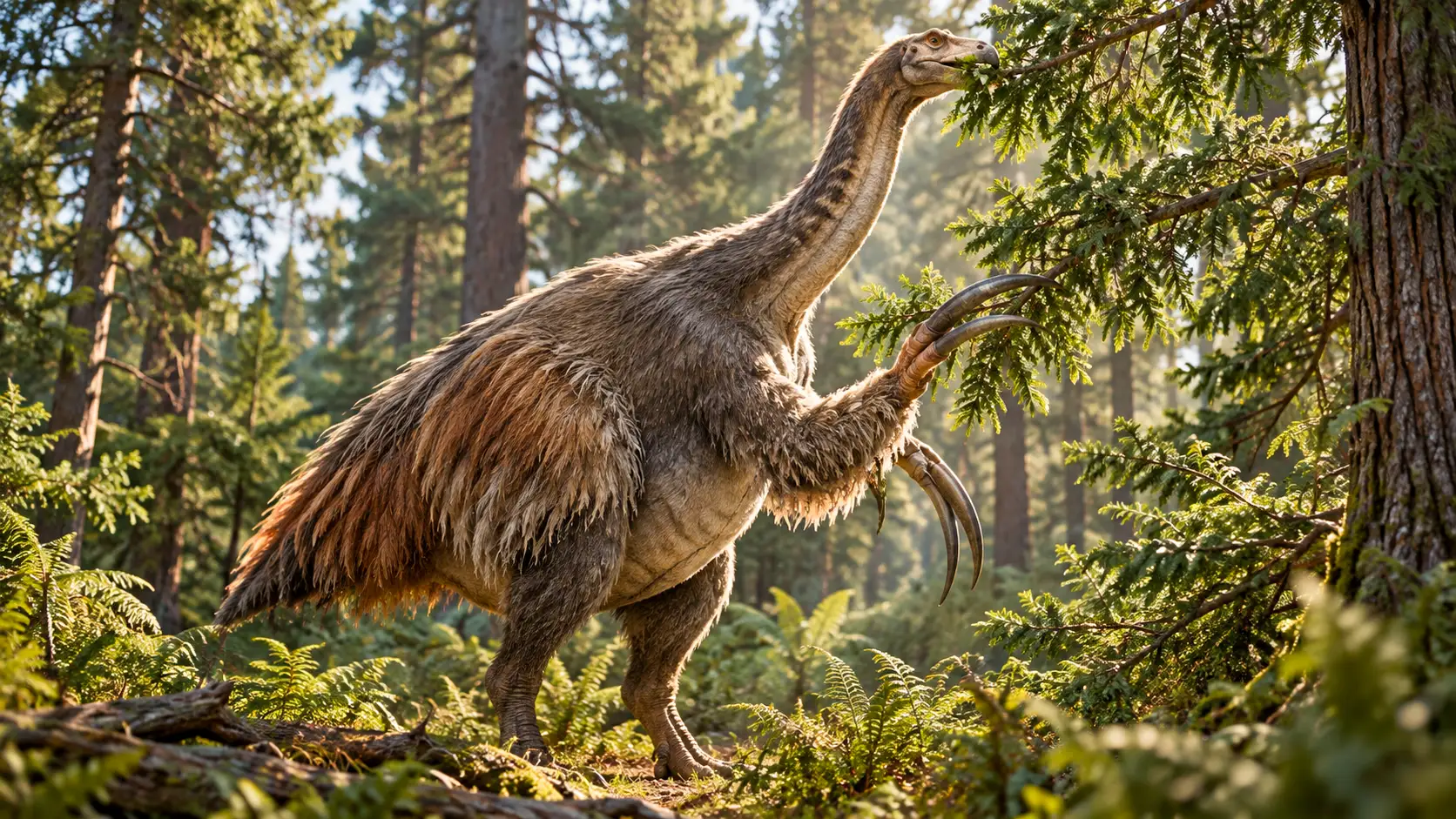
The species has been named Kayrasaurus changliensis by Chun-Chi Liao, William J. Freimuth, Lindsay E. Zanno, and Xing Xu. This large dinosaur walked on two sturdy legs and primarily consumed plant matter in its forest habitat.
Its prominent belly was covered in feathers, and its elongated neck supported limbs equipped with long, curved claws. This unusual silhouette bears a resemblance to modern birds, albeit on a much larger scale.
This therizinosaur surpasses other Jehol biota fossils in size
This newly discovered dinosaur measured over 3.6 meters in length, with weights estimated between 117 and 274 kilograms. Consequently, it stands as the largest therizinosaur identified from the renowned Jehol biota.
It is at least 1.6 times the size of its cousin Beipiaosaurus inexpectus. This discovery fills a morphological gap between several already known groups and underscores the rapid evolution of these herbivorous dinosaurs during the Cretaceous period.
Dense dentition and unique claws distinguish this large plant-eating dinosaur
The upper jaw housed more than 32 small, closely packed teeth, while the lower jaw contained over 45. This unusual dental arrangement likely facilitated the continuous processing of tough vegetation.
Its cervical vertebrae were significantly longer than its dorsal bones, providing great mobility for reaching the treetops, though this structure also enforced a somewhat cumbersome posture during movement.
Researchers have also noted a peculiar elevated ridge on one of its large claws. This distinct feature is not found in any other members of the therizinosaur family. This curved weapon likely helped the dinosaur to pull down branches before eating.
Skull and jaw shape reveal diverse feeding strategies in the Early Cretaceous
The skull displayed a unique nasal opening and a triangular notch in the jaw, confirming the existence of distinct ecological niches among these bipedal herbivores. Some species favored powerful bites, while others relied on agility.
Species such as Jianchangosaurus and Lingyuanosaurus were known to run faster in search of food. However, researchers remain cautious regarding the behavior of this large fossil, as the absence of hind limbs and its extremely flattened skull limit definitive conclusions.